OTP Authentication in 2026: Pros, Cons, and Better Alternatives
When one-time passwords still hold up in 2026, when they don't, and the phishing-resistant alternatives that have replaced them for high-impact use cases.
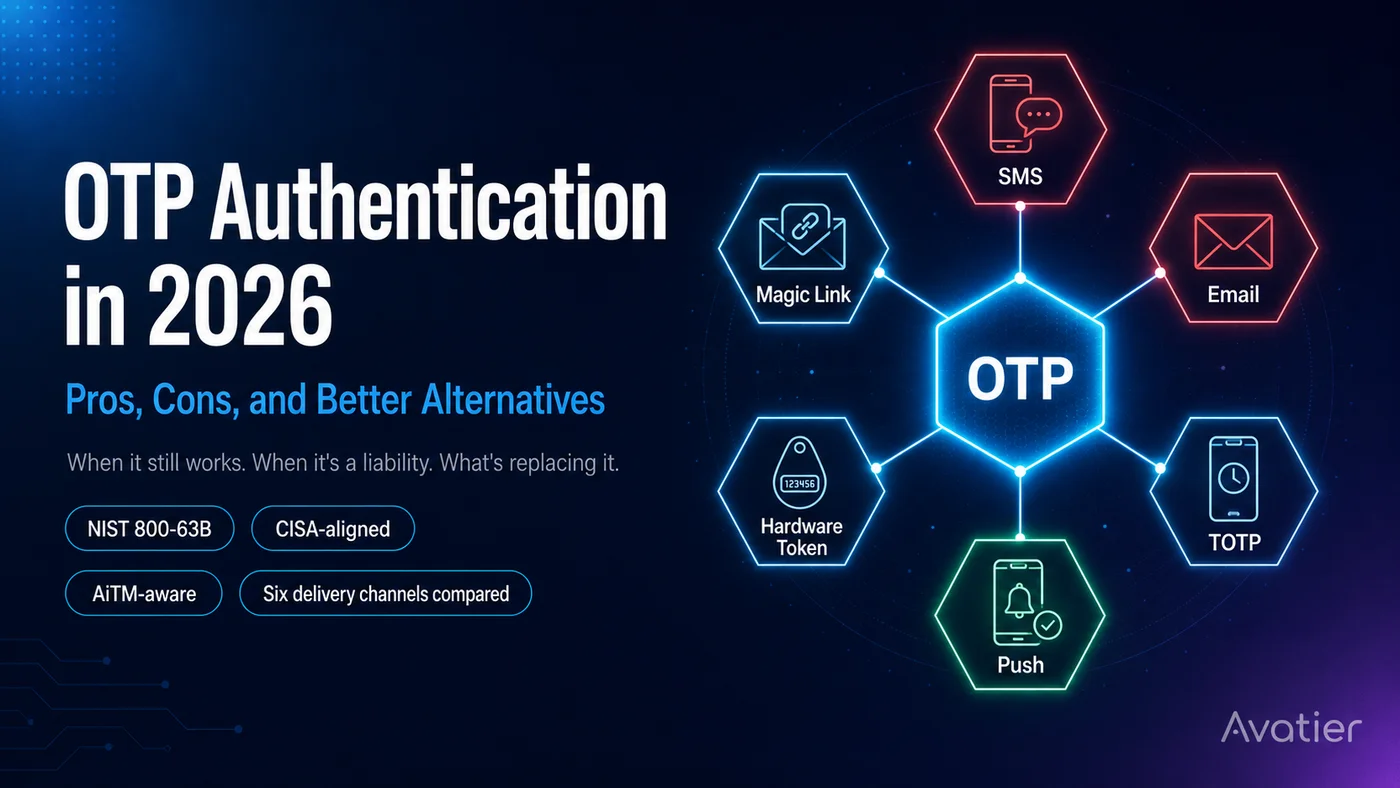
When one-time passwords still hold up in 2026, when they don't, and the phishing-resistant alternatives that have replaced them for high-impact use cases.
One-time passwords are still the most common MFA factor deployed in enterprise authentication. They are also the factor with the widest gap between marketing positioning and 2026 security reality. The "Pros and Cons of OTP" question that people asked in 2018 has a different answer in 2026 — partly because adversary-in-the-middle phishing made the OTP-typing model less defensible, partly because CISA and NIST tightened the phishing-resistant MFA bar, and partly because passkeys and FIDO2 finally became operationally credible at workforce scale.
This is a 2026 refresh of an earlier piece. The OTP fundamentals are unchanged. What changed is the threat landscape and the alternatives now available.
The short version: OTP is still a defensible second factor for low-impact authentication, and it is still the right answer for some specific recovery and CIAM scenarios. For workforce, privileged access, and any account that touches a regulated control plane, OTP is now the floor, not the ceiling — and several OTP variants (SMS, email) no longer meet the floor. The rest of this piece is the longer version, with the specific decision points.
What is a one-time password?
A one-time password (OTP) is a temporary authentication code valid for a single use — typically valid for 30 seconds to a few minutes. The user receives or generates the OTP through a delivery channel (SMS, email, an authenticator app, a push notification, or a hardware token), enters it into the application, and the application validates it against the authorization server. The code expires immediately after use or after its time window closes.
OTPs solve the static-password reuse problem. A static password an attacker captures can be reused indefinitely until the user changes it. An OTP an attacker captures is useful only for a short window and only against the specific service that requested it. The narrow window is the security improvement.
OTPs are themselves a factor — usually a "something you have" factor (the device that generates or receives the code) layered on top of a "something you know" factor (the password). They are not themselves multi-factor authentication. An enterprise deployment that uses only OTP without a paired primary factor is single-factor authentication using a temporary credential.
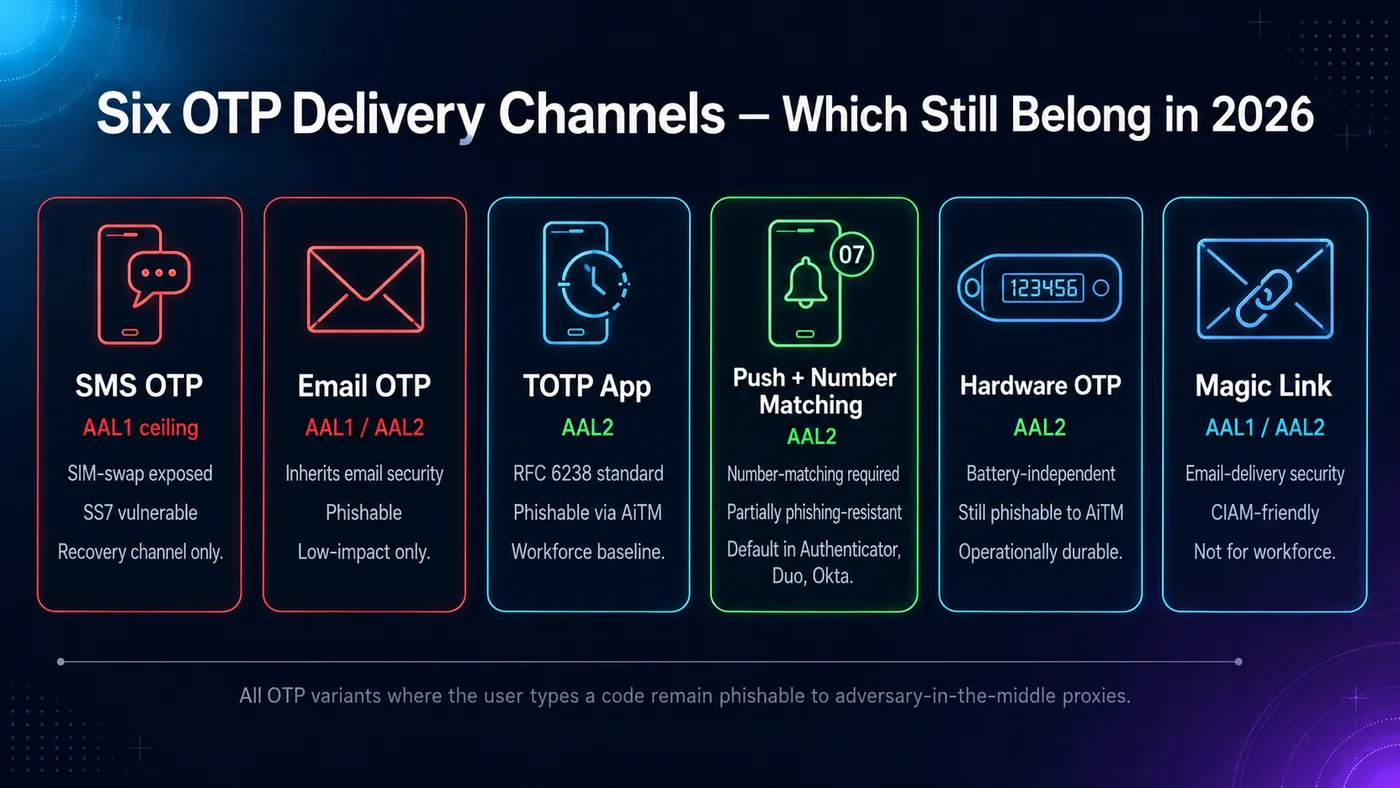 Six channels, three NIST AAL ceilings, one common vulnerability — the OTP-typing model remains phishable to AiTM proxies regardless of channel. Channel choice mitigates some risks; only FIDO2 closes the structural one.
The OTP delivery channels — and which ones still belong in 2026
The security of an OTP deployment is determined more by the delivery channel than by the OTP algorithm itself. Six channels are in common production use; only some of them are still defensible for high-impact authentication.
SMS OTP. Sent as a text message to a registered phone number. NIST SP 800-63B no longer treats SMS as meeting AAL2 under recent revisions, citing SIM-swap fraud, SS7 protocol attacks, and SMS interception. CISA's published phishing-resistant MFA guidance lists SMS as a phishable method. SMS OTP is acceptable as a fallback recovery channel and for low-impact consumer accounts. It is not appropriate as primary authentication for workforce, privileged, or regulated-data access.
Email OTP. Sent as a code to a verified email address. Inherits the security posture of the user's email account — which, if that account is also protected by SMS OTP, creates a circular dependency that an attacker can break with a single SIM swap. AAL1 to AAL2 ceiling depending on the security of the email account. Acceptable for low-impact consumer accounts; unfit for primary workforce authentication.
TOTP from an authenticator app. Time-based One-Time Password (RFC 6238) generated by an authenticator app (Microsoft Authenticator, Google Authenticator, Authy, 1Password, Duo Mobile). The user reads a rotating code from the app and types it. AAL2 under NIST 800-63B. Still phishable via adversary-in-the-middle (AiTM) proxies — covered in our Stryker breach analysis as the primary 2024-2026 attack pattern against TOTP-protected accounts.
Push notification (with number-matching). Sent as a notification to a registered device; the user approves with a tap or types a number the server displays. Number-matching is now the default in Microsoft Authenticator, Cisco Duo, and Okta Verify; non-matching push is no longer recommended. Reaches AAL2. Partially phishing-resistant via the number-matching ceremony; defeated by sophisticated AiTM in some deployments.
Hardware OTP token. Physical fob (RSA SecurID, Yubico OTP) that displays a rotating code. Reaches AAL2. Operationally durable — no battery dependency on a phone, no app to maintain — but still phishable to AiTM because the code is the secret in transit, the same fundamental weakness as TOTP.
Magic links. A click-to-authenticate URL delivered by email (Stytch, Auth0, Descope, FusionAuth all support this in CIAM products). The email link is the OTP equivalent. Convenient for consumer authentication; unfit for privileged workforce access because the delivery channel is email.
The architectural shift since 2024 is the recognition that the OTP-typing model — read a code, type it elsewhere — is structurally phishable. Any flow where the user transmits the OTP value through a channel an attacker can intercept becomes a target the moment AiTM proxies become commodity tooling, which they did in 2024.
OTP advantages that still hold up in 2026
Despite the limitations, several OTP advantages remain operationally relevant in 2026 deployments.
Defense in depth over static passwords. An OTP layered on top of a password materially reduces the value of a stolen credential. Even if the password is compromised through database leak or phishing, the OTP requirement adds a step the attacker has to either intercept in real time (via AiTM) or compromise the OTP delivery channel separately. For low-and-medium-impact accounts, this is meaningful protection.
Broad user familiarity. Most enterprise users have encountered OTP in consumer applications — banking apps, social media login, account recovery flows. The onboarding curve for OTP is low. This matters because authentication deployments fail more often through user-acceptance issues than through cryptographic weaknesses.
Operational simplicity. OTP requires no PKI infrastructure, no biometric enrollment ceremony, no certificate management. An authenticator app can be deployed to a workforce in hours. For mid-market organizations without dedicated identity engineering teams, OTP remains the most operationally affordable second factor.
Compliance baseline coverage. Most regulatory frameworks — PCI DSS, HIPAA, SOX, GLBA — that mandate MFA accept OTP-based MFA as meeting the baseline requirement. For organizations whose primary authentication driver is compliance, OTP-with-static-password is the floor that satisfies the auditor.
Self-service recovery. OTP delivered to a verified channel supports self-service password reset and account recovery flows that reduce help-desk load. The economics here are real — industry analyst data places password-reset tickets at 20 to 50 percent of total help-desk volume; OTP-based self-service materially reduces that share, though the realized reduction depends on enrollment coverage and recovery-flow design.
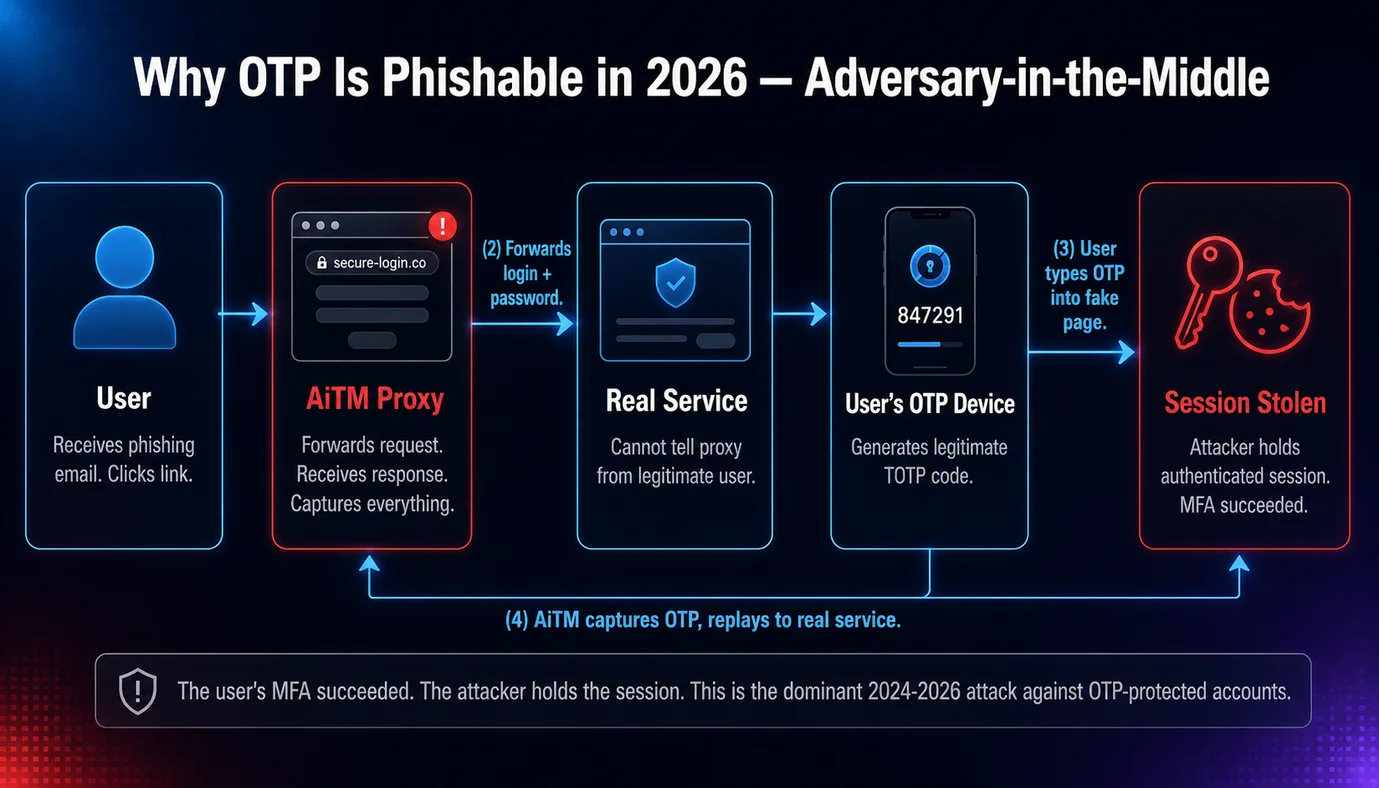 The adversary-in-the-middle attack chain. The OTP works correctly; the user types it correctly; the cryptographic challenge succeeds. Only the session cookie ends up in the wrong hands. This is structural — fixed only by FIDO2's origin-bound credential model.
OTP limitations that have only gotten worse since 2024
The OTP limitations that mattered in 2018 still matter, and several have intensified.
AiTM phishing made OTP-typing model obsolete for high-impact accounts. Adversary-in-the-middle proxies — Evilginx, Modlishka, and the commodity tooling derived from them — present a fake login page that proxies the user's session to the real service in real time. The user authenticates legitimately, including entering their OTP. The attacker captures the resulting session cookie. The user's MFA succeeded. The attacker holds the session. Microsoft reported AiTM campaigns at scale starting in 2023; CISA flagged the pattern as a federal-baseline concern in 2024. Our Stryker MFA analysis covers what this means for enterprise authentication architecture.
SMS-channel security degraded faster than the broader OTP picture. SIM-swap fraud became a commodity attack in 2022-2023. SS7 protocol attacks against SMS delivery are documented and operational. The combined risk drove NIST SP 800-63B to remove SMS from AAL2 in recent revisions — a regulatory recognition of what security researchers had argued for years.
Push fatigue (prompt bombing) defeats non-matching push. An attacker who has stolen the user's password triggers push notifications repeatedly until the user approves one — out of frustration, by accident, or because the rapid notifications create the impression that an enrollment ceremony is running. The 2022 Uber breach used this pattern against a contractor. Number-matching mitigates this attack by requiring the user to type a server-displayed number; non-matching push deployments remain vulnerable and should be upgraded.
Service-desk identity verification during OTP recovery is a soft target. OTP recovery flows that allow the user to call IT and request a code reset depend on the IT staff verifying that the caller is who they say they are. Storm-2949 — covered in our governance-failure analysis on the CGov blog — used IT-impersonation calls to socially engineer exactly this step. The OTP technology was working as designed; the verification of the human asking for the recovery was not.
Operational costs scale with workforce. SMS delivery fees, authenticator-app license tier upgrades, hardware-token replacement budgets, and the help-desk support load when a user loses access to their OTP channel all accumulate. For a 10,000-person workforce, the annualized cost of OTP infrastructure routinely runs into six figures even before factoring in incident response when a credential is compromised.
Accessibility gaps remain. Users with visual impairments may struggle to read codes. Users in areas with poor cellular coverage face SMS delivery failures. International travelers encounter SMS roaming issues. Users without smartphones — frontline workers, factory floors, hospital shifts — lack access to authenticator apps. These are not edge cases; they are workforce segments where OTP-by-phone simply does not work. We covered the deviceless alternatives in our passwordless solutions guide.
When OTP is still the right answer
The fair read on OTP in 2026 is that it remains the right answer for several specific scenarios, even as the high end of the authentication category has moved past it.
Low-impact consumer accounts. Forum logins, loyalty programs, content subscriptions, account-recovery flows for non-sensitive consumer services. The convenience-versus-friction calculus tilts toward OTP here, and the breach impact of a single compromised consumer account is limited.
Recovery channel paired with phishing-resistant primary factor. A workforce deployment that uses FIDO2 passkeys as the primary factor can use OTP as the recovery factor when the passkey device is lost. The primary defense is phishing-resistant; the recovery channel is convenient. This is the dominant pattern in mature 2026 workforce deployments.
Compliance-baseline coverage where regulatory text accepts OTP. Many compliance frameworks accept OTP-based MFA as meeting the baseline. For organizations whose primary authentication driver is auditor satisfaction rather than threat-actor resistance, OTP-with-password is the floor that satisfies most frameworks.
Mid-market organizations without dedicated identity engineering capacity. OTP deployment costs orders of magnitude less in operational overhead than PKI smart cards or FIDO2 security keys at scale. For organizations under approximately 500 employees without dedicated IAM staff, OTP-with-strong-password-policy remains an operationally affordable second factor.
Transitional state during passkey rollout. Most enterprises deploying passkeys keep OTP active during the rollout period for users who have not yet enrolled. The transitional pattern lasts months to years; OTP carries the workforce through it.
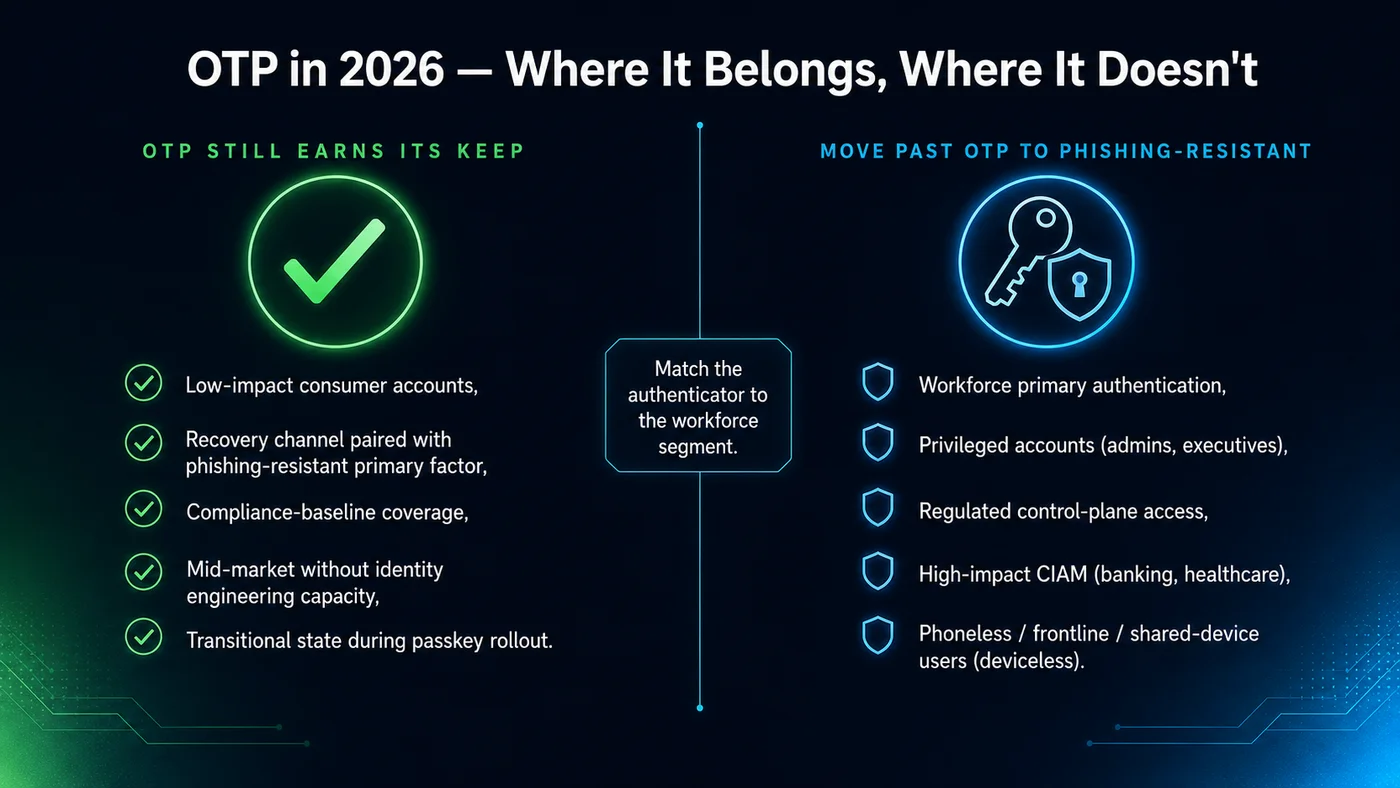 The 2026 answer to "should we keep OTP?" is "for which segments?" The left column is where OTP still earns its place; the right column is where phishing-resistant alternatives have replaced it.
When to move past OTP — to FIDO2, passkeys, and deviceless options
For workforce authentication, privileged access, and any account touching a regulated control plane, OTP is now the floor rather than the ceiling. The phishing-resistant alternatives that have replaced OTP at the high end of the category are operationally mature in 2026.
FIDO2 security keys (Yubico YubiKey, Feitian, HID Crescendo) bind the credential to physical hardware. The cryptographic challenge is bound to the origin domain, so an AiTM proxy on a look-alike domain cannot replay the response. Reach AAL3 by virtue of the hardware-backed authenticator. Operational pattern: paired with a backup key for recovery; help-desk identity verification when both are lost. We covered the YubiKey trade-offs in our passwordless solutions guide.
Platform passkeys (Apple, Google, Microsoft, 1Password, Bitwarden) implement FIDO2 with sync between the user's devices. Reach AAL2 with syncable variants, AAL3 with non-syncable hardware-bound variants. Operationally lower-friction than security keys; the sync vendor matters for compliance.
Windows Hello, Touch ID, Face ID are platform biometrics paired with a hardware-isolated cryptographic authenticator. AAL2 to AAL3 depending on the device. Phishing-resistant via the FIDO2 binding.
Deviceless options (Avatier's Identity Challenge Card, smart cards, PKI badges) address the workforce segments where personal-device-bound authenticators do not work — frontline staff, shared workstations, mainframe operators, contractors. The right combined deployment matches the authenticator to the workforce segment, which we structured in detail in the passwordless buyer's guide.
The decision is not "OTP versus FIDO2." It is "OTP for which workforce segments, FIDO2 for which, and what does the recovery flow look like for each." Our Best MFA Solutions 2026 guide walks through the buyer's-guide framing for that decision.
Frequently asked questions
What is a one-time password (OTP)?
A one-time password is a temporary authentication code valid for a single use — typically for 30 seconds to a few minutes — after which it expires. OTPs replace or supplement a static password, reducing the window an intercepted credential can be reused. Delivery channels include SMS, email, authenticator apps (TOTP), push notifications, hardware tokens, and magic links. OTP is one factor in a multi-factor authentication design; it is not itself MFA.
Is SMS OTP secure in 2026?
SMS OTP is no longer considered secure for primary authentication. NIST SP 800-63B no longer includes SMS OTP as a method meeting AAL2 under recent revisions, citing SIM-swap fraud, SS7 protocol vulnerabilities, and SMS interception. CISA's published guidance on phishing-resistant MFA treats SMS as a phishable method. SMS OTP is acceptable as a fallback recovery channel and for low-impact consumer accounts; it is not appropriate as primary authentication for workforce or privileged accounts.
What is the difference between TOTP and HOTP?
Both are algorithmic OTP standards. TOTP (Time-based One-Time Password, RFC 6238) generates a code that rotates on a fixed time interval — typically every 30 seconds. HOTP (HMAC-based One-Time Password, RFC 4226) generates a code that advances each time the user requests one, using a counter rather than a clock. TOTP is more widely deployed because clock synchronization is simpler to manage than counter synchronization across multiple devices. Both produce codes the user reads from an authenticator app and types into the application — and both inherit the same fundamental phishability that adversary-in-the-middle proxies exploit.
Are OTPs phishing-resistant?
No. All OTP variants where the user reads a code and enters it elsewhere — SMS, email, TOTP, HOTP, hardware tokens — are phishable. An adversary-in-the-middle (AiTM) proxy can present a fake login page, capture the OTP, and replay it to the real service in real time. The user's MFA succeeded; the attacker holds the resulting session. Push with strict number-matching is partially phishing-resistant; only FIDO2/WebAuthn methods (security keys, platform authenticators with verifier impersonation resistance) are phishing-resistant by design under CISA and NIST definitions.
Does OTP authentication meet NIST 800-63B AAL2?
Some OTP methods meet AAL2; SMS OTP does not under recent revisions. TOTP from an authenticator app meets AAL2. Hardware OTP tokens meet AAL2. Push with number-matching meets AAL2. SMS and email OTP fall to AAL1 due to channel weaknesses. None of the OTP methods reach AAL3 — AAL3 requires hardware-backed authenticators with verifier impersonation resistance, which is the FIDO2 security-key bar, not the OTP bar.
Should we replace OTP with passkeys?
For workforce and privileged authentication, yes — for the broad reasons CISA and NIST published in 2022-2024 and the post-Storm-2949 reality of 2026. Passkeys (FIDO2 / WebAuthn) are phishing-resistant by design and reach AAL2 with syncable variants or AAL3 with device-bound hardware keys. For CIAM and low-impact consumer accounts where the conversion friction of passkey enrollment is the main barrier, OTP-by-magic-link or push-with-number-matching remains a defensible interim. The pattern most mature enterprises converge on is passkeys for workforce, OTP only as a fallback recovery channel.
What is push fatigue?
Push fatigue is the attack where an adversary repeatedly triggers push notifications to a target until the target approves one — either by accident, out of frustration, or in the belief that the notification is legitimate. The Uber 2022 breach used this technique against a contractor. The mitigation is number-matching push (the user types a server-displayed number rather than tapping Approve), which converts the action from "approve anything" to "approve this specific request." Number-matching is now the default in Microsoft Authenticator, Cisco Duo, and Okta Verify.
How long should an OTP code be valid?
Typical safe defaults are 30 seconds for TOTP (the RFC 6238 standard interval), 60 to 120 seconds for SMS and email OTP (allowing for network delivery delay), and 5 to 10 minutes for magic links. Codes valid for more than a few minutes give an attacker more time to phish, intercept, or replay. Codes valid for less than 30 seconds create user friction with clock-drift errors. Most enterprise deployments converge on 30 to 60 seconds for primary OTP and longer windows only for password-reset flows where deliverability matters more than blast radius.
Bottom line
OTP is the right answer for several specific scenarios in 2026 — low-impact consumer accounts, recovery channels paired with phishing-resistant primary factors, compliance-baseline coverage, mid-market deployments without dedicated identity engineering, and transitional states during passkey rollout. It is not the right answer for workforce, privileged, or regulated-data primary authentication, where the phishing-resistant alternatives have replaced it.
The architectural move in 2026 is not "remove OTP" or "keep OTP." It is "match the authenticator to the workforce segment." Our Best MFA Solutions 2026 buyer's guide and Best Passwordless Solutions 2026 buyer's guide cover the structured decision in depth. If your hardest workforce segment is mainframe operators, shared workstations, or phoneless frontline workers, the deviceless options are the answer. If your hardest segment is desk workers, passkeys are. If your hardest segment is consumer CIAM, OTP-by-magic-link or push-with-number-matching still earns its keep.
The 2026 question is not whether OTP is good or bad. It is which OTP variant belongs in which segment of your stack — and what replaces it where it no longer earns its place.
About the author

More from MFA & Authentication
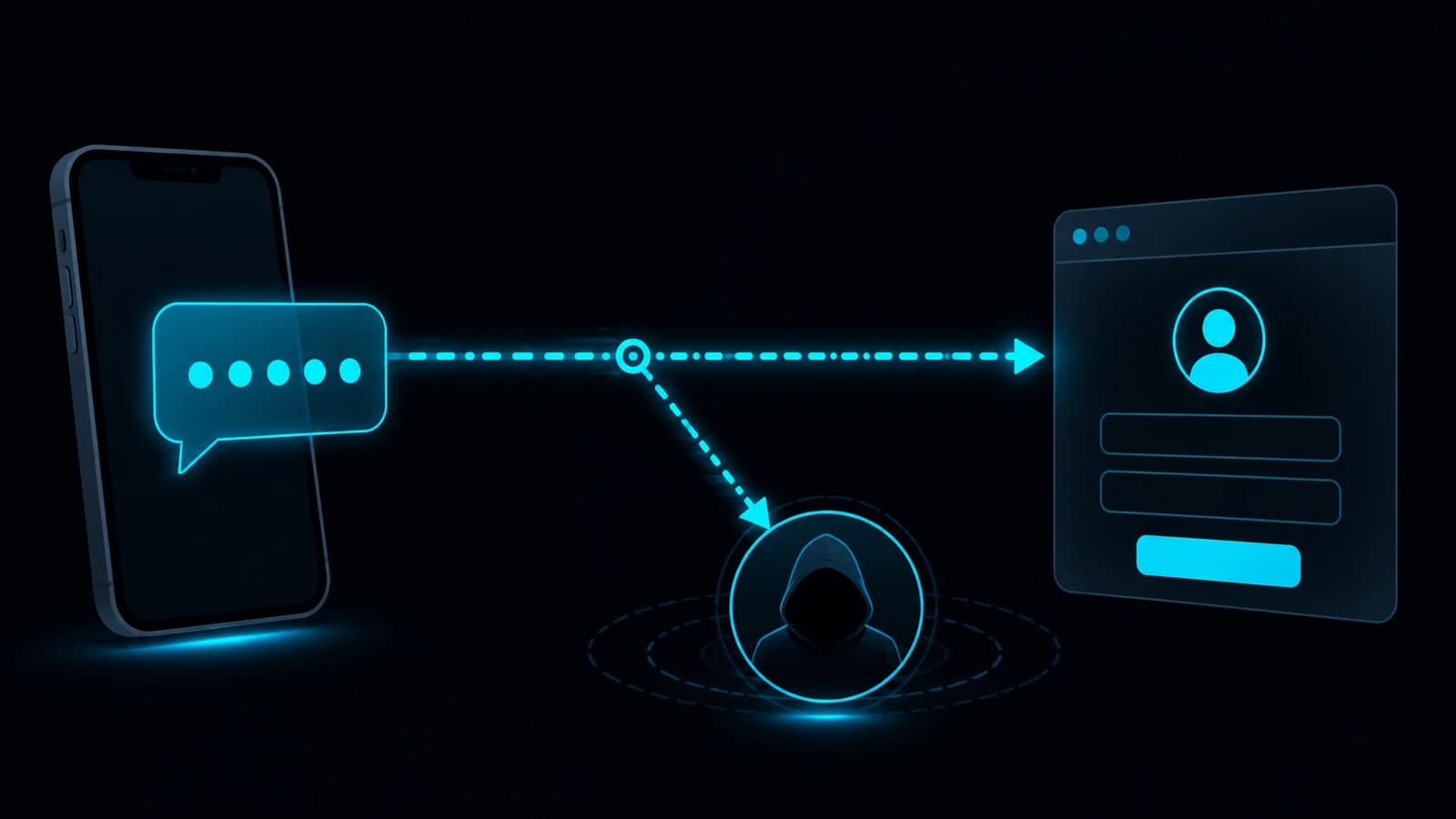
How Cybercriminals Exploit Weak OTP: The Attacker Playbook (2026)
Weak OTP fails at four specific points — SIM swap, real-time phishing relay, SS7 interception, and MFA fatigue — and every one of them is a known, repeatable attacker technique in 2026.

Advanced MFA in 2026: What Actually Counts as a Factor
Multi-factor authentication only works when the factors are genuinely different — this 2026 reference clears up what counts as a real factor and what advanced MFA actually means.
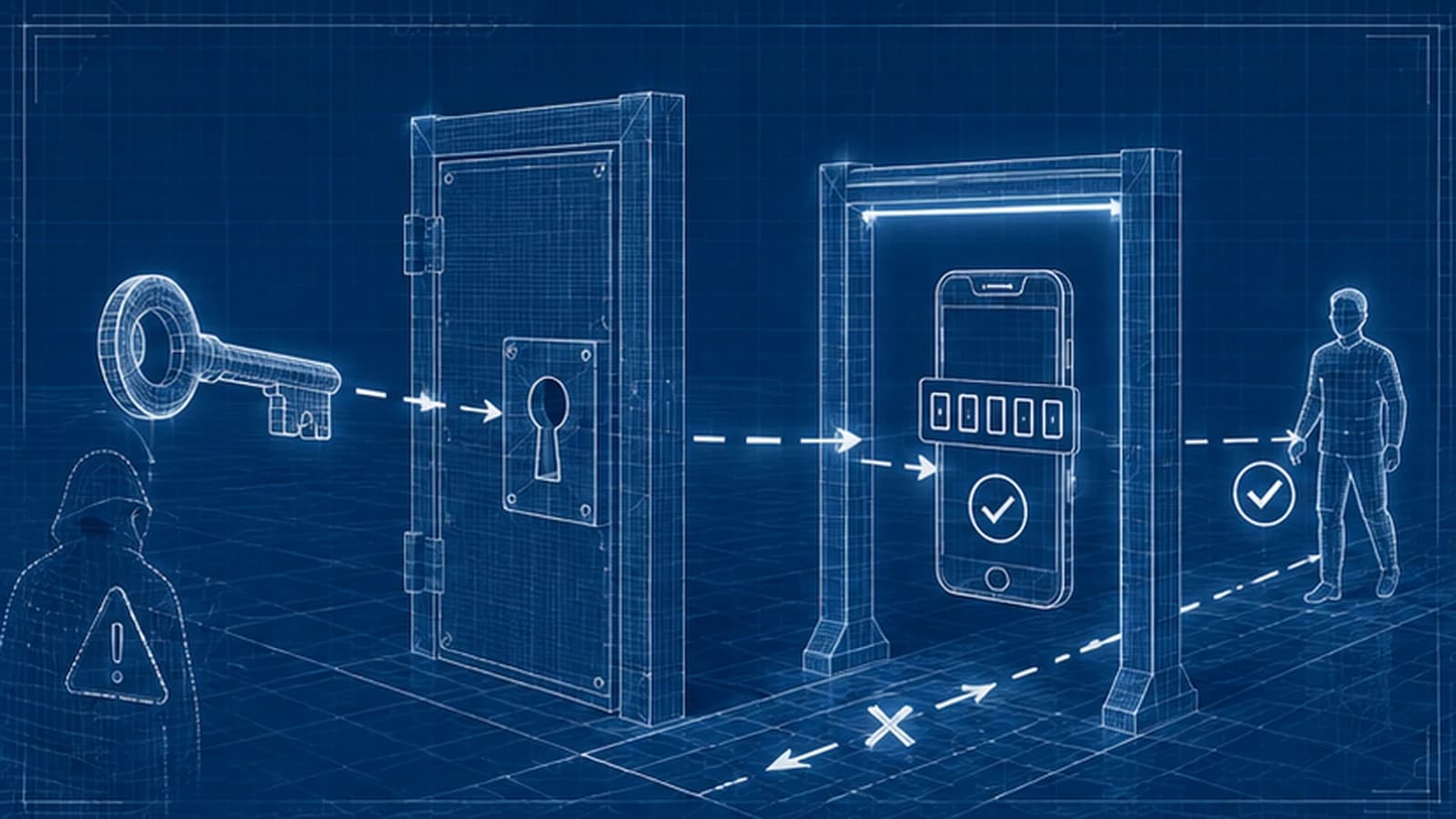
Does OTP Prevent Breaches? The Attacks It Actually Stops in 2026
OTP does not stop every attack, but it reliably defeats credential stuffing, password-spray, basic brute force, and stolen-password reuse from unrelated breaches. The 2026 breach-prevention case for OTP — the attack chains it breaks, the ones it doesn't, and how to deploy it so the prevention benefit actually lands.