Beyond Foundational MFA in 2026: The Recovery Channel Gap
Phishing-resistant MFA is the right answer for the front door. It does not protect the recovery channel, which is where the 2026 attacks are landing.
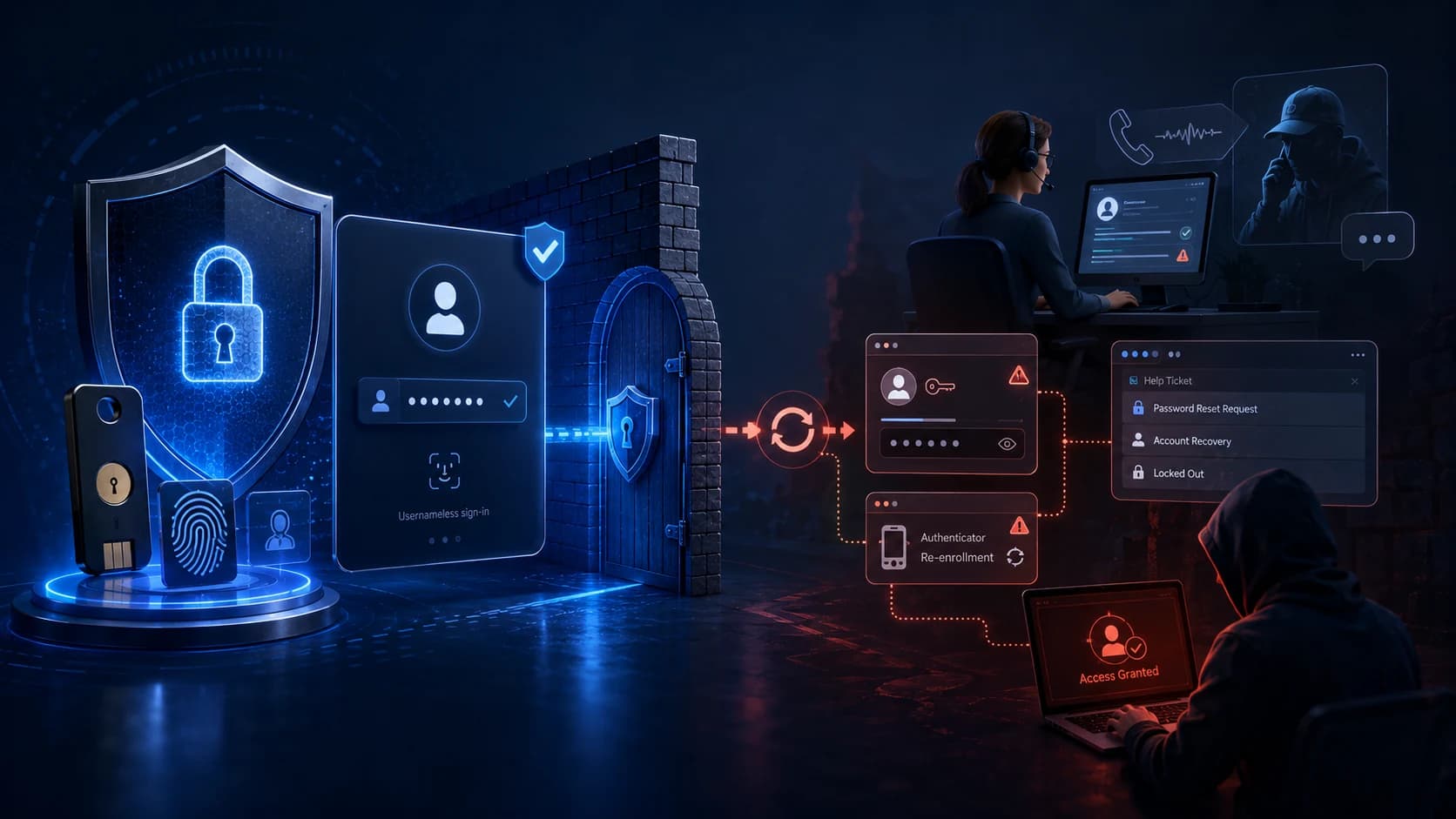
Phishing-resistant MFA is the right answer for the front door. It does not protect the recovery channel, which is where the 2026 attacks are landing.
The state of the conversation about enterprise authentication has shifted in 2026. Two years ago the question was how do we get to MFA? Last year it became how do we get to phishing-resistant MFA? The answers to both questions are largely settled at this point. Where the gap actually sits today is in what comes after — the recovery channel, where attackers have moved as the front door has hardened.
Stephen McDermid, Okta's EMEA Chief Security Officer, argued in TechRadar in February 2026 that organizations should "build on existing security practices and embrace phishing-resistant authentication." He's right. The data he cites — 63 percent growth in phishing-resistant adoption, SMS usage falling from 17.5 to 15.3 percent year over year — describes a category that is finally catching up with what CISA and NIST have been saying since 2022. Most enterprises should be deploying FIDO2 keys, platform passkeys, or PIV smart cards on every privileged account this year.
The piece is also incomplete in one specific way. The attack pattern McDermid identifies — adversaries "impersonated employees and called support teams" to "reset credentials and exploit human touchpoints in recovery processes" — is exactly the pattern phishing-resistant MFA does not solve. The recovery process he names as the exploit path is the part of the authentication architecture that sits behind the phishing-resistant authenticator. Once an attacker can get the authenticator reset, the fact that it is phishing-resistant no longer matters.
This piece is about the gap between those two things — what phishing-resistant MFA actually protects, what it doesn't, and what the architectural answer looks like when you close both sides of the equation.
What phishing-resistant MFA actually fixes
Phishing-resistant MFA solves a specific cryptographic problem. The authenticator binds its response to the origin domain the user is signing into, so an adversary-in-the-middle proxy on a look-alike domain cannot replay the response to the real service. CISA's federal guidance under OMB M-22-09, NIST SP 800-63B's verifier-impersonation-resistance requirement, and the FIDO Alliance's standards all converge on this property.
The result is that an attacker who runs an Evilginx-style proxy against a user with a FIDO2 credential gets nothing usable. The credential will not authenticate against the proxy's domain, period. The user's MFA succeeds against the real service or fails against the proxy; the attacker cannot harvest a session cookie the way they could against a TOTP user.
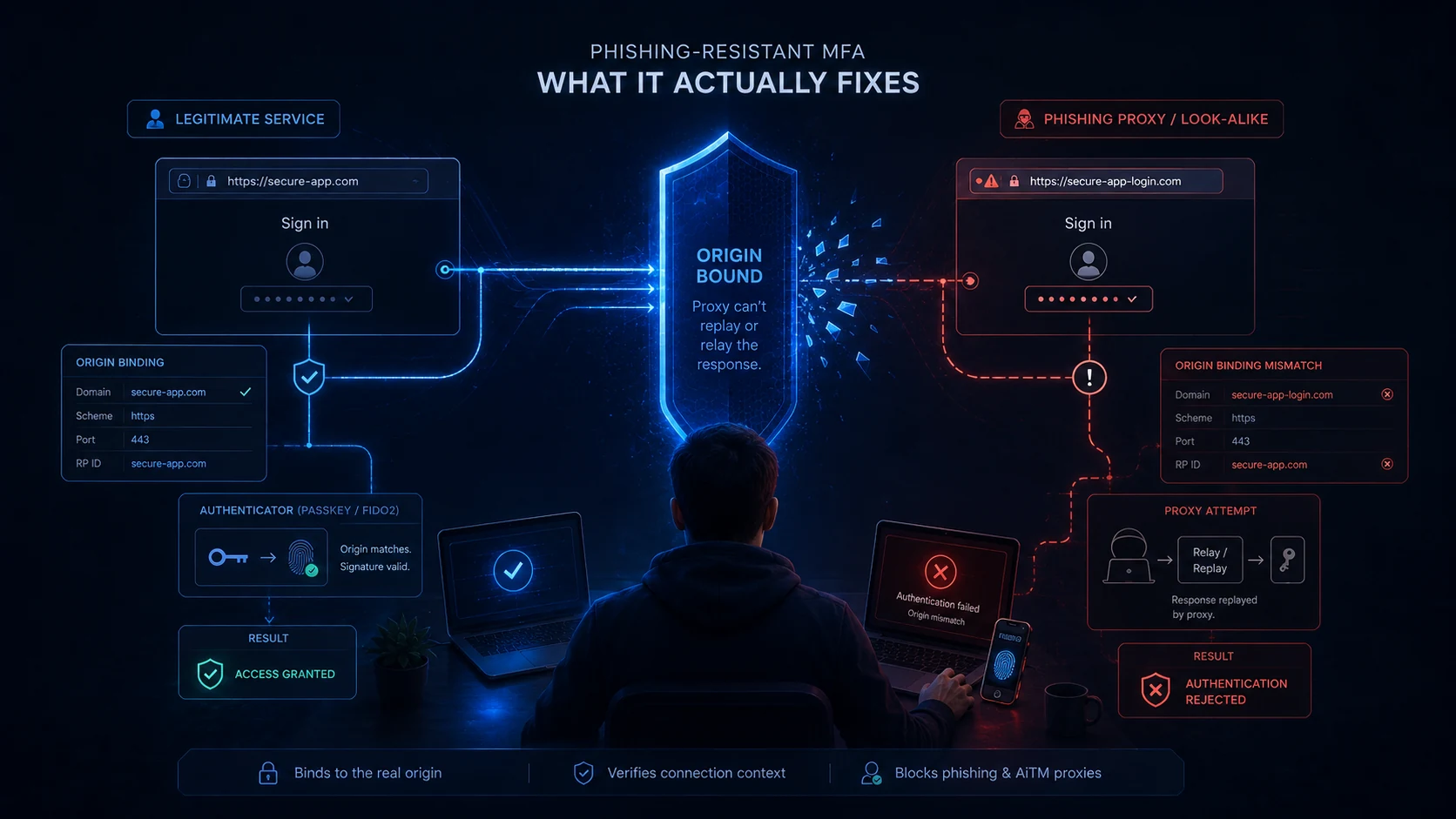 Phishing-resistant MFA solves the cryptographic relay problem. The user's authenticator refuses to respond to any origin except the real service. The attacker who can't replay the credential turns to the recovery channel.
This is real. It is a structural improvement over TOTP, push without number-matching, and SMS OTP. Every enterprise should deploy it on privileged accounts, and most should deploy it as the workforce default. We covered the buyer-guide framing for that decision in our Best Passwordless Authentication Solutions guide, and the relationship between MFA architecture and breach outcomes in the Stryker MFA Liability analysis.
What phishing-resistant MFA does not fix is the authenticator-binding ceremony — the moment when a new authenticator is registered to the account, either at first enrollment or as a recovery from a lost device. That ceremony is governed by a different control surface, and in most enterprise deployments today, it is the weakest part of the stack.
Where 2026 attackers are actually landing
The Microsoft Storm-2949 disclosure on May 18, 2026 is the clearest documented example. We covered the full breach analysis on the Credential Governance blog, but the relevant moment for this piece is the recovery step.
The attacker did not bypass MFA. The attacker initiated Microsoft's Self-Service Password Reset on a privileged user's account, then called the user impersonating IT support, and coaxed the user into approving a "routine" MFA prompt that was the SSPR confirmation. The user approved a legitimate MFA prompt — the cryptographic ceremony worked correctly. What the user did not realize was that the prompt was for a password reset they had not requested, initiated by an attacker who had already obtained the user's password from a credential supply chain.
Once the reset completed, the attacker stripped the user's existing authentication methods, registered their own Microsoft Authenticator on their own device, and held the account. The user was locked out. The attacker held compliant Entra ID MFA on the account.
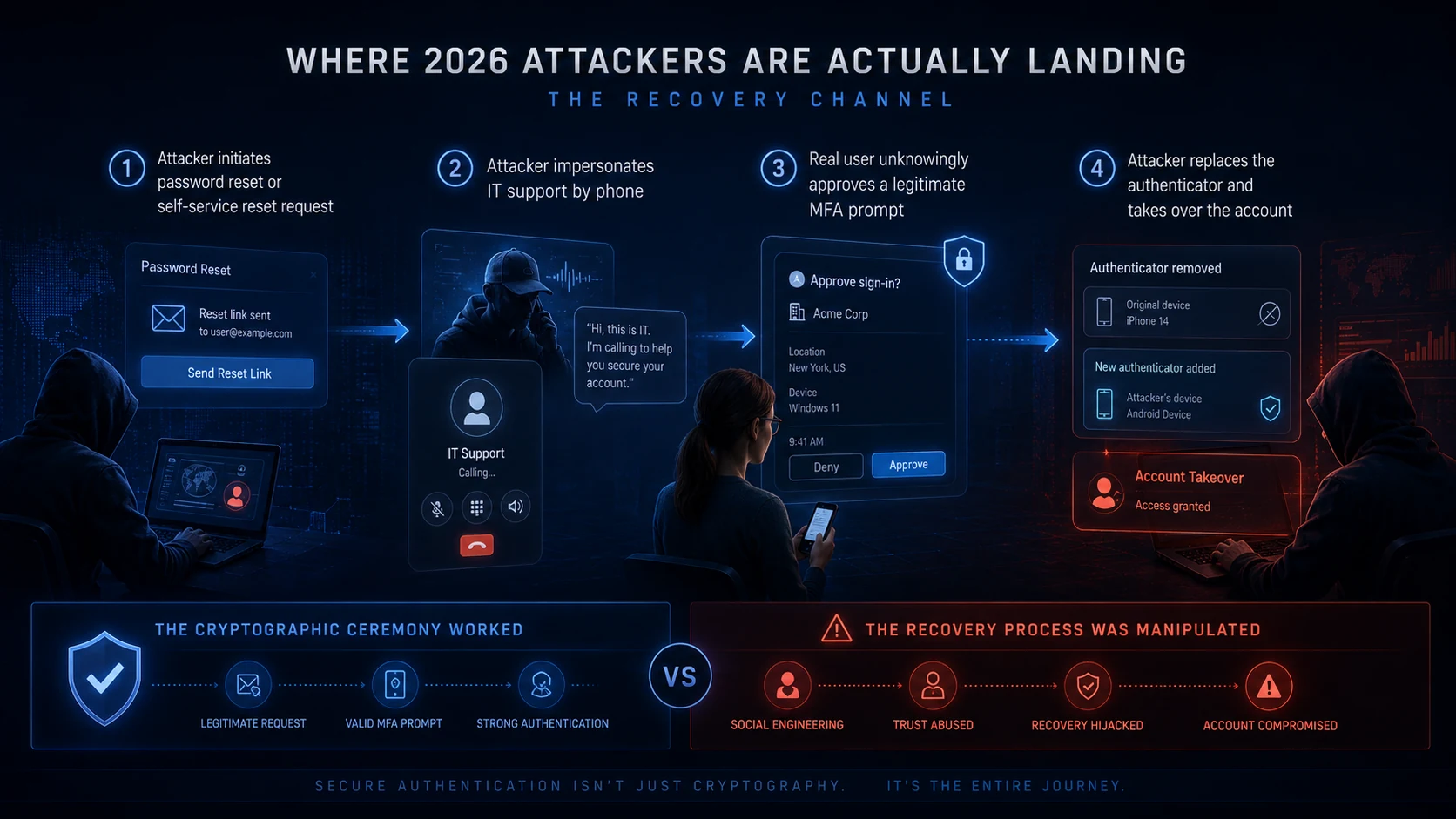 The attacker never bypassed the MFA cryptography. The attacker used the recovery channel to register their own authenticator on the account. The user approved a legitimate prompt for a request they did not initiate.
If the user had been on a FIDO2 security key instead of TOTP — the phishing-resistant upgrade McDermid recommends — the same attack still works. The FIDO2 credential gets reset and replaced during the SSPR ceremony just like a TOTP credential does. The cryptographic strength of the original authenticator does not protect against the attacker convincing the user (or the service desk) to authorize re-enrollment of a new authenticator.
This is not a hypothetical. The Storm-2949 disclosure documented this exact chain. The Stryker incident in March 2026 followed an adjacent pattern — covered in our MFA Liability analysis. The pattern is well-established by mid-2026 and is the dominant vector against accounts that have already deployed strong primary authentication.
What the recovery channel gap actually is
The recovery channel is the set of paths by which a user can re-establish access to their account when their primary credential is lost, stolen, or otherwise unusable. In a typical enterprise deployment it includes:
- Self-service password reset flows triggered by the user (or by an attacker impersonating the user)
- Service-desk-assisted password resets and authenticator re-enrollments
- Lost-device flows that issue temporary access codes via email or SMS
- Manager-approved recovery paths for elevated accounts
- Helpdesk identity verification at each of the above
In most enterprises, the recovery channel meets a lower assurance level than the primary authentication channel. The system that requires FIDO2 to log in falls back to SMS OTP to recover. The system that requires phishing-resistant push for sensitive operations falls back to a knowledge-based question (mother's maiden name, last four of SSN, employee start date) when the user calls the service desk. The system that issues hardware tokens for primary auth issues temporary access codes by email for recovery.
NIST SP 800-63B is explicit on this point. Re-enrollment after a lost or stolen authenticator should require an assurance level equivalent to the AAL of the system being protected. AAL3 systems should not be recoverable through AAL1 channels. The guidance is clear; the implementations frequently are not.
The result is the architectural inconsistency Storm-2949 exploited. The front door requires AAL2 or AAL3 to enter. The side door requires AAL1 to re-key. Attackers move to the side door.
The service-desk verification problem
Service-desk identity verification is the central control in this picture, and it is also the weakest. The typical enterprise pattern is that a user calls the service desk, the agent asks a sequence of identifying questions (employee ID, manager name, recent project, birthday), and if the answers are correct the agent performs the requested reset.
This is the pattern Storm-2949 exploited at scale, and the pattern documented in service-desk social-engineering incidents going back at least a decade. The verification questions are answerable from public LinkedIn profiles, leaked HR data, or short conversation with a current employee. The agent is graded on call-resolution time and customer satisfaction. The structural pressure on the verification step is to be lenient.
The fix is to move identity verification off the user and onto the workflow system. The pattern that works in production is a verification code generated inside the IT ticket system that is visible only to the legitimate user (via the ticket they opened, the authenticator app they are still logged into, or a notification on a verified device) and to the legitimate agent (via the ticket itself). The user reads the code back on the call. No code, no help.
An impersonating caller cannot produce the code because the impersonator does not have access to the ticket system. The legitimate user does not need to remember anything or answer trivia questions; they just read the code visible on their screen. The service desk agent does not have to make a judgment call about the caller's identity; they verify the code is correct, the same way a bank teller verifies a deposit slip.
Avatier ships this pattern in Identity Anywhere Password Station — the service-desk module that handles assisted resets, authenticator changes, and account unlocks with workflow-tied verification. The technique is not novel and Avatier is not the only vendor that implements it. It is a structural answer to the recovery-channel gap that any enterprise can adopt, whether or not they buy our specific product. The substantive point is that the verification step has to be tied to the workflow system rather than to the user's memory or to publicly-knowable facts.
What the complete architecture looks like
Closing both sides of the equation means treating authentication as a two-layer control system rather than as a single phishing-resistant authenticator at the front door.
The first layer is phishing-resistant MFA at every authentication event — FIDO2 security keys for privileged accounts, syncable passkeys for general workforce, PIV smart cards for federal-aligned environments. The Best Passwordless Authentication Solutions and Best MFA Solutions guides cover the buyer-guide framing for this layer.
The second layer is workflow-tied identity verification at every recovery event — at password reset, at authenticator re-enrollment, at account unlock, at access certification, at the moment when the user's identity claim is being trusted by a human (the service desk agent) rather than by a cryptographic check. The verification has to be tied to something the legitimate user controls (the ticket system, a workflow channel, a verified authenticator) and that an impersonator cannot reproduce.
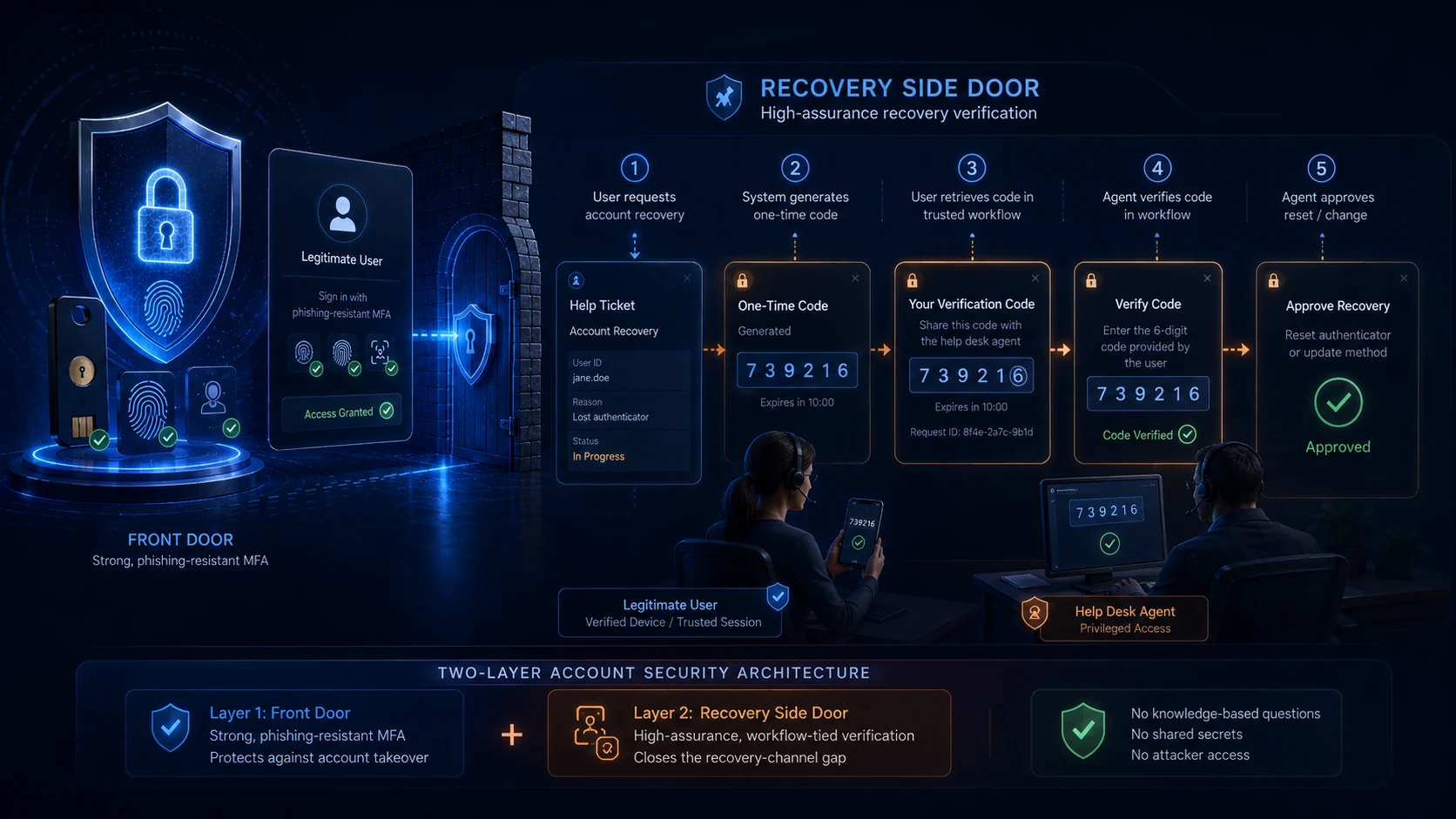 The complete 2026 architecture treats the front door and the recovery side door as one control system. Phishing-resistant MFA at sign-in, workflow-tied verification at every recovery event. Both layers, all the time.
Both layers are necessary. The first layer without the second is what Storm-2949 demonstrated — phishing-resistant MFA on accounts whose recovery channels were socially engineered. The second layer without the first is what most enterprises had ten years ago — strong service-desk verification protecting a credential that could be phished directly. The 2026 architecture is both at once.
CISA's Secure-by-Design Pledge — Avatier is a signatory — frames this as a default-secure expectation rather than as something the customer should have to assemble. The platforms should ship with strong recovery defaults the same way they now ship with strong primary-auth defaults. The pledge framing matters because it shifts the conversation from "what additional product can the customer buy" to "what should the platform have made the default."
What this looks like in practice
For an enterprise architect closing the recovery-channel gap, the operational steps are concrete and well-understood.
First, audit the recovery paths for the systems that meet AAL2 or AAL3 at primary authentication. Document each path, including the channel (self-service, agent-assisted, manager-approved), the verification method, and the assurance level the verification meets. Most enterprises discover the side-door inconsistency on this step alone.
Second, raise the recovery-channel assurance to match the primary-authentication assurance. AAL3 systems get AAL3 recovery. AAL2 systems get AAL2 recovery. SMS-and-knowledge-based-questions does not survive this audit.
Third, deploy workflow-tied verification at the service-desk layer. The verification code goes in the ticket system. The user reads it back. The agent confirms before any reset. Several vendors ship this pattern; we ship it in Avatier Identity Anywhere Password Station, and the implementation pattern is the same regardless of vendor — the verification is bound to the workflow rather than to the user's memory.
Fourth, instrument the recovery channel like an attack surface. Alert on rapid successive resets, on resets from unusual IP ranges, on resets that change the authenticator immediately after the user's previous successful authentication, on patterns that indicate adversarial intent. The same anomaly-detection discipline the SOC applies to primary authentication needs to extend to recovery.
Fifth, do the joiner/mover/leaver work. Recovery is part of the identity lifecycle. An employee who leaves the company should not have a recovery path that survives them. A contractor whose engagement ends should not have a service-desk-callable identity that an attacker can still impersonate. The governance discipline that closes orphaned accounts also closes orphaned recovery paths.
The point McDermid almost made
The TechRadar piece ends with an argument about competitive advantage — the organizations that move forward intentionally on phishing-resistant MFA will be the ones ahead of the curve. The argument is right; the timeframe McDermid frames it on is the right one for the front door.
The competitive advantage argument also applies to the recovery channel, and on a tighter timeline. The attacks documented in 2026 are landing through recovery flows because the front door has hardened faster than the side door. The enterprises that get to phishing-resistant MFA and stop there will be the ones in next year's breach reports. The enterprises that close both layers will not.
The platforms can help here. CISA's Secure-by-Design Pledge points at default-secure recovery flows the same way it points at default-secure primary authentication. The signatories — Avatier and several others — have committed to that direction publicly. The customers who hold the platforms to it, and who close the gap in their own deployments while the platforms catch up, will be the ones who do not have to write a Storm-2949-style postmortem about their own tenant in 2027.
The conversation about authentication in 2026 should be about both layers at once. Phishing-resistant MFA is the right answer for the front door. The recovery channel is the rest of the answer. The complete architecture is both.
About the author

More from Perspectives
We Don't Just Sell Identity Security. We Use It.
Why Avatier uses its own identity products internally — and why Microsoft, Rippling, and other SaaS leaders are doing the same with their own toolchains.

Compliance in a Passwordless Environment: The 2026 Audit Playbook
Going passwordless doesn't automatically satisfy an auditor. Here is what NIST, SOX, HIPAA, and PCI reviewers actually check in a passwordless deployment, and where the evidence gaps show up first.
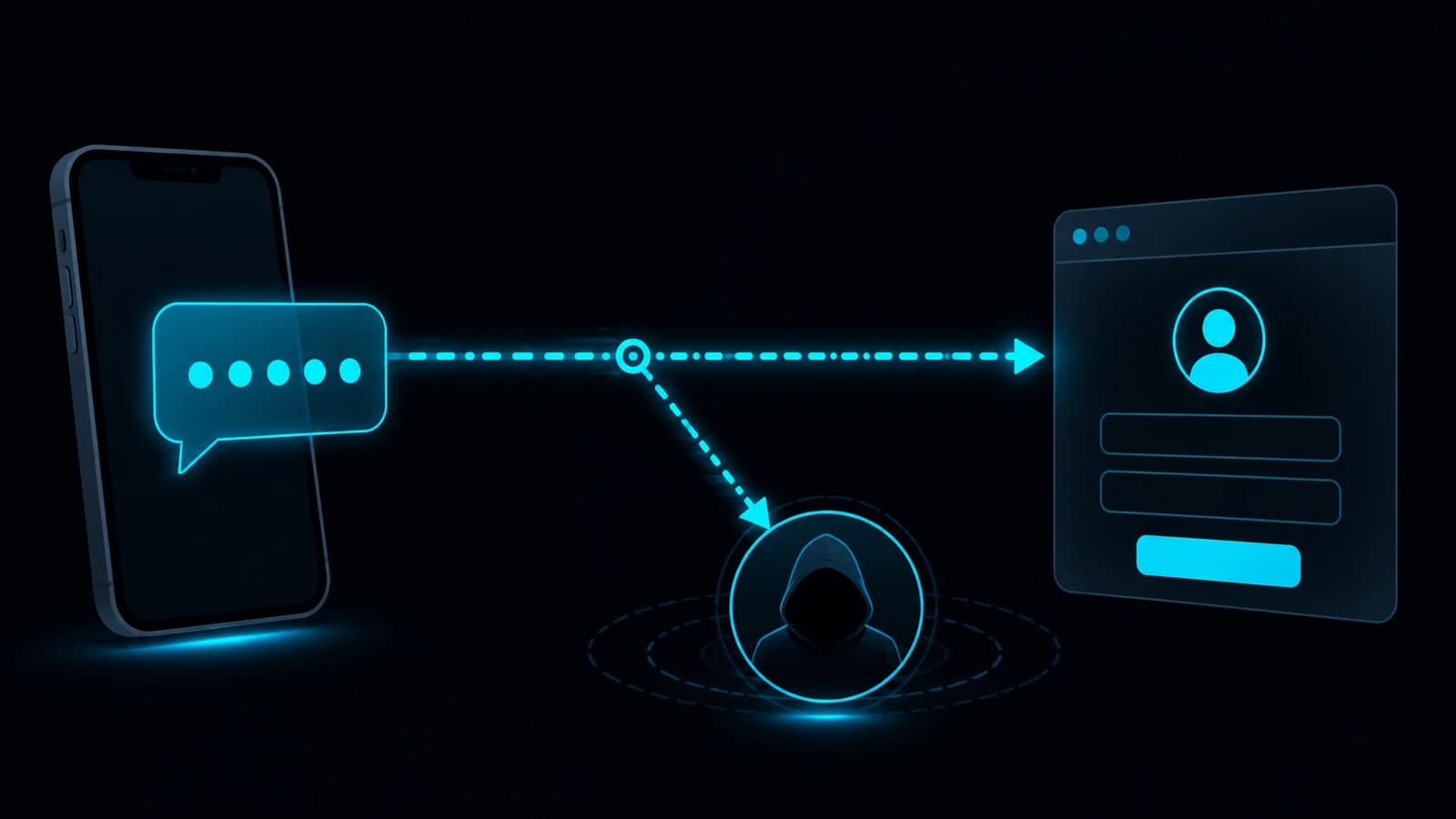
How Cybercriminals Exploit Weak OTP: The Attacker Playbook (2026)
Weak OTP fails at four specific points — SIM swap, real-time phishing relay, SS7 interception, and MFA fatigue — and every one of them is a known, repeatable attacker technique in 2026.