Authentication vs Authorization: The 2026 Enterprise Reference
Authentication proves who you are; authorization decides what you can do. The boundary sounds clean — but the implementation decisions that follow are where most enterprise identity systems break. The 2026 reference on the boundary, the protocols that span it, and the architecture that gets both layers right.
Authentication proves who you are; authorization decides what you can do. The boundary sounds clean — but the implementation decisions that follow are where most enterprise identity systems break. The 2026 reference on the boundary, the protocols that span it, and the architecture that gets both layers right.
Authentication and authorization are the two foundational layers of every enterprise identity system. The textbook definition is clean: authentication proves who you are, authorization decides what you can do. The clean definition sets up a clean architectural boundary — until you look at how real production systems implement both layers, where the same protocols span both, the same session tokens carry both, and the same policy engine sometimes makes both decisions.
The result is that engineers, security architects, and procurement teams confuse the two more often than the textbook suggests they should. The confusion isn't a competence problem. It is a reflection of the fact that modern enterprise identity architectures intentionally blur the boundary in places where the operational simplicity gains exceed the conceptual clarity losses. Understanding where the blur is intentional and where it is a bug is the difference between an identity architecture that scales and one that produces incident reviews where the question "did the auth fail or the authz fail?" is genuinely hard to answer.
This piece is the 2026 enterprise reference on the boundary. The companion pieces handle adjacent territory: Beyond Foundational MFA in 2026 covers the authentication-layer architecture deeply, Passkey Deployment Playbook covers the modern authentication ceremony, and the Identity Threat Detection and Response piece covers the runtime decisions that span both layers. This piece is the conceptual reference that frames all of them.
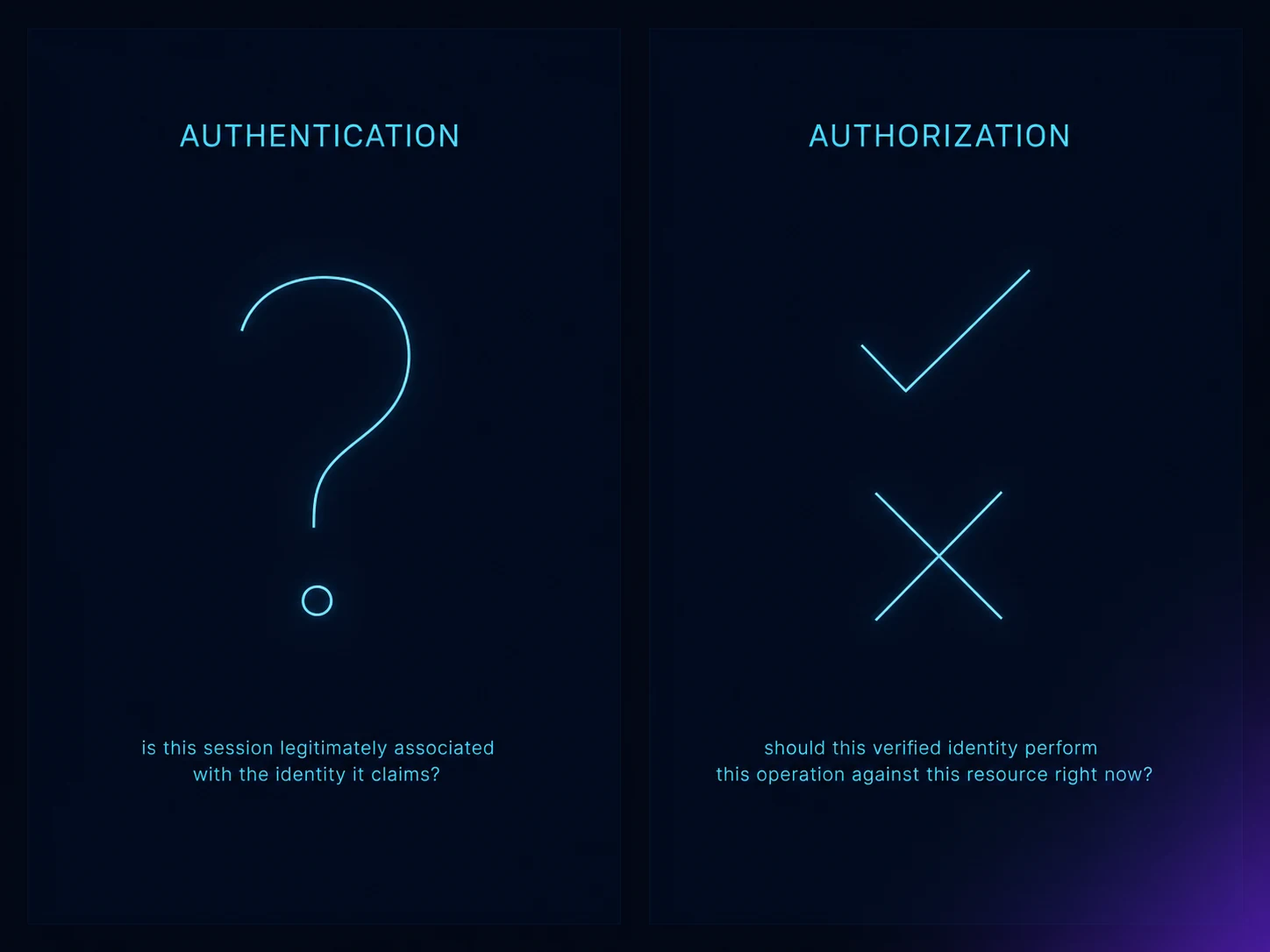 Two layers, two questions. Authentication answers identity verification at session establishment; authorization answers permission evaluation at every protected access. The cleaner the separation, the easier the incident-response triage when things break.
What each layer actually decides
Authentication answers one question: is this session legitimately associated with the identity it claims to represent? The mechanism is a cryptographic ceremony that verifies a credential (password, passkey, hardware key, biometric unlock, federated assertion) and produces a verified identity assertion. The authentication layer does not make decisions about what the identity is allowed to do; it only decides whether the claimed identity is real.
Authorization answers a different question, repeatedly: should this verified identity be allowed to perform this specific operation against this specific resource right now? The mechanism is a policy evaluation that consumes the verified identity from authentication, plus context (resource being accessed, action being requested, time of day, location, risk score, device posture), and produces an allow-or-deny decision. Authorization happens many times per session — every protected API call, every database query against role-controlled tables, every UI element that should appear conditionally.
The architectural implication is that authentication is a session-establishment concern and authorization is a per-access concern. A correctly designed system authenticates once per session (with optional step-up re-authentication for sensitive operations) and authorizes at every meaningful resource access. The session token issued at authentication carries the identity assertion plus authorization-relevant claims (roles, groups, attributes); the authorization layer reads those claims and combines them with policy to produce decisions.
The two layers also have different failure modes. An authentication failure produces an unauthenticated session — the user cannot proceed at all. An authorization failure produces an authenticated-but-unauthorized session — the user is verified but specific operations are denied. Conflating these in error handling produces incident-response confusion that propagates into security architecture decisions long after the original code was written.
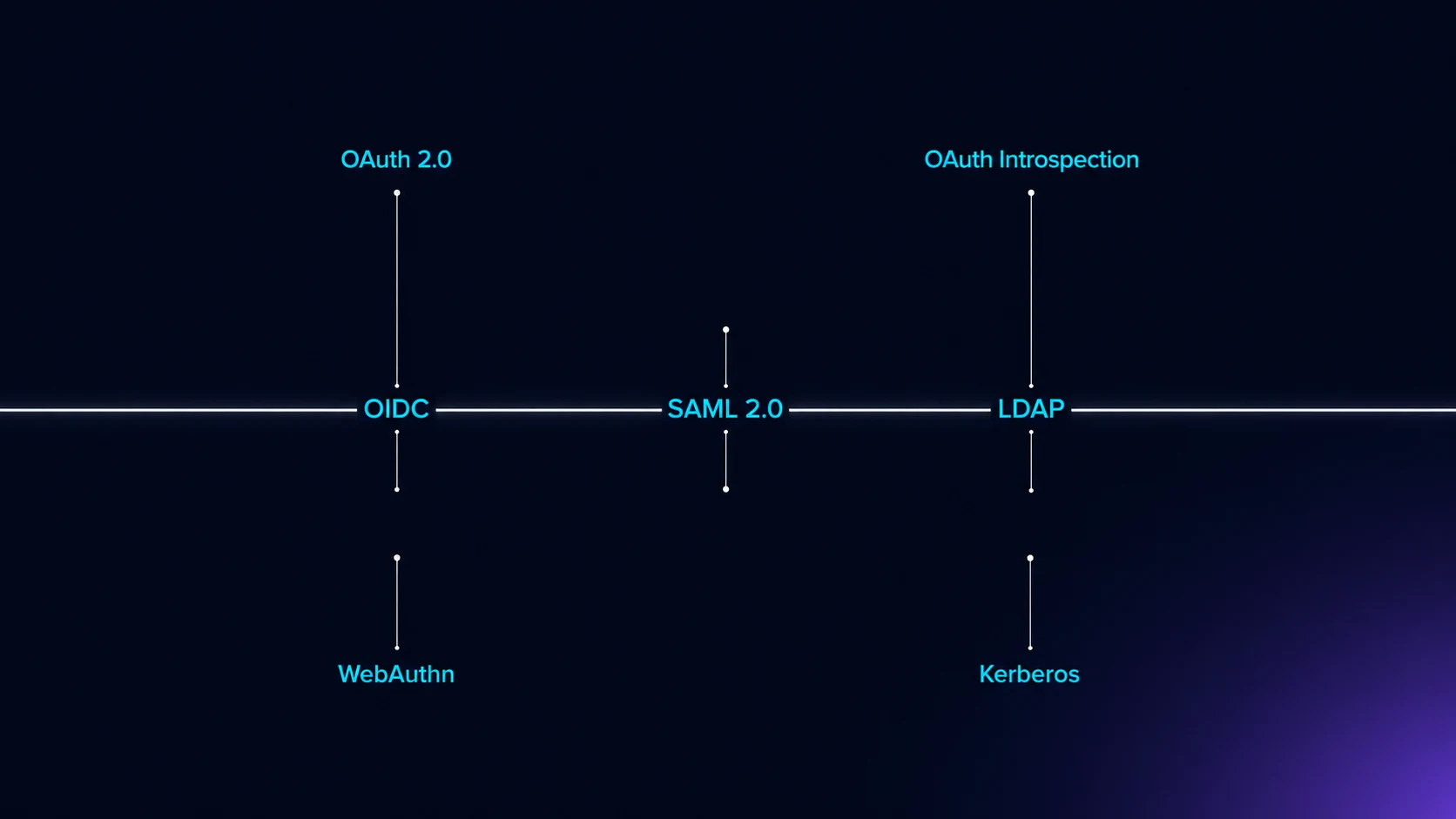 Each protocol has a specific position relative to the boundary. OAuth authorizes; OIDC authenticates on top of OAuth; SAML spans both; WebAuthn is pure authentication; Kerberos handles authentication and leaves authorization to the resource layer. Knowing which protocol handles which side is what makes the architecture comprehensible during incident response.
Where the protocols sit on each side of the boundary
The standard enterprise identity protocols all have specific positions relative to the authentication/authorization boundary. Mapping them correctly is what separates a clean architecture from a confused one.
OAuth 2.0 is the most-misunderstood protocol in enterprise identity. The name "OAuth" suggests it's an authentication protocol; the specification is explicit that it is an authorization framework. OAuth 2.0 issues an access token that authorizes a client application to access resources on a user's behalf — the protocol does not directly verify the user's identity. If you are using OAuth 2.0 to authenticate a user (by treating the access token's existence as proof of authentication), you are extending the protocol in ways its specification warns against. The standard correction is to add OpenID Connect, which sits on top of OAuth 2.0 to handle authentication explicitly.
OpenID Connect (OIDC) is the authentication layer built on OAuth 2.0. OIDC issues an ID token alongside the OAuth access token; the ID token contains a JSON Web Token (JWT) with cryptographically-verifiable claims about the user's identity (the sub claim is the unique user identifier; iss is the identity provider; aud is the intended audience). When a relying party verifies the ID token's signature and validates its claims, the relying party knows the user authenticated successfully at the identity provider. OIDC is the de facto modern authentication standard for SaaS and most web applications.
SAML 2.0 handles both authentication and authorization in a single XML-based assertion. A SAML response from an identity provider contains an authentication statement (when and how the user authenticated, which authentication context class was used) plus an attribute statement (the user's roles, groups, and attributes that the relying party uses for authorization decisions). SAML is older than OIDC and more verbose, but is still the dominant protocol in enterprise SaaS where the integration was established before 2018. Migration from SAML to OIDC is a multi-year project for most enterprises and is rarely a top priority.
WebAuthn / FIDO2 is purely an authentication protocol. The WebAuthn ceremony produces a cryptographic challenge-response that verifies the user holds a specific credential (a passkey, hardware FIDO2 key, or biometric-unlocked credential). WebAuthn does not produce authorization claims; the authorization layer must read those from a separate source (the IdP's session, an LDAP/Active Directory directory, a dedicated authorization service). WebAuthn is composable with OIDC and SAML: the IdP uses WebAuthn to authenticate the user, then issues an OIDC ID token or SAML assertion to the relying party.
Kerberos is an enterprise-network authentication protocol that issues tickets — the Kerberos ticket-granting ticket (TGT) and service tickets prove the user authenticated. Authorization decisions in Kerberos environments are typically handled by the resource's access control list, not by Kerberos itself. Active Directory's combination of Kerberos for authentication and AD's directory for authorization is the canonical pattern.
LDAP is a directory protocol that's frequently used for both authentication (binding to verify a user's password) and authorization (querying for group membership). LDAP authentication is a legacy pattern that has been progressively replaced by federated authentication via SAML and OIDC; LDAP authorization (group queries) remains widespread.
The strategic point is that enterprise architectures usually run multiple protocols simultaneously — OIDC for modern SaaS authentication, SAML for legacy SaaS, WebAuthn underneath both for the cryptographic ceremony, LDAP/AD for directory queries, OAuth 2.0 for service-to-service authorization, plus Kerberos in the AD-bound environment. Knowing which protocol handles which side of the boundary is what makes the architecture comprehensible during incident response.
Where the boundary gets blurred in production
Three patterns in modern enterprise architectures intentionally blur the authentication/authorization boundary. Knowing where the blur is intentional and where it is a bug matters.
Risk-based conditional access evaluates context at authentication time and uses it to make decisions that look like authorization. A user authenticates with their password, the IdP's risk engine evaluates context (impossible travel, anomalous device, suspicious behavior pattern), and decides whether to require step-up MFA, allow the session, or deny outright. The deny decision is conceptually authorization (the verified identity is not allowed to proceed in this context), but it happens at authentication time and is implemented by the authentication layer. This is intentional — moving the deny decision earlier in the flow improves security posture.
Continuous authentication in zero-trust architectures evaluates identity context at every resource access, not just at session establishment. The authorization layer can effectively re-authenticate by requiring fresh MFA on sensitive operations — the user clicks a button, the policy engine sees the operation is high-risk, the user is prompted to complete a new WebAuthn ceremony before the operation proceeds. The architectural pattern is that authorization decisions can trigger authentication ceremonies, which is the opposite of the textbook flow (authentication produces authorization claims). This is intentional and is what makes zero-trust security stronger than session-based security.
Token introspection in OAuth 2.0 patterns produces both authentication and authorization information from a single token check. An API receives an OAuth access token, calls the IdP's introspection endpoint, and receives both "is this token still valid" (an authentication-adjacent question) and "what scopes is this token authorized for" (an authorization question). The API treats both as a single check. This is operationally convenient but conceptually fuzzy — when introspection fails, the failure mode is sometimes hard to triage as "auth or authz."
The three patterns are intentional architectural choices. The bug pattern is different. The bug is when the codebase conflates authentication and authorization in places where it shouldn't — handling an "unauthorized" HTTP 403 the same way as "unauthenticated" HTTP 401, returning the wrong error code from the wrong layer, or designing the session-token contents in ways that make authorization claims hard to update without re-authenticating. The 401/403 distinction is the most-commonly-confused HTTP status pair in enterprise API code and is worth getting right.
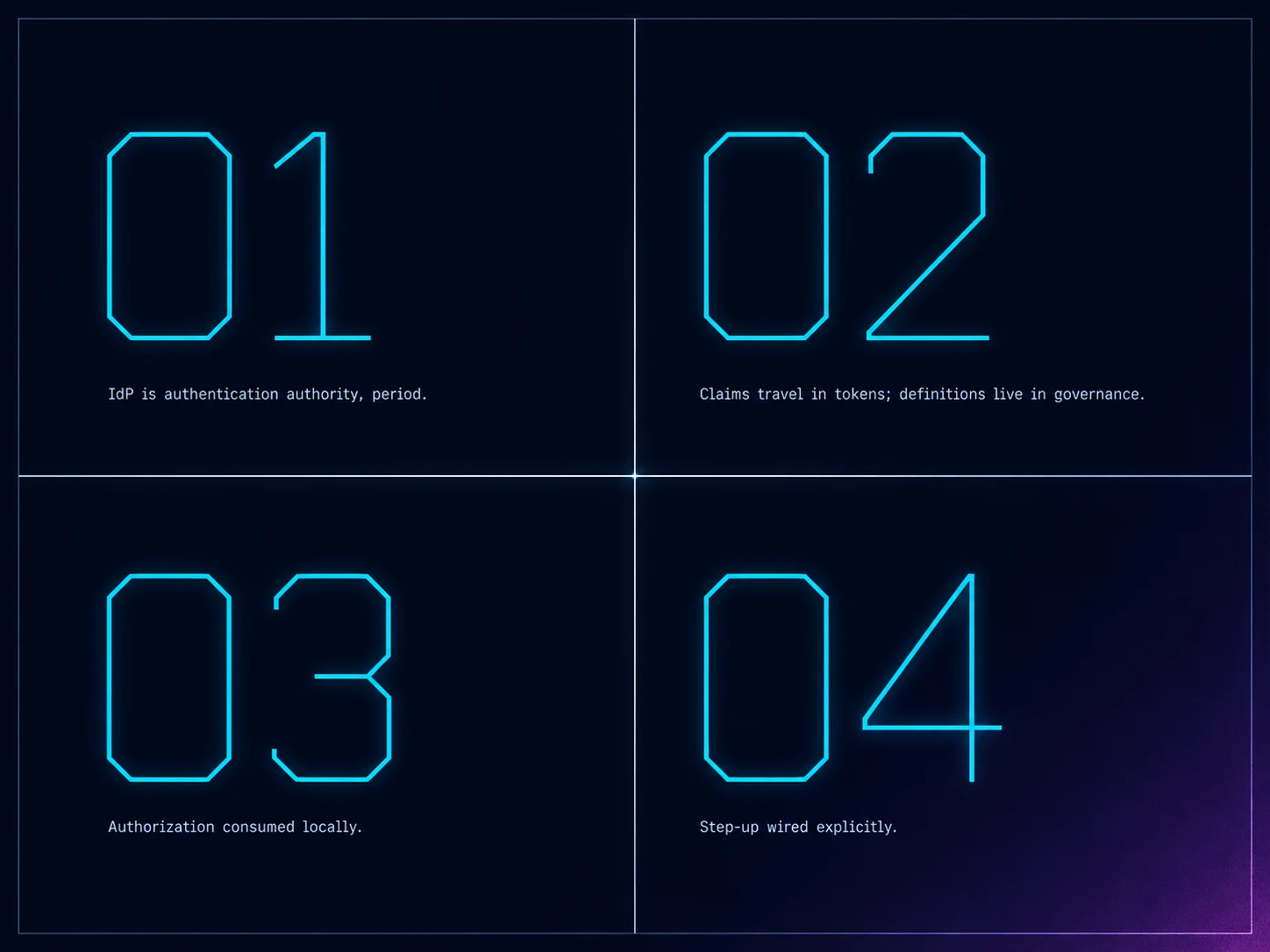 Four properties. The architecture that ships cleanly on both layers gets all four right. The ones that ship with one or more violated produce the incident-response confusion the boundary was supposed to prevent.
The architecture that ships clean on both layers
Enterprise architectures that ship cleanly on both authentication and authorization in 2026 share four design properties.
Property 1: The identity provider is the authentication authority, period. The IdP (Microsoft Entra ID, Okta, Ping, ForgeRock, Avatier Identity Anywhere, etc.) is the only system that verifies user identity. Downstream applications do not run their own password databases, do not duplicate MFA enrollment, and do not maintain shadow user records that drift from the IdP's truth. The IdP authenticates; everything else federates. The federation is implemented via OIDC for modern applications, SAML for legacy SaaS, and Kerberos/AD for Windows-native workloads.
Property 2: Authorization claims travel in the session token, but role definitions live in a governance system. The session token (OIDC ID token, SAML assertion, JWT access token) carries the user's role names, group memberships, and policy-relevant attributes. The downstream application reads these claims and uses them for authorization decisions. But the role-and-attribute definitions themselves are owned by an identity governance system — the IGA platform decides who has which role, the IdP just reads from that governance state and packs the relevant subset into the session token. This separation is what makes role changes auditable and rollback-able.
Property 3: Authorization is consumed locally, not delegated. Each application is responsible for its own authorization decisions, based on the session token claims plus its own resource model. The IdP does not make per-resource authorization decisions; the IdP cannot, because it does not know each application's resource model. The pattern that fails is over-centralizing authorization — trying to have the IdP make every per-resource decision via a callback. The pattern that scales is having each application's own authorization layer read the session claims and make decisions locally.
Property 4: Step-up authentication is wired explicitly. Sensitive operations require fresh authentication, not just an existing session. The pattern is a re-authentication redirect to the IdP with an acr_values claim specifying the required authentication context (e.g., requires hardware key, requires recent MFA), followed by the user completing a new WebAuthn ceremony, followed by an updated session token with a fresher authentication timestamp. The step-up wiring is per-operation, not global — most operations use the existing session, sensitive operations require fresh authentication.
The four properties compose into an architecture where the boundary is clean enough to reason about during incident response, the protocols handle the right layer, and the operational pattern scales as the application surface grows.
What Avatier ships toward this pattern
Avatier Identity Anywhere implements both layers with the standard separation. The authentication layer handles FIDO2/WebAuthn passkey enrollment and authentication, OIDC and SAML federation broker functionality, hardware FIDO2 key support across the standard vendors (YubiKey, Feitian, Token2, Google Titan), and the workflow-tied recovery patterns covered in the Beyond Foundational MFA piece. For workforce segments where personal devices don't fit, the Avatier Identity Challenge Card provides FIDO2-compatible deviceless authentication via a physical card.
The authorization layer is handled by Avatier Identity Anywhere Lifecycle Management — role provisioning from HRIS source-of-truth, attribute-based access control across the modern stack and the mainframe via native RACF/ACF2/Top Secret connectors, segregation-of-duties policy enforcement, and access certification workflows that keep authorization decisions auditable. The session-token format follows the OIDC ID-token specification with standard claims plus the role and attribute claims downstream applications need for local authorization.
Step-up authentication is wired through the standard OIDC acr_values flow. Applications can request a specific authentication context for sensitive operations; the IdP redirects the user through the appropriate ceremony (hardware key, biometric-unlocked passkey, deviceless card-and-PIN); the updated session token reflects the fresher authentication. Recovery flows tie through Password Station for workflow-verified resets — closing the gap covered in the Storm-2949 governance failure analysis.
The Avatier Trust Center publishes our compliance posture (SOC 2 Type II zero exceptions, ISO/IEC 27001:2022, PCI DSS v4.0.1, CSA STAR Level 1, NIST 800-53 Rev. 5 aligned, CISA Secure-by-Design Pledge signatory). The architectural pattern works regardless of vendor — the point of this piece is not that you have to buy Avatier — but the integrated pattern of clean authentication-authorization separation, governance-owned role definitions, locally-consumed authorization, and explicit step-up flows is what separates an enterprise identity architecture that survives incident review from one that doesn't.
The honest closing
Authentication proves who you are. Authorization decides what you can do. The two layers solve different problems, use different patterns, and fail differently. Most enterprise identity architectures have both layers working, but many have boundary confusion that surfaces during incident response, audit review, or migration projects — the moments when knowing which layer made which decision matters most. The 2026 architectural reality is that the boundary is intentionally blurred in places (risk-based conditional access, continuous zero-trust authorization, OAuth introspection) where the operational gains exceed the conceptual losses, and accidentally blurred in others (codebase 401/403 confusion, IdP-centralized authorization decisions, shadow user records) where the bug is real and worth fixing. Knowing which is which is the difference between an architecture you can explain to an auditor and one you can only apologize for.
About the author

More from Identity & Access Trends

Biometrics in Sci-Fi Movies: A 2026 Reality Check
For sixty years, sci-fi has been showing us biometric authentication — palm scans, retinal lasers, voice prompts, faces unlocking doors. Now most of us authenticate with biometrics every morning before we've finished our coffee. What did sci-fi get right, what did it get hilariously wrong, and what does workforce biometric authentication actually look like in 2026?

Identity for AI Agents and Agentic Authentication 2026
AI agents need identities, credentials, and authentication ceremonies of their own — separate from the humans they act on behalf of, separate from the service accounts they're often confused with. The 2026 enterprise reference on the architectures that issue agent identity, the protocols that authenticate them, the delegation chain that keeps user authority intact, and where agentic auth deployments break.
SSO Architecture for Distributed Workforces in 2026
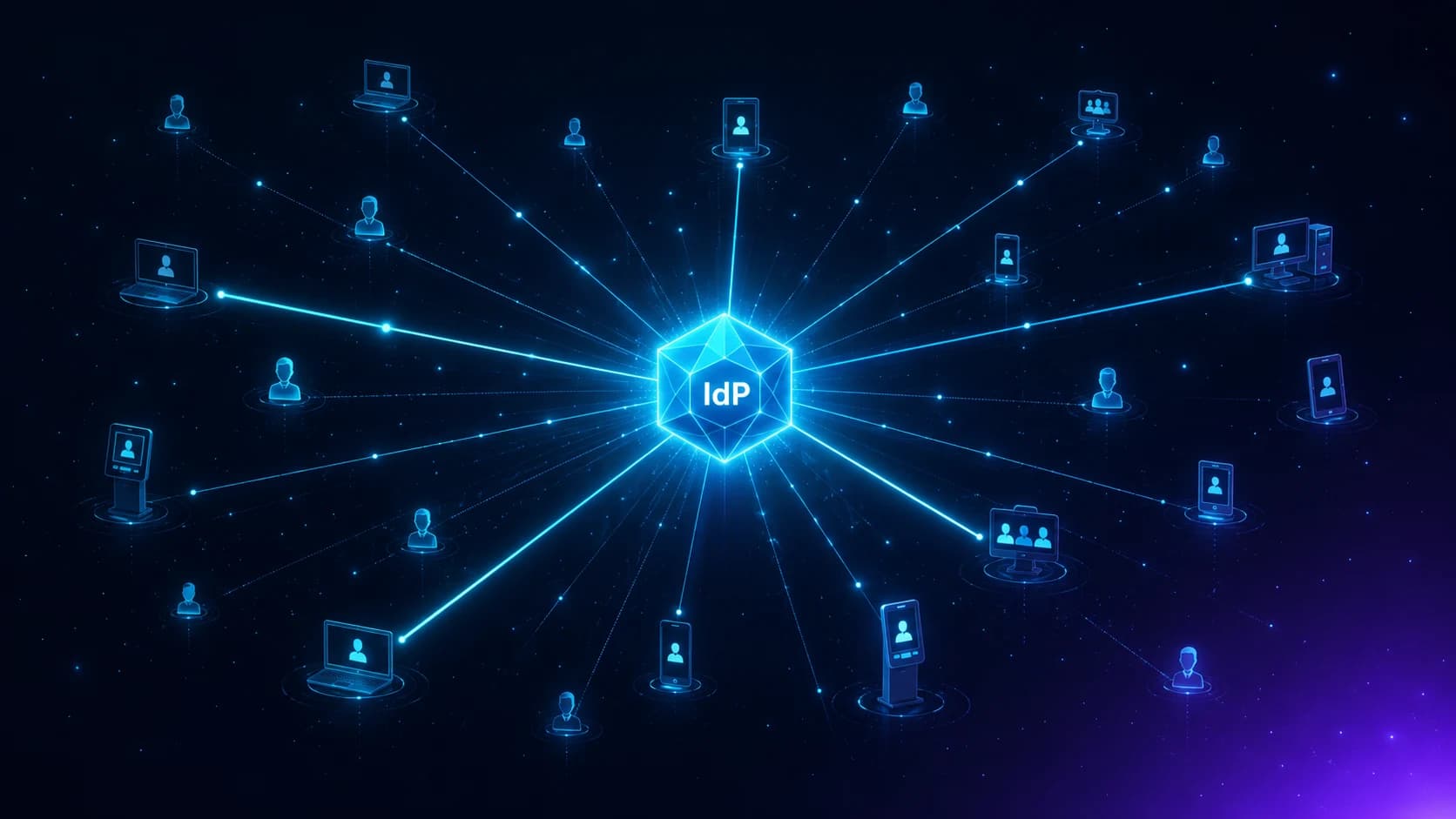
Single Sign-On for a distributed workforce — remote employees, hybrid schedules, contractor populations, partner organizations, and education-sector users — isn't the same problem it was when SSO meant SAML inside a corporate intranet. The 2026 reference on what SSO actually solves, where the architectural breakage modes live, and the federation patterns that survive contact with mixed workforces.