Why Companies Use Multi-Factor Authentication in 2026
The real reasons enterprises deploy MFA — what's changed since 2024, what Storm-2949 taught us about the recovery channel, and how to evaluate whether your MFA architecture is actually doing the job.
The real reasons enterprises deploy MFA — what's changed since 2024, what Storm-2949 taught us about the recovery channel, and how to evaluate whether your MFA architecture is actually doing the job.
Companies use multi-factor authentication for one foundational reason: a password alone is not enough security on a credential surface that attackers can buy, phish, or brute-force at scale. Every other reason — regulatory pressure, insurance requirements, breach response, audit hygiene — is a downstream consequence of the same underlying truth. The interesting question in 2026 is not whether to deploy MFA. It is which MFA, on which workforce segments, with what recovery channel, and how to make it survive contact with the attack patterns that work against MFA-protected enterprises.
This piece is the operational refresh on the "why MFA" question for a 2026 audience. The reasons enterprises deploy MFA in 2026 are different from the reasons they deployed it in 2020, because the threat model is different and the toolkit is different. The Storm-2949 attack pattern documented in 2025-2026 by Microsoft Threat Intelligence specifically targets enterprises that thought they had solved authentication with MFA — and showed them that they hadn't. Our companion piece Beyond Foundational MFA in 2026 covers the architectural response. This piece covers the strategic framing that gets the architecture funded.
 MFA in practice is not one authenticator, one workforce. It's the right authenticator for each workforce segment, integrated into a single identity surface that the security team can actually operate.
The three drivers that actually move enterprise MFA budgets
Anyone in security knows MFA matters. The interesting question is what gets the budget approved. In 2026 that comes down to three drivers.
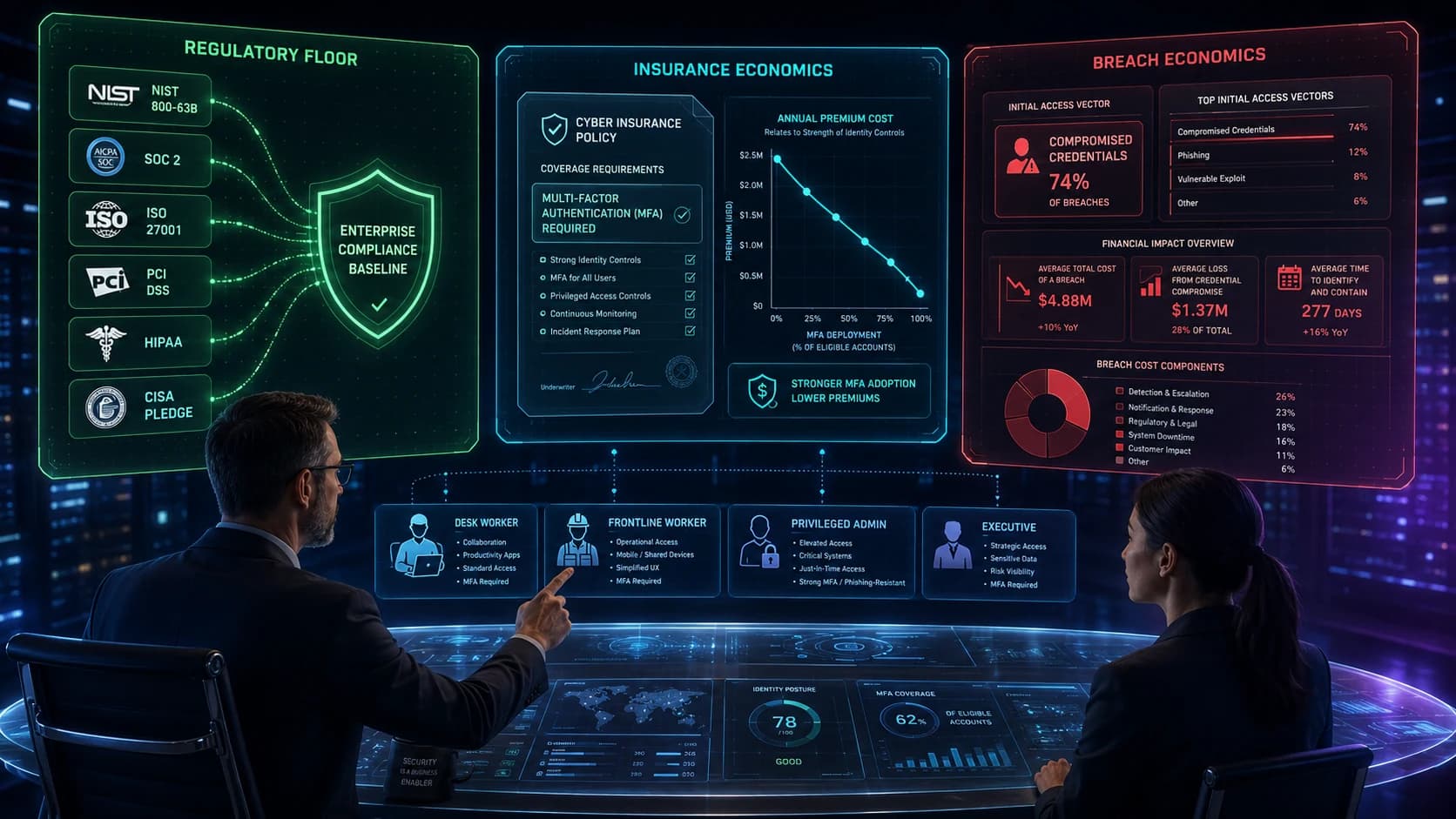
Regulatory floor. NIST 800-63B, SOC 2 Type II, ISO/IEC 27001:2022, PCI DSS v4.0.1, HIPAA, GLBA, the CISA Secure-by-Design Pledge, and most state-level data-breach notification laws either require or strongly recommend MFA on workforce authentication. Enterprises operating in regulated industries cannot meet their compliance posture without a documented MFA deployment. The audit floor on its own gets the project funded. The architecture decisions are what determine whether the deployment actually does the security work or just satisfies the checkbox.
Insurance economics. Cyber insurance carriers in 2026 require documented MFA on privileged accounts as a baseline coverage condition. The premium structure penalizes enterprises without phishing-resistant MFA on admin accounts. Several major carriers have started excluding ransomware coverage from policies on enterprises that can't demonstrate workforce MFA with documented recovery-channel verification. The insurance argument is the second budget driver — and increasingly, the most CFO-legible one.
Breach economics. Compromised credentials remain the leading initial-access vector in roughly half of breaches per current industry consensus across the Verizon DBIR, IBM Cost of a Data Breach, and Mandiant M-Trends reports. The cost asymmetry is severe — MFA deployment is a fraction of a percent of the cost of one major credential-theft breach. The CISO who shows the per-account MFA cost against the per-breach exposure cost gets the budget.
These three drivers are what get a workforce MFA project funded. What we cover next is what determines whether the project actually does the security job.
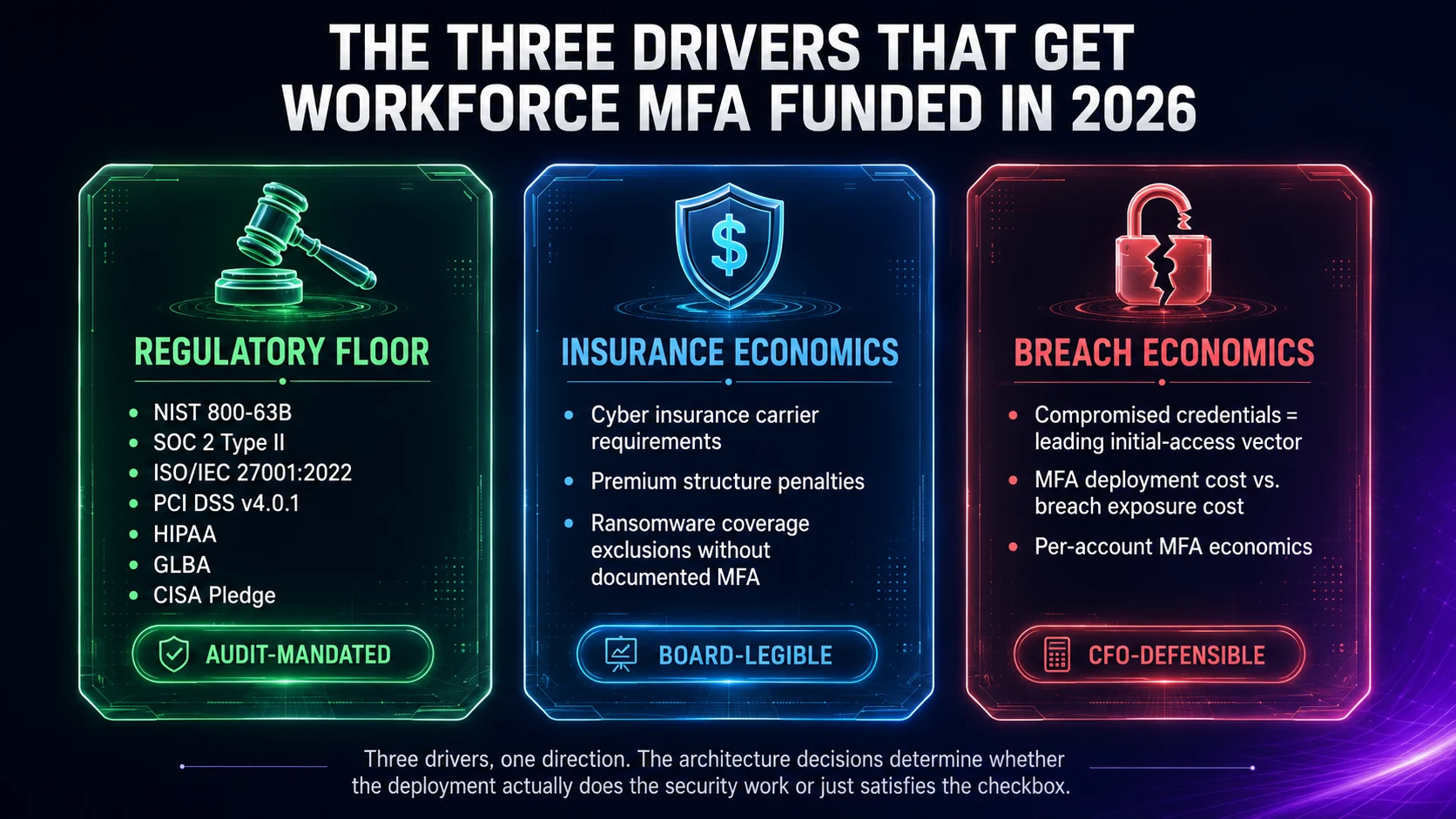 Three drivers, three audiences. Regulatory floor lands the audit. Insurance economics lands the board. Breach economics lands the CFO. The CISO threading all three is what gets the project funded.
What MFA actually prevents
The honest framing on MFA effectiveness in 2026 is that it is highly effective against the most common attack patterns, and only partially effective against the most sophisticated ones. The distinction matters because security architectures that conflate the two end up under-protected against the sophisticated patterns.
MFA reliably prevents credential-stuffing attacks where an attacker has a leaked password from another breach and tries it against the corporate IdP. The MFA prompt blocks the attempt because the attacker doesn't have the second factor. MFA reliably prevents password-spraying attacks where an attacker tries a small set of common passwords across thousands of accounts. MFA reliably prevents basic phishing attacks where an attacker convinces the user to type their password into a fake login page. The MFA challenge that follows asks for a factor the attacker doesn't have.
MFA partially prevents adversary-in-the-middle (AiTM) phishing attacks. The attacker runs a proxy on a look-alike domain (Evilginx, Modlishka, and similar tooling) that forwards the user's TOTP or push approval to the real service in real time, then captures the resulting session cookie. The user's MFA succeeds against the real service; the attacker keeps the session. Phishing-resistant MFA (FIDO2, passkeys, PIV smart cards) defeats this attack because the cryptographic ceremony binds to the origin domain — the AiTM proxy cannot replay the response. TOTP and push MFA do not.
MFA does not prevent the recovery-channel attack. This is the Storm-2949 pattern. The attacker initiates a self-service password reset on a privileged account, calls the user impersonating IT support, and coaxes the user into approving the MFA prompt that the SSPR workflow generates. The MFA cryptography works correctly. The user genuinely approves the prompt. But the prompt was for a password reset the user did not request, initiated by an attacker who had already obtained the user's password from credential-theft. Once the reset completes, the attacker registers their own authenticator and holds the account. Our companion Storm-2949 governance failure analysis on the CGov blog covers this in operational detail.
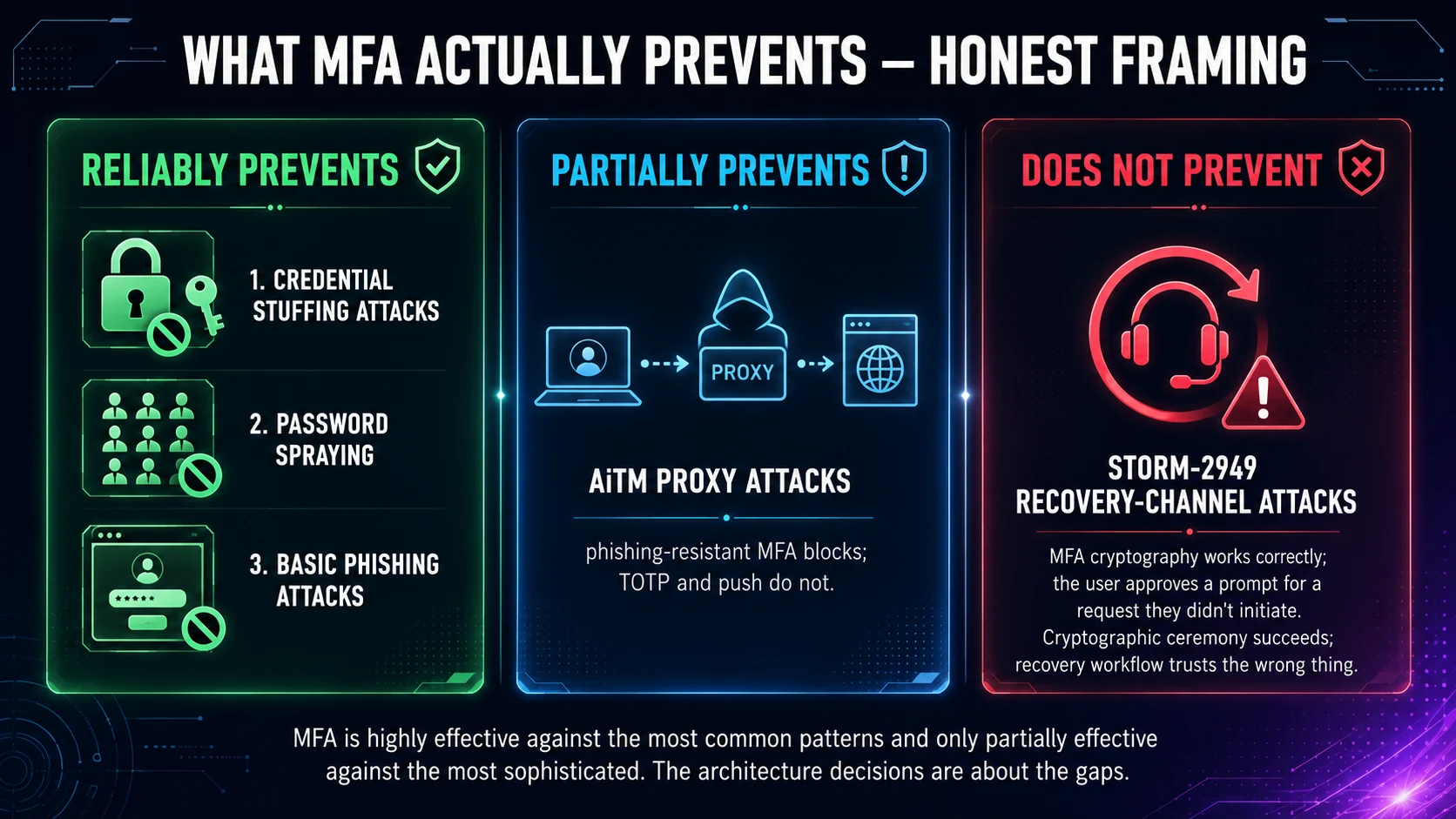 MFA effectiveness is not binary. The architecture decisions are about which attacks it actually covers — and which gap your recovery channel still leaves open after the front door is locked.
The strategic point is that "we deployed MFA" is not the right success measure. The right success measure is whether the MFA architecture covers the attack patterns the enterprise actually faces — including the recovery channel.
The workforce-segmented deployment pattern
The mistake most enterprise MFA deployments make is treating workforce MFA as a single decision: pick the authenticator, deploy it to everyone, declare victory. The pattern that survives operational reality is workforce-segmented — different authenticator combinations for different workforce types based on device access, security posture, and risk profile.
Desk workers on managed laptops typically get phishing-resistant MFA via platform passkeys (Windows Hello, macOS Touch ID, Chrome OS) or roaming FIDO2 security keys. The device is enrolled in management; the cryptographic credential lives in hardware; recovery flows through workflow-verified channels. This segment is where modern enterprises invest most heavily in deployment maturity.
Frontline workers on shared workstations don't have personal devices at work, can't bring phones onto manufacturing floors or into defense-restricted areas, and rotate through shared workstations. Phone-based MFA does not work for this segment. The deployment pattern is deviceless — the Avatier Identity Challenge Card pattern, where authentication happens via a physical card the worker carries and a card reader at the shared workstation. Our Best Passwordless Solutions guide covers the deviceless layer in vendor-by-vendor detail.
Privileged accounts — domain admins, security tools, financial system access — get hardware security keys with no SMS OTP fallback. The recovery flow for these accounts requires in-person or video-verified identity verification, not knowledge-based questions. The cost calculus is different because the impact of compromise is different.
Contractors and temporary workers get TOTP authenticator apps with mandatory rotation at the contract end-date. The integration with the joiner/mover/leaver lifecycle ensures the credentials revoke automatically when the contractor's HR record terminates.
Executives get phishing-resistant MFA with workflow-verified recovery channels. The threat model for executives includes targeted spear-phishing, which is exactly the pattern phishing-resistant MFA defeats and TOTP does not. The recovery channel for executives needs particular hardening because attackers will specifically target executive recovery flows.
The strategic point is that "we deployed MFA" without workforce segmentation usually produces a deployment that's either too restrictive for some segments (frontline can't comply) or too weak for others (privileged accounts on the same baseline as general workforce). The segmented pattern is what makes the architecture both deployable at scale and defensible against the threat model.
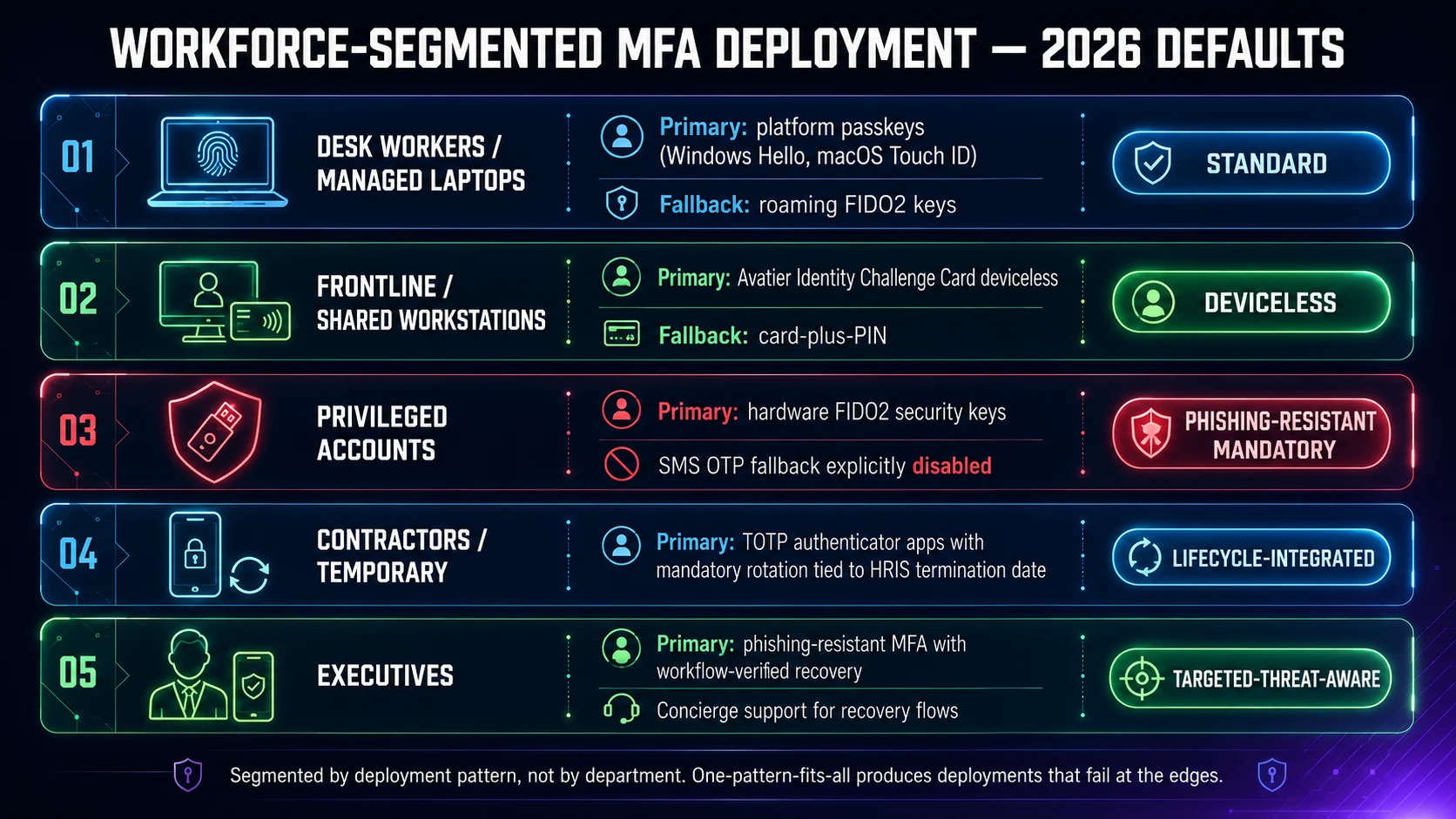 Five workforce segments, five authenticator stacks. The one-size-fits-all deployment fails at the edges; the segmented deployment fits the workforce as it actually exists.
The recovery channel — the part most MFA deployments leave undone
The single highest-leverage improvement most 2026 MFA deployments need is not on the primary authentication channel — it is on the recovery channel. Storm-2949 is the canonical example. The architectural fix is workflow-tied verification at every recovery event.
The pattern that works is this: when a user requests a password reset or authenticator re-enrollment through the help desk, the help-desk agent does not authenticate the user via knowledge-based questions or shared-secret answers. The agent retrieves a verification code from the ticket system that the user submitted the request on, and reads it back to the user. The user reads back the same code from their workflow channel. If the codes match, the reset proceeds. An attacker impersonating the user cannot produce the code because the impersonator does not have access to the ticket system.
Avatier ships this pattern in Identity Anywhere Password Station — the help-desk module that handles assisted resets, authenticator changes, and account unlocks with workflow-tied verification. The pattern is implementable on top of any major IT ticket system; the Avatier product is not the only path to it. The substantive architectural point is that the recovery channel needs to be tied to a workflow channel rather than to user-memory facts or to user-approved prompts in an unverified context.
The Beyond Foundational MFA piece — linked here — covers the complete two-layer architecture: phishing-resistant MFA at the front door + workflow-tied verification at every recovery event. Both layers are necessary. Most 2026 enterprises have the front door covered and the recovery channel exposed. That asymmetry is what Storm-2949 attackers exploit.
What this looks like for an enterprise architect
The implementation sequence that works for an enterprise upgrading MFA in 2026 is concrete.
First, audit the workforce segments and document what authenticator option each segment can actually use. Desk workers can use platform passkeys; frontline workers can use deviceless cards; privileged users get hardware keys. The audit itself usually surfaces three or four exceptions an enterprise didn't know about — a manufacturing floor where phones are banned, a contractor population with no managed devices, an executive cohort that needs concierge support.
Second, deploy phishing-resistant MFA on privileged accounts first. The privileged surface is the smallest population and the highest-impact target. The deployment pattern is well-documented and the operational overhead is bounded. This is the segment where ROI lands fastest.
Third, roll out workforce MFA segmented by deployment pattern, not by department. Desk workers in segment 1, frontline in segment 2, contractors in segment 3. Each segment gets its appropriate authenticator stack, recovery channel pattern, and training. The segmented rollout takes longer than a single-pattern rollout but produces an architecture that actually fits the workforce.
Fourth, deploy workflow-tied recovery channel infrastructure before the recovery volume scales. This is the Storm-2949-prevention step. The pattern needs to be in place when the deployment scales, not retroactively bolted on after the recovery channel becomes the attack vector.
Fifth, monitor the deployment surface continuously — credential-stuffing rates, authenticator-loss rates, recovery-flow success rates, and any pattern that resembles the Storm-2949 chain. The metrics tell you whether the architecture is operating as designed.
The honest closing
Enterprises use multi-factor authentication in 2026 because the architecture works on the most common attack patterns and because the regulatory, insurance, and economic environments make it non-optional. The interesting question is not whether to deploy MFA but how to deploy it well — workforce-segmented, with phishing-resistant primary factors where the workforce supports it, with deviceless options where it doesn't, with workflow-tied recovery channels at every recovery event, and with continuous monitoring to validate the deployment is doing what the design specified.
Avatier ships the Identity Challenge Card for deviceless workforce segments, integrates with the major phishing-resistant MFA platforms for desk and privileged segments, and provides Password Station for workflow-verified recovery. The Avatier Trust Center publishes our SOC 2 Type II (zero exceptions), ISO/IEC 27001:2022, PCI DSS v4.0.1, CSA STAR Level 1, NIST 800-53 Rev. 5 alignment, and CISA Secure-by-Design Pledge signatory posture.
The architecture is the fix. The training and policy theater is not.
About the author

More from MFA & Authentication
How Cybercriminals Exploit Weak OTP: The Attacker Playbook (2026)
Weak OTP fails at four specific points — SIM swap, real-time phishing relay, SS7 interception, and MFA fatigue — and every one of them is a known, repeatable attacker technique in 2026.

Advanced MFA in 2026: What Actually Counts as a Factor
Multi-factor authentication only works when the factors are genuinely different — this 2026 reference clears up what counts as a real factor and what advanced MFA actually means.
Does OTP Prevent Breaches? The Attacks It Actually Stops in 2026
OTP does not stop every attack, but it reliably defeats credential stuffing, password-spray, basic brute force, and stolen-password reuse from unrelated breaches. The 2026 breach-prevention case for OTP — the attack chains it breaks, the ones it doesn't, and how to deploy it so the prevention benefit actually lands.