Hardware FIDO2 Keys vs Passkeys for Enterprise 2026
Both hardware FIDO2 keys and passkeys deliver phishing-resistant authentication using the WebAuthn standard. Operationally they're substantially different — portability, recovery patterns, cost at scale, and credential sovereignty all diverge. The 2026 enterprise buyer's reference on which credential class fits which workforce segment, where each breaks, and why most mature deployments compose both.
Both hardware FIDO2 keys and passkeys deliver phishing-resistant authentication using the WebAuthn standard. Operationally they're substantially different — portability, recovery patterns, cost at scale, and credential sovereignty all diverge. The 2026 enterprise buyer's reference on which credential class fits which workforce segment, where each breaks, and why most mature deployments compose both.
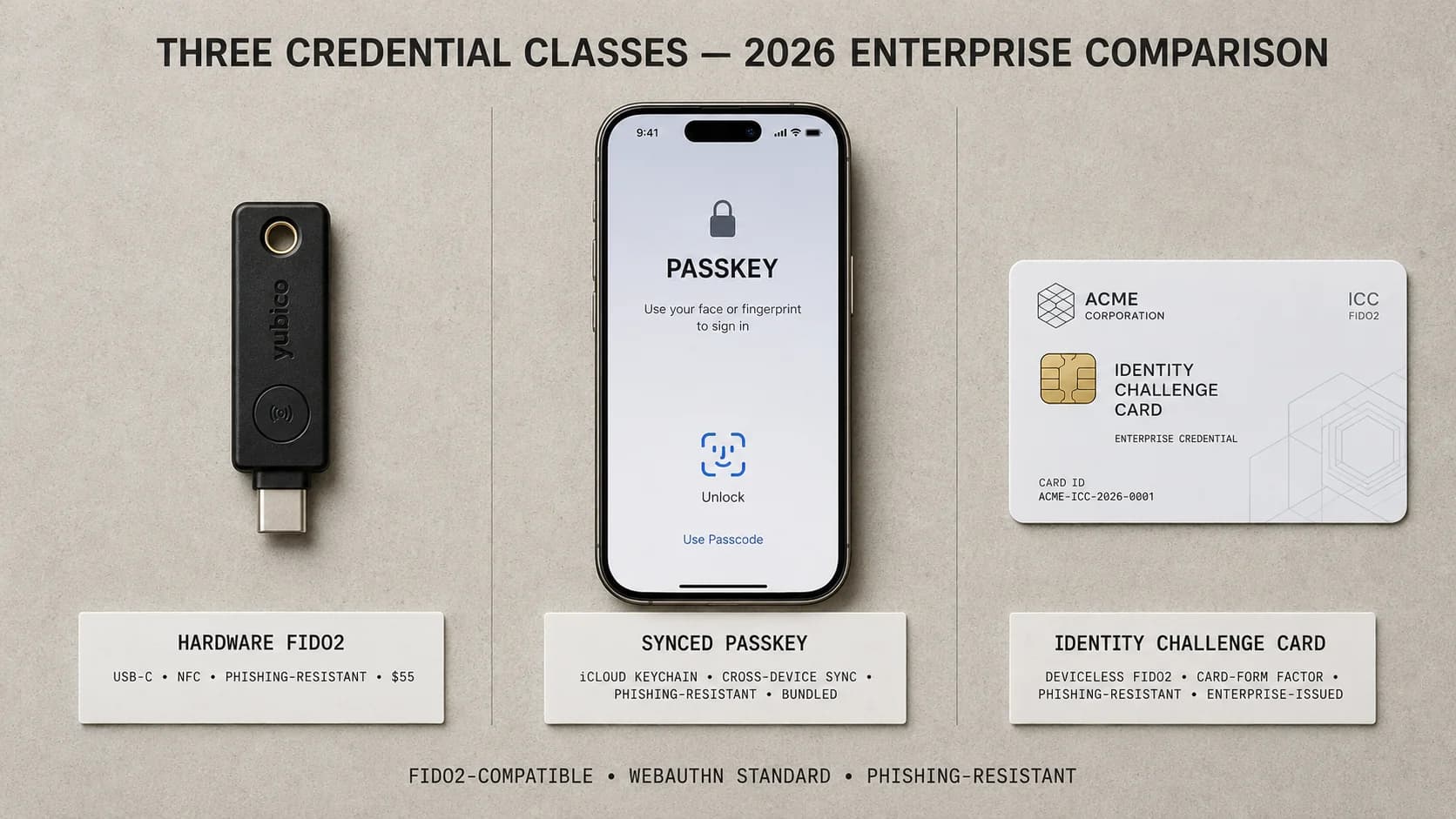
- Hardware FIDO2 keys and passkeys both deliver phishing-resistant authentication using the WebAuthn standard. They differ structurally in portability, recovery, cost at scale, and credential sovereignty — and those differences determine which credential class fits which enterprise workforce segment.
- Hardware FIDO2 keys (YubiKey, SoloKey, Feitian, Google Titan, others) are dedicated devices: highly portable across host devices, recoverable through physical possession of backup keys, cost-bounded as a per-user purchase, and stored entirely on enterprise-controlled hardware. Best fit: privileged operators, executive accounts, high-assurance environments.
- Passkeys exist in two operational variants. Synced passkeys (Apple iCloud Keychain, Google Password Manager, Microsoft Entra ID) live in cloud-replicated credential stores and propagate across the user's device ecosystem automatically. Device-bound passkeys live only on the specific device they were enrolled on. Synced passkeys are best fit for distributed workforces with managed devices; device-bound passkeys for environments requiring per-device cryptographic boundaries.
- Five enterprise use cases each have a credential-class best fit: privileged operators (hardware keys, often with a backup hardware key), distributed workforces (synced passkeys with hardware-key fallback for higher-assurance operations), deviceless workforces (the Avatier Identity Challenge Card for FIDO2-compatible authentication without a smartphone or hardware key), regulated environments (composition of multiple classes per scope), and AI agents (per-invocation scoped delegation tokens covered in the [Agentic Authentication piece](/en/blog/identity-ai-agents-agentic-authentication-2026/)).
- Most mature 2026 enterprise deployments compose both classes rather than picking one. The composition pattern — synced passkeys as the default workforce credential, hardware keys for privileged segments, the Identity Challenge Card for deviceless segments — covers the workforce comprehensively without forcing a single credential class across all segments.
Phishing-resistant authentication is settled territory in 2026 enterprise security. The credential class is mature; the WebAuthn standard is broadly supported; the regulatory framing (CISA's phishing-resistant MFA guidance, NIST 800-63B Rev. 4, EO 14028) expects it as baseline. What's still actively debated in procurement and architecture meetings is which form factor — hardware FIDO2 keys or passkeys — is the right choice for the enterprise.
The answer in 2026 is structural: neither, in the abstract. Both deliver phishing-resistant authentication. Both use the WebAuthn standard. Both produce the same cryptographic security properties at the protocol layer. They differ operationally — portability, recovery patterns, cost at scale, credential sovereignty — and those operational differences determine which credential class fits which workforce segment. Mature 2026 enterprise deployments don't pick one class enterprise-wide; they compose multiple classes per segment, with each class serving the workforce it's operationally appropriate for.
This piece is the 2026 enterprise buyer's reference. The four buyer dimensions that distinguish the credential classes at the operational layer, the five enterprise use cases mapped to the credential class that fits each, the failure modes of each class, and the composition pattern that mature deployments use. The companion pieces handle the broader credential layer: the Phishing-Resistant MFA piece covers the full credential-class architecture, the Best MFA Solutions buyer guide covers the broader platform landscape, the Passkey Deployment piece covers the operational rollout pattern for synced passkeys specifically, and the Adaptive Authentication piece and Continuous Authentication piece cover the risk-based layers that compose with the credential layer.
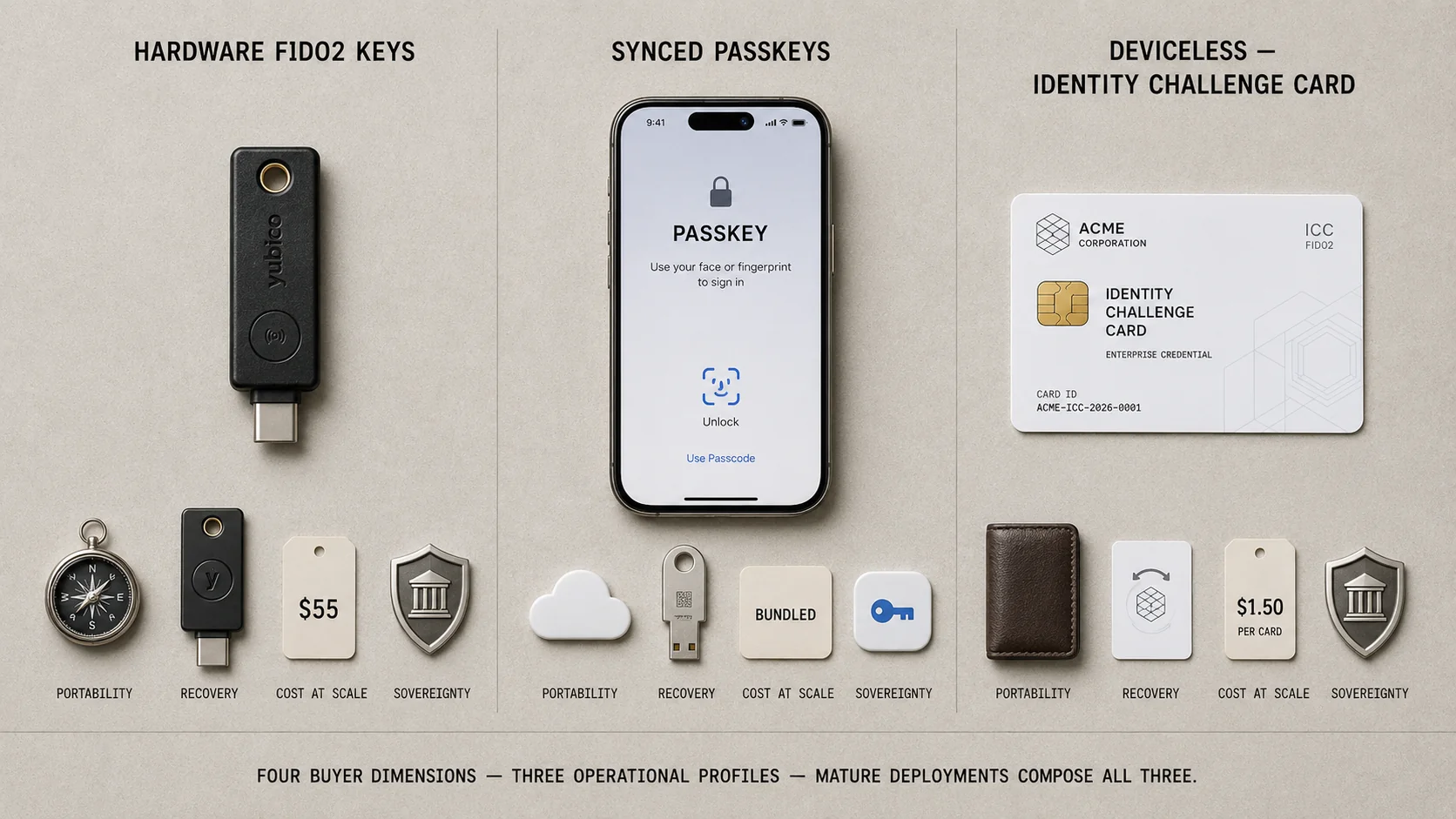 Three credential classes, three operational profiles. The buyer dimensions distinguish them clearly. Mature 2026 deployments compose all three rather than forcing a single class enterprise-wide.
The four buyer dimensions
Four operational dimensions distinguish the credential classes for enterprise procurement. The dimensions matter because each maps to a specific workforce-segment fit; understanding the dimensions is what produces appropriate class selection per segment.
Portability. Where does the credential travel, and how does it move with the user?
Hardware FIDO2 keys travel with the user as a physical object. The key plugs into the host device (USB-A, USB-C, NFC tap, Bluetooth, Lightning for older iPhones), the user authenticates, the key disconnects. The same key works across the user's laptop, phone, tablet, kiosk, or any other compatible host. The credential is portable to any device the key can connect to.
Synced passkeys travel with the user's credential-manager ecosystem. The credential is stored in iCloud Keychain (synced across the user's Apple devices), Google Password Manager (synced across Android and Chrome), Microsoft Entra ID (synced across Windows and Edge), or third-party managers like 1Password, Bitwarden, and Dashlane (which support cross-ecosystem syncing). The credential is portable across the user's device ecosystem; cross-ecosystem portability (Apple to Windows, Android to iOS) is improving but still produces operational friction in some scenarios.
Device-bound passkeys don't travel at all. The credential lives only on the specific device it was enrolled on. The user authenticates on that device or not at all.
The Identity Challenge Card travels in the user's wallet or on a lanyard. The card carries FIDO2-compatible credentials and authenticates through a card reader at any compatible host. The card is portable to any environment with a reader.
Recovery. When the credential is lost, damaged, or compromised, how does the user recover access?
Hardware FIDO2 key recovery typically requires an enrolled backup hardware key. The user authenticates with the backup, then re-enrolls a new primary. Without a backup, the user requires the workflow-verified recovery process documented in our Temporary Password Best Practices piece. Enterprise best practice is to enroll two hardware keys per user during initial provisioning — primary + backup — and treat the backup as inventory.
Synced passkey recovery flows through the credential manager's account-recovery process. The user proves their identity to Apple, Google, Microsoft, 1Password, Bitwarden, or whichever manager holds the synced credentials, and the recovery process restores access. The depth and security of the recovery varies by manager — major-vendor recovery processes are increasingly robust (multi-factor verification, identity-document verification, trusted-contact attestation) but the user is dependent on the credential-manager vendor's security model.
Device-bound passkey recovery is essentially re-enrollment. When the device is lost, the credential is gone with it; the user enrolls a new credential on a new device through the standard enrollment workflow.
Identity Challenge Card recovery is card re-issuance — the lost card is revoked, a new card is issued and enrolled with the user's identity. The pattern is operationally familiar to organizations that have run badge-based access systems.
Cost at scale. What's the per-user cost over the credential lifecycle?
Hardware FIDO2 keys are direct per-user purchases. YubiKey 5 series pricing ranges from $50-$110 per key depending on form factor; Google Titan keys in the $30-$50 range; Feitian keys $20-$40; SoloKeys $20-$40 for open-source options. Enterprise procurement of dual keys per user (primary + backup) puts the per-user hardware cost at $40-$220 depending on key choice. Additional costs include logistics for distribution, replacement for lost/damaged keys, and lifecycle management.
Synced passkey costs are typically bundled with existing enterprise software. Apple Business Manager users get iCloud Keychain at no incremental cost. Google Workspace users get Password Manager. Microsoft 365 Business users get Entra ID. Third-party managers (1Password Business, Bitwarden Enterprise) have their own subscription pricing. The marginal per-user cost of synced passkeys is typically already included in seat license costs.
Device-bound passkeys have similar bundled-cost characteristics — Windows Hello is included with Windows; TouchID/Face ID with macOS and iOS.
The Identity Challenge Card has per-user card issuance cost plus reader infrastructure cost. The economics scale favorably for deviceless workforces where the alternative (issuing hardware keys, dealing with smartphone-less segments, working around frontline-worker device policies) has higher operational cost.
Sovereignty. Who controls the credential lifecycle and the recovery process?
Hardware FIDO2 keys are enterprise-controlled. The enterprise procures the keys, distributes them, manages the enrollment, and controls the recovery process. The credential lives on enterprise-controlled hardware; the credential vendor's relationship to the user is just hardware supply. If the credential vendor goes out of business, the keys keep working; if the credential vendor changes policies, the existing credentials are unaffected.
Synced passkeys are credential-manager-controlled. The enterprise has policy influence (Apple Business Manager, Google Workspace admin controls, Microsoft Entra ID admin controls let enterprises set passkey policies for managed accounts) but the credential lifecycle ultimately depends on the credential manager's infrastructure and policies. If the credential manager changes its sync behavior, its recovery policies, or its security model, the enterprise's credential lifecycle is affected. The dependency is bounded but real.
Device-bound passkeys are device-controlled. The credential exists on the specific device; the device's security model is the credential's security model.
The Identity Challenge Card is enterprise-controlled. The enterprise issues the cards, manages the lifecycle, controls the readers, controls the recovery. The credential lives on enterprise-issued hardware.
The five enterprise use cases and credential-class best fit
The buyer dimensions map to workforce-segment fit. Five use cases dominate 2026 enterprise procurement decisions.
1. Privileged operators. Domain administrators, database administrators, infrastructure operators, security engineers. The segment whose credentials carry the highest blast radius if compromised.
Best fit: hardware FIDO2 keys, with primary + backup enrolled per user. The sovereignty dimension matters (the enterprise controls the credential lifecycle entirely), the recovery model is well-bounded (physical possession of the backup), and the cost is acceptable because the user count is small. Many organizations issue hardware keys with PIN protection enabled for additional defense against physical theft.
2. Distributed workforces with managed devices. Office workers, knowledge workers, sales staff, customer-success, marketing. The bulk of the enterprise workforce in most organizations.
Best fit: synced passkeys through the dominant credential manager for the device ecosystem (iCloud Keychain for Apple-heavy, Google Password Manager for Android/Chrome-heavy, Microsoft Entra ID for Windows-heavy), with hardware-key fallback for the user when they need to access systems that require higher-assurance credentials. The portability dimension drives this choice — the workforce uses multiple devices throughout the day and the credential needs to follow them. Synced passkeys deliver the seamless cross-device experience without imposing the per-user cost and physical-key-burden of hardware keys.
3. Deviceless workforces. Frontline retail workers, manufacturing floor operators, healthcare clinicians who can't bring smartphones into sterile environments, defense workforces in classified spaces, kiosk users.
Best fit: the Avatier Identity Challenge Card. The segment doesn't have smartphones available at the moment of authentication; hardware keys are typically not standard issue for these populations; synced passkeys can't deploy without a device to sync to. The Identity Challenge Card provides FIDO2-compatible authentication in a card form factor that works without any device the user needs to carry beyond the card itself.
4. Regulated environments. Federal, defense, financial services, healthcare, defense industrial base. Environments where regulatory framing imposes specific authentication assurance requirements (AAL2 or AAL3 mapping under NIST 800-63B Rev. 4, FedRAMP-aligned access controls, PCI DSS v4.0 strong authentication requirements).
Best fit: composition of multiple classes per scope. Hardware keys for privileged access. Synced passkeys for routine workforce access. Possible Identity Challenge Card deployment for the deviceless segments within the environment. The regulatory framing typically allows the composition; it requires assurance-level mapping per access pattern, which the composition delivers naturally.
5. AI agents. AI agents authenticating to enterprise systems (covered in detail in the Agentic Authentication piece).
Best fit: per-invocation scoped delegation tokens, not hardware keys or passkeys. AI agents don't fit the hardware-key model (no physical possession concept) or the passkey model (no user device for sync). They fit the scoped-token model, where each invocation produces a delegation token that carries the user-on-behalf-of context, narrow scope, and short expiration. The Agentic Authentication piece covers this in depth.
The five use cases reinforce the same operational point: there's no single "best" credential class. There's a best class per workforce segment, and mature deployments compose the classes accordingly.
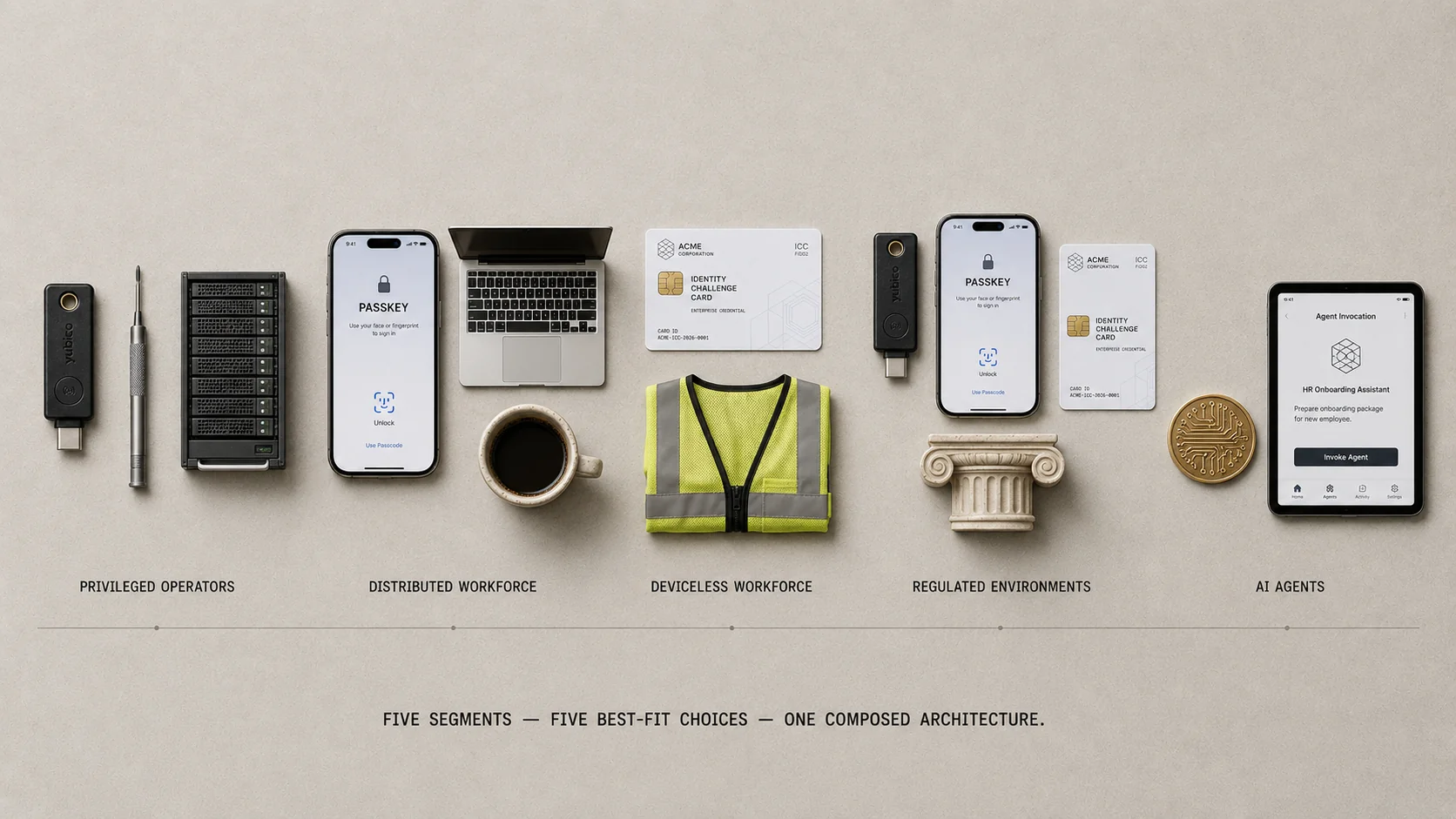 Five workforce segments, five credential-class best fits. The mature 2026 enterprise architecture composes them rather than forcing a single class across all segments.
Where each credential class breaks
Three failure patterns per class. Understanding the failure modes is part of the procurement decision — the class that's a perfect fit operationally still needs the failure-mode mitigations in place.
Hardware FIDO2 keys.
Lost or damaged keys without a backup enrolled. The user is locked out and requires the workflow-verified recovery process documented in our Temporary Password Best Practices piece. The mitigation is mandatory dual-key enrollment during initial provisioning — primary + backup, treated as inventory.
Cost-at-scale procurement burden. Equipping 10,000 users with primary + backup hardware keys is a meaningful procurement effort ($400,000-$2.2M in hardware costs depending on key choice, plus distribution logistics and lifecycle management). The mitigation is selective deployment — hardware keys for the segments that warrant them, other credential classes for the rest.
Carry-the-device burden. The user must remember to bring the key or have it physically present at the moment of authentication. Forgotten-at-home keys produce a daily operational tax in some workforces. The mitigation is keychain-attached or laptop-attached keys for users who tend to forget, combined with synced-passkey fallback for routine access.
Synced passkeys.
Credential-manager dependency. The user's passkeys are only as available as the credential manager. If Apple has an iCloud outage, if Google's account-recovery process flags the user, if Microsoft's Entra ID has an incident, the user's passkeys are affected. The mitigation is multi-manager strategy (synced passkeys in the primary manager, with one alternative credential class — typically hardware keys — for high-assurance operations) and explicit broken-glass-scenario procedures.
Cross-ecosystem portability gaps. Apple synced passkeys work seamlessly across Apple devices but interoperating with Windows or Android adds friction. The standards are improving (cross-platform sync through new WebAuthn extensions, third-party managers like 1Password and Bitwarden bridging the gap), but real-world users sometimes hit friction when they try to authenticate on a non-primary-ecosystem device. The mitigation is ecosystem standardization within the enterprise where feasible, or third-party credential managers that handle the bridging.
Device-loss scenarios for device-bound passkeys specifically. When the device is lost, the credential is gone with it. The user enrolls a new credential on a new device, which requires the workflow-verified recovery process. The mitigation is to prefer synced passkeys over device-bound passkeys where the user's device ecosystem supports it.
Identity Challenge Card.
Reader infrastructure availability. The card requires a reader at the authentication point. Environments where readers aren't available — visiting a customer site, traveling, working remotely — produce coverage gaps. The mitigation is multi-class provisioning (the Identity Challenge Card for in-environment authentication, synced passkeys or hardware keys for out-of-environment authentication).
Card lifecycle management. Issuing, distributing, replacing, and revoking cards is operational work. The volume scales with the workforce size; the operational discipline is real. The mitigation is integrated lifecycle management through the IGA platform — the card lifecycle becomes part of the joiner-mover-leaver workflow rather than a separate manual process.
Initial enrollment friction. Card enrollment requires an in-person or supervised step to verify identity and tie the card to the user. The mitigation is enrollment workflow integration with the existing onboarding process — typically done at HR onboarding when the user is on-site for orientation.
The failure modes don't disqualify any credential class; they shape the operational discipline required for successful deployment. The mature 2026 procurement decision picks the class that fits each segment and invests in the operational discipline that makes that class successful.
The composition pattern in mature 2026 deployments
Most mature 2026 enterprise deployments compose multiple credential classes. The composition isn't accidental — it reflects the operational reality that different workforce segments have different best-fit credentials and forcing a single class across all segments produces deployments that work well in some segments and break in others.
The dominant composition pattern in 2026 mature deployments:
Synced passkeys as workforce default. The bulk of the workforce (typically 70-90% of users) uses synced passkeys through the dominant credential manager for their device ecosystem. The user experience is seamless — touch the sensor or look at the camera, and the cryptographic ceremony completes through the credential manager. Cross-device portability through cloud sync.
Hardware keys for privileged operators. The privileged segment (typically 1-5% of users — domain admins, infrastructure operators, security engineers, executive assistants, finance back-office) uses hardware FIDO2 keys with primary + backup enrolled. The sovereignty and assurance dimensions favor hardware for this segment.
Identity Challenge Card for deviceless segments. The frontline, manufacturing, healthcare, defense, and other deviceless workforces (typically 5-25% of users depending on industry) use the Identity Challenge Card. The deviceless authentication pattern is unique to this credential class.
Scoped delegation tokens for AI agents. The agentic workload uses per-invocation scoped tokens as covered in the Agentic Authentication piece.
The composition produces a credential envelope where each workforce segment uses the credential class that fits it operationally, with the enterprise identity platform handling the unified policy layer (authentication assurance requirements, session management, audit trail composition) across all classes.
The 2026 reference path
Stop looking for the single best credential class. The mature 2026 enterprise procurement decision composes multiple classes per workforce segment.
Map the workforce segments first. Privileged operators, distributed workforce, deviceless workforce, regulated environments, AI agents. Each segment has a credential-class best fit.
Deploy synced passkeys as workforce default for distributed segments with managed devices. The portability and user-experience dimensions deliver the largest workforce-segment value at the lowest operational cost. The Passkey Deployment piece covers the rollout pattern.
Deploy hardware FIDO2 keys for privileged operators. Primary + backup per user; selective deployment to the segments where sovereignty and assurance matter most. The cost is bounded by the small user count.
Deploy the Identity Challenge Card for deviceless segments. The deviceless authentication pattern doesn't fit either hardware keys (requires possession at moment of authentication, often impractical) or synced passkeys (requires a device to sync to). The Identity Challenge Card covers the gap.
Compose with the broader credential stack. The Phishing-Resistant MFA piece covers the full credential-class architecture. The Adaptive Authentication piece and Continuous Authentication piece cover the risk-based layers that compose with the credential layer. The MFA + IGA piece covers the IGA layer above the credential layer.
Hardware FIDO2 keys and passkeys aren't competitors. They're complementary credential classes that fit different workforce segments. The 2026 mature enterprise architecture is composition, not selection. Compose deliberately.
About the author

More from Passwordless
Passwordless Authentication in Healthcare: The HIPAA Case (2026)
Passwordless authentication doesn't earn HIPAA certification — HIPAA doesn't certify vendors — but it directly strengthens the §164.312 access-control safeguards clinical IT teams are graded on.
Windows Hello Limitations 2026: Where It Works and Where It Stops
Windows Hello does one thing extremely well — it produces a strong, TPM-bound, biometric or PIN sign-in on the specific Windows device a user enrolled on. The limitations show up the moment authentication needs to leave that device: shared and kiosk workstations, roaming across machines, cross-platform access, and the per-device enrollment burden. The 2026 practitioner reference on how Windows Hello actually works, exactly where its device-bound model falls short, and the FIDO2 and passkey patterns that extend it to the endpoints Hello was never designed to cover.
Passwordless Implementation Step-by-Step: The 2026 Enterprise Deployment Playbook
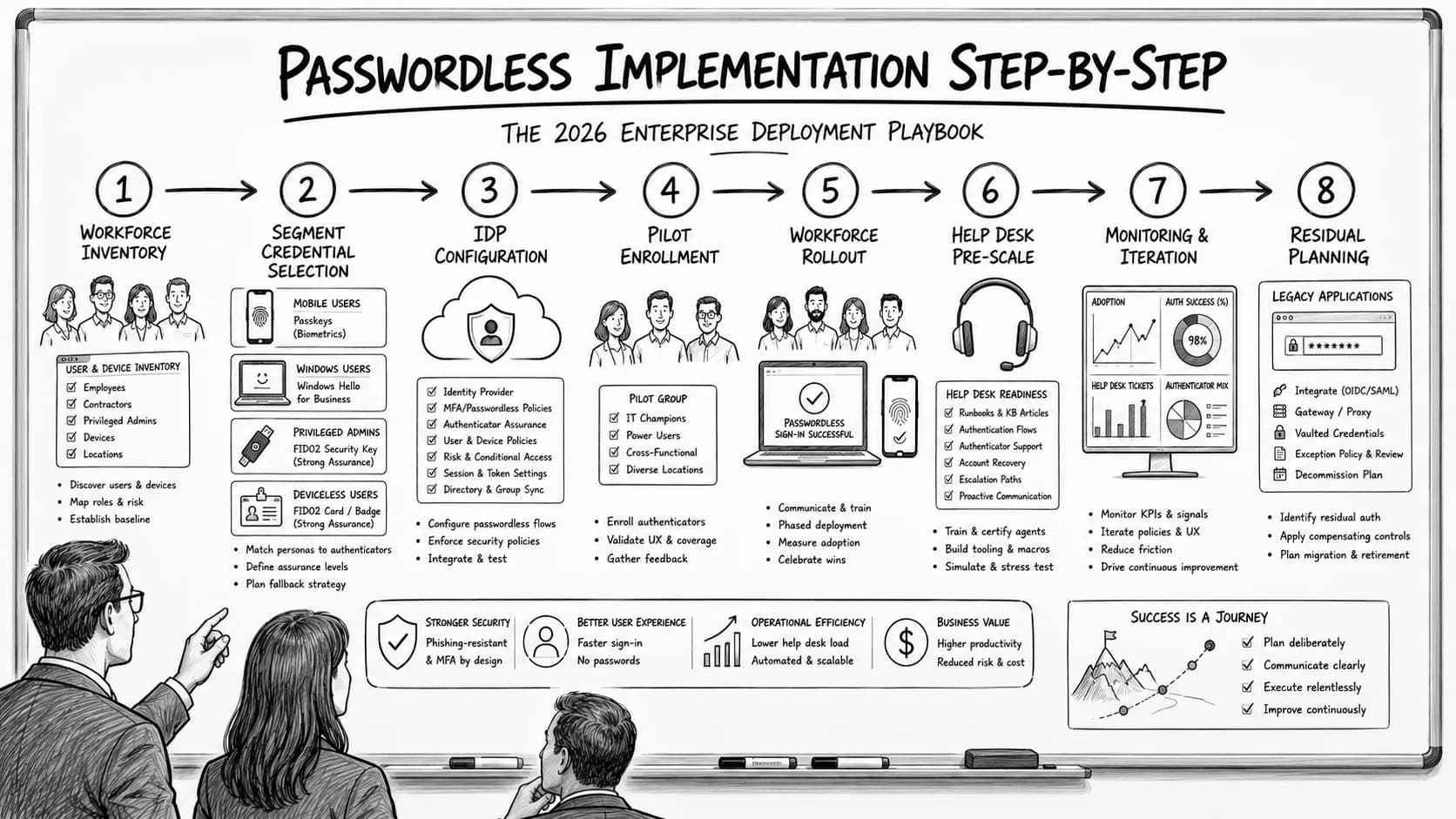
Enterprise passwordless implementation runs on a specific eight-step deployment sequence — workforce inventory, credential-class selection per segment, IdP configuration, pilot enrollment, workforce rollout with change management, help desk pre-scaling, monitoring and iteration, and passwordless-fallback residual planning. The 2026 enterprise reference on the step-by-step deployment playbook, the go/no-go criteria at each phase gate, and the discipline that produces successful passwordless rollout at workforce scale.