Single-Factor vs Multi-Factor Authentication: The 2026 Reference
Single-factor authentication still runs most login events on earth, and most of the advice about it is a strawman. The 2026 reference on what SFA actually is, where it remains defensible, why factor independence decides whether you really have MFA, and the failure ladder from password-only to phishing-resistant FIDO2.
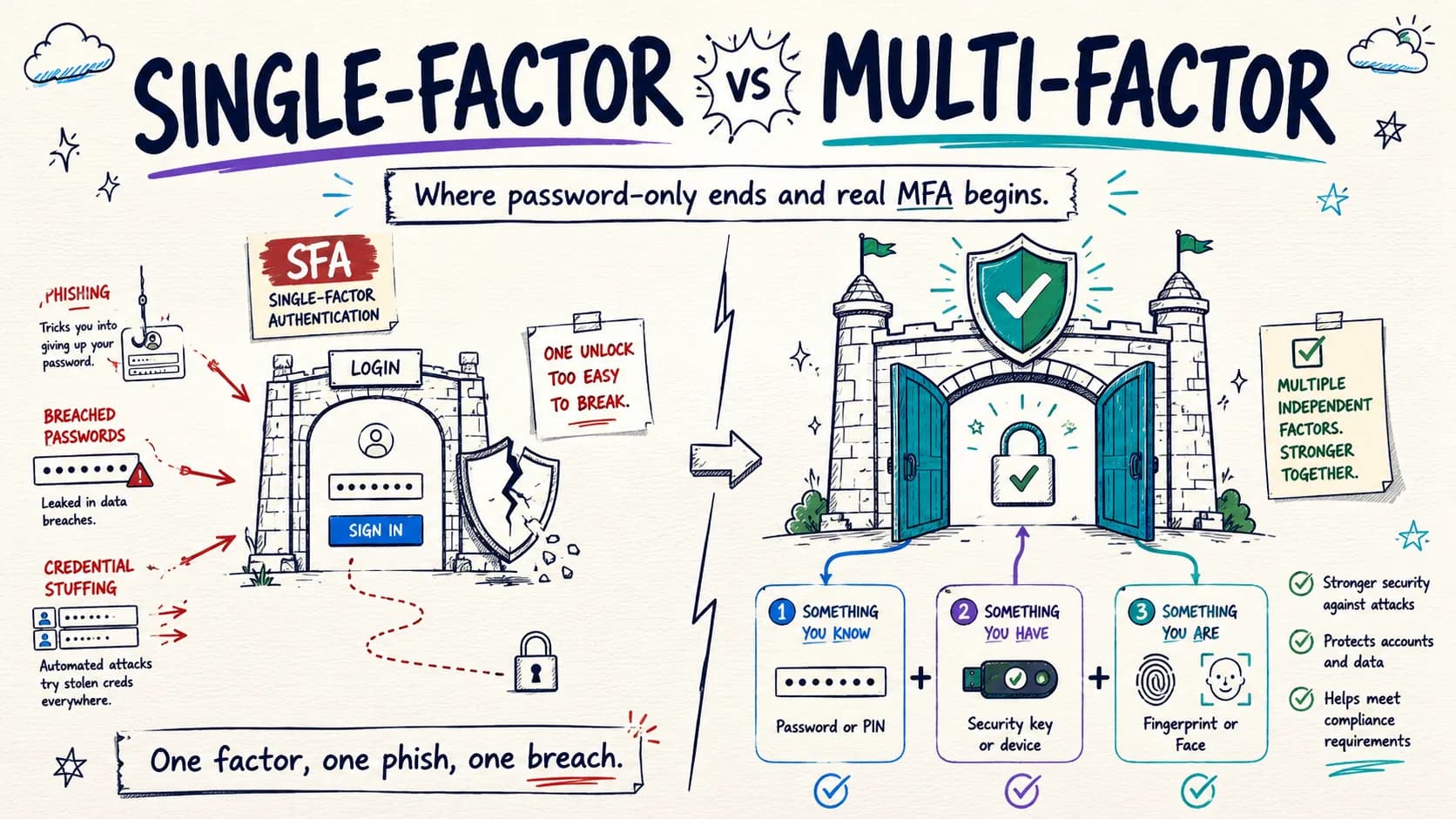
Single-factor authentication still runs most login events on earth, and most of the advice about it is a strawman. The 2026 reference on what SFA actually is, where it remains defensible, why factor independence decides whether you really have MFA, and the failure ladder from password-only to phishing-resistant FIDO2.
- Single-factor authentication (SFA) verifies identity with exactly one piece of evidence — almost always a password. It is not automatically negligent: for low-sensitivity, internal-only surfaces it can still be a defensible engineering decision in 2026.
- MFA requires factors from at least two independent classes — something you know, something you have, something you are. Two knowledge factors (a password plus security questions) is still single-factor security, and 2FA is simply the two-factor subset of MFA.
- Authentication methods fail on a ladder: password-only falls to credential stuffing, SMS OTP to SIM swap and real-time relay, app OTP to phishing and AiTM proxies, push approval to MFA fatigue. Only FIDO2/passkey authentication is origin-bound and survives adversary-in-the-middle.
- The compliance floor moved: PCI DSS v4 made MFA mandatory for all access into cardholder data environments as of March 31, 2025, cyber-insurance questionnaires gate coverage on MFA for email, remote access, and privileged accounts, and CISA guidance points past baseline MFA toward phishing-resistant methods.
- The migration that works runs SFA → MFA → phishing-resistant in risk order — external and privileged surfaces first — and treats enrollment, recovery channels, and frontline workers without smartphones as the actual project, not footnotes.
Single-factor authentication is still the most common way humans log in to things, and most of what is written about it treats it as a punchline — a strawman to knock down on the way to selling MFA. That framing produces bad decisions in both directions. Teams over-invest in bolting MFA onto surfaces that never needed it, and under-invest in the surfaces where password-only access is quietly indefensible, because nobody ever drew the boundary precisely.
This piece is a full 2026 refresh of our original explainer, Understanding Authentication Methods, rebuilt around the questions practitioners actually ask: what single-factor authentication precisely is, where it is still a defensible engineering decision, what separates real multi-factor authentication from theater, and the failure ladder that runs from password-only to phishing-resistant FIDO2. The companion pieces cover the adjacent territory — Phishing-Resistant MFA for Enterprise for the regulatory category at the top of the ladder, MFA Fatigue Attacks for the attack that broke push approval, and Adaptive Authentication for the risk-scoring layer that decides how much ceremony each login deserves.
What single-factor authentication actually is
Single-factor authentication (SFA) is an identity verification method that relies on exactly one piece of evidence — one factor — to grant access. In almost every deployment that factor is a knowledge factor: a password or PIN checked against a stored verifier. If the secret matches, the session is granted; no second, independent proof of identity is ever demanded. The defining property, and the defining weakness, is that the entire security posture of the account collapses to the secrecy of one credential.
Two clarifications keep the definition precise. First, SFA is not synonymous with "password authentication," even though the two overlap almost completely in practice. A proximity badge that opens a door with no PIN is single-factor. A biometric-only unlock with no other evidence is single-factor. The count of independent factors is what defines the category, not the type of the factor.
Second, SFA is not automatically negligence. It is a risk posture: one layer of defense, zero redundancy. For a cafeteria menu app on a segmented internal network, that posture can be entirely rational. For an internet-facing mailbox, it is a standing invitation, because the attacks that defeat single-factor authentication — credential stuffing from the billions of leaked username-password pairs in circulation, password spraying, straightforward phishing — are automated, cheap, and untargeted. Credential-driven intrusion remains the dominant initial-access pattern in breach reporting year after year; that is the industry consensus, and it is the reason the perimeter of acceptable SFA keeps shrinking.
The useful question in 2026 is therefore not "is SFA bad" — it is "which of our surfaces still run on one factor, and can each of them justify it." Most enterprises cannot answer the first half of that question, which is the real problem.
What multi-factor authentication is — and why 2FA is a subset
Multi-factor authentication (MFA) requires the user to present evidence from at least two independent factor classes before access is granted. The canonical classes are something you know (password, PIN), something you have (passkey, hardware key, smart card, enrolled phone), and something you are (fingerprint, face, iris). Defeat one factor and the attacker still faces another of a fundamentally different kind — that is the entire design.
Two-factor authentication (2FA) is simply the two-factor subset of MFA. Every 2FA deployment is MFA; not every MFA deployment stops at two. A defense-facility login that combines a smart card (have), the card's PIN (know), and a biometric (are) is three-factor MFA. The terms get marketed as if they were competing products; architecturally, 2FA is a point on the MFA spectrum, nothing more.
What MFA changes is attack economics. Against single-factor surfaces, an attacker replays leaked credentials at scale and monetizes whatever sticks. Against MFA, each account requires a targeted, usually real-time attack on the second factor — SIM swap, live phishing relay, push bombing. Those attacks all exist, and the failure ladder below walks through them, but they cost incomparably more per account than credential stuffing. MFA does not make an account unbreachable; it removes the account from the cheapest, most automated tier of compromise.
The trap in the definition is the word independent, which deserves its own section — because a surprising amount of deployed "MFA" fails the independence test.
The three factor classes — and what doesn't count
Factor classes matter more than factor counts. A password plus a security question is two pieces of evidence and one factor class — both are things you know, both are phishable in the same conversation, and both frequently leak in the same database dump. That configuration is single-factor security wearing a two-step costume. The same logic applies to a password plus a memorized backup code, or two passwords on two screens. Multi-step is not multi-factor.
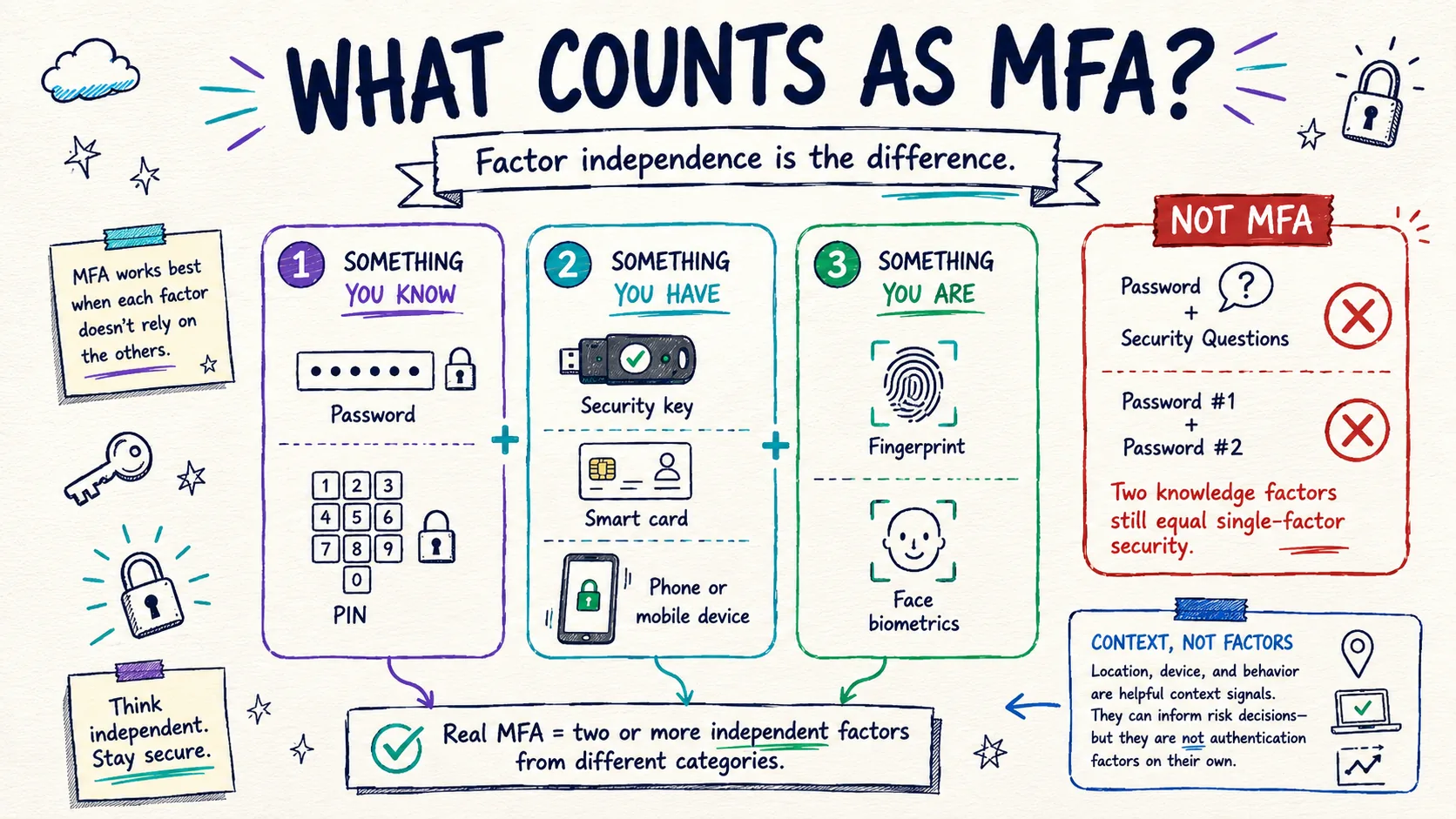 The three independent factor classes, the context signals that never count as factors, and the independence rule that separates real MFA from two-step theater.
Independence has a second dimension: channel and device. An OTP delivered to the same browser session it protects, or a password manager that autofills both the password and the TOTP code from the same unlocked vault on the same machine, narrows the gap between "two factors" and "one compromised endpoint." The strongest MFA configurations keep the second factor on separate hardware or inside a hardware-protected enclave, so that compromising the knowledge factor tells the attacker nothing about the possession factor.
Then there is the category that counts as zero factors: context signals. Location, IP reputation, device posture, time-of-day, typing cadence, behavioral patterns — none of these are authentication factors, because none of them constitute evidence the user deliberately presents and an attacker cannot observe or spoof. A residential proxy in the victim's city defeats geolocation. A hijacked session on the victim's own laptop defeats device checks. What context signals are is risk inputs: the raw material for adaptive authentication, which uses them to decide how strong a ceremony to demand — silent pass for the routine login, phishing-resistant step-up for the anomalous one. Signals modulate the challenge; factors satisfy it. Architectures that blur that line end up counting a geofence as a second factor, which is how "MFA-protected" surfaces fall to a VPN exit node.
The authentication failure ladder
Authentication methods are best understood as a ladder, where each rung exists because a specific attack defeated the rung below — and each rung has a specific attack waiting for it.
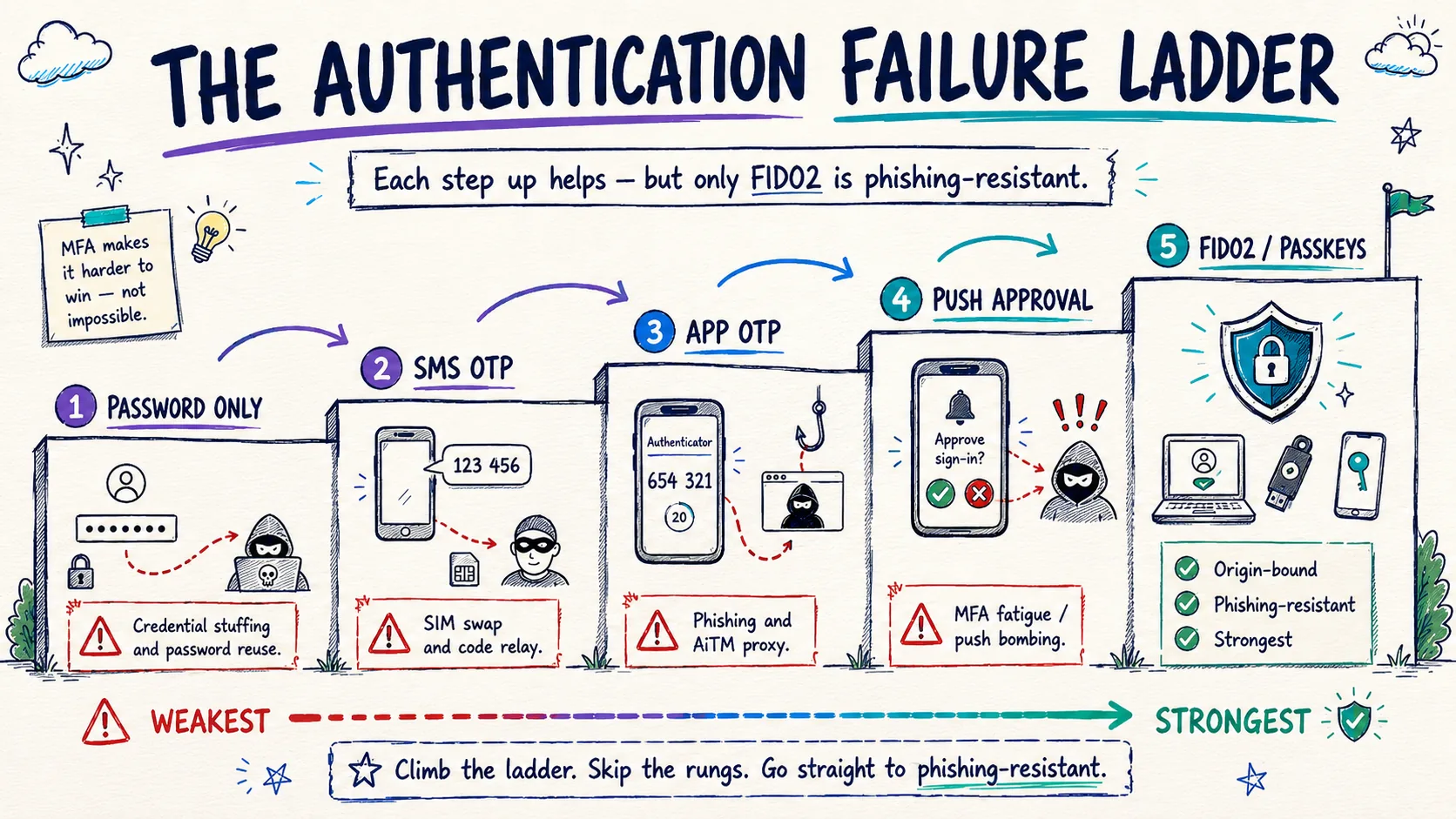 Five rungs, five attacks. Every step up buys real security against the attack below it — and only FIDO2 at the top survives a live adversary-in-the-middle.
Rung 1: password only. Falls to credential stuffing — automated replay of leaked username-password pairs — plus password spraying and plain phishing. No targeting required; the attacker does not know or care who you are. This is the rung the entire rest of the ladder exists to escape.
Rung 2: SMS OTP. Stops credential stuffing cold: the attacker with a valid password no longer has a valid session. What it does not stop is SIM swap — social-engineering the carrier into porting the victim's number to an attacker SIM, at which point the codes arrive at the attacker's phone — SS7-level interception in transit, and real-time relay, where the victim types the code into a proxy phishing page and the attacker forwards it within its validity window. The code is a short shared secret typed by a human; nothing about it knows which website is asking.
Rung 3: authenticator-app OTP. Removes the SMS transport entirely, so SIM swap and carrier attacks stop working — a real improvement. The relay attack survives untouched: a TOTP code generated on the victim's phone can be phished and replayed through an adversary-in-the-middle (AiTM) proxy exactly like an SMS code. The OTP failure-case catalogue is deep, but AiTM relay is the one that matters strategically.
Rung 4: push approval. Removes the typed code, which kills code-relay — and introduces a new human failure mode: the approval prompt itself. MFA fatigue attacks bombard the user with push requests until one gets approved out of exhaustion or confusion, a pattern that has featured in several headline breaches and that we dissected in MFA Fatigue Attacks: Defense Patterns. Number matching closes blind approval, but an AiTM proxy that triggers a legitimate push — which the victim, mid-login on the phishing page, expects and approves — still wins, and the attacker still walks away with the session cookie.
Rung 5: FIDO2 / passkeys. The phishing-resistant rung. The authenticator holds a private key and signs a challenge that is cryptographically bound to the origin domain; presented with login.contoso.example.phish.tld, the ceremony simply does not complete. There is no shared secret to relay, no code to type, no approval to fatigue. AiTM proxies, the attack that defeats every lower rung, fail structurally. This is the category CISA and NIST mean by phishing-resistant MFA, covered in depth in the enterprise reference, and the passkey deployment playbook covers how to actually roll it out.
The ladder yields the honest hierarchy: every rung above password-only is worth climbing to, any MFA beats no MFA, and only the top rung defeats a live, motivated phisher.
Where single-factor authentication is still defensible in 2026
The precise answer to "when is SFA acceptable" is a two-axis test: data sensitivity and exposure. SFA remains defensible only in the quadrant where both are low — low-sensitivity data on surfaces that are not reachable from the open internet.
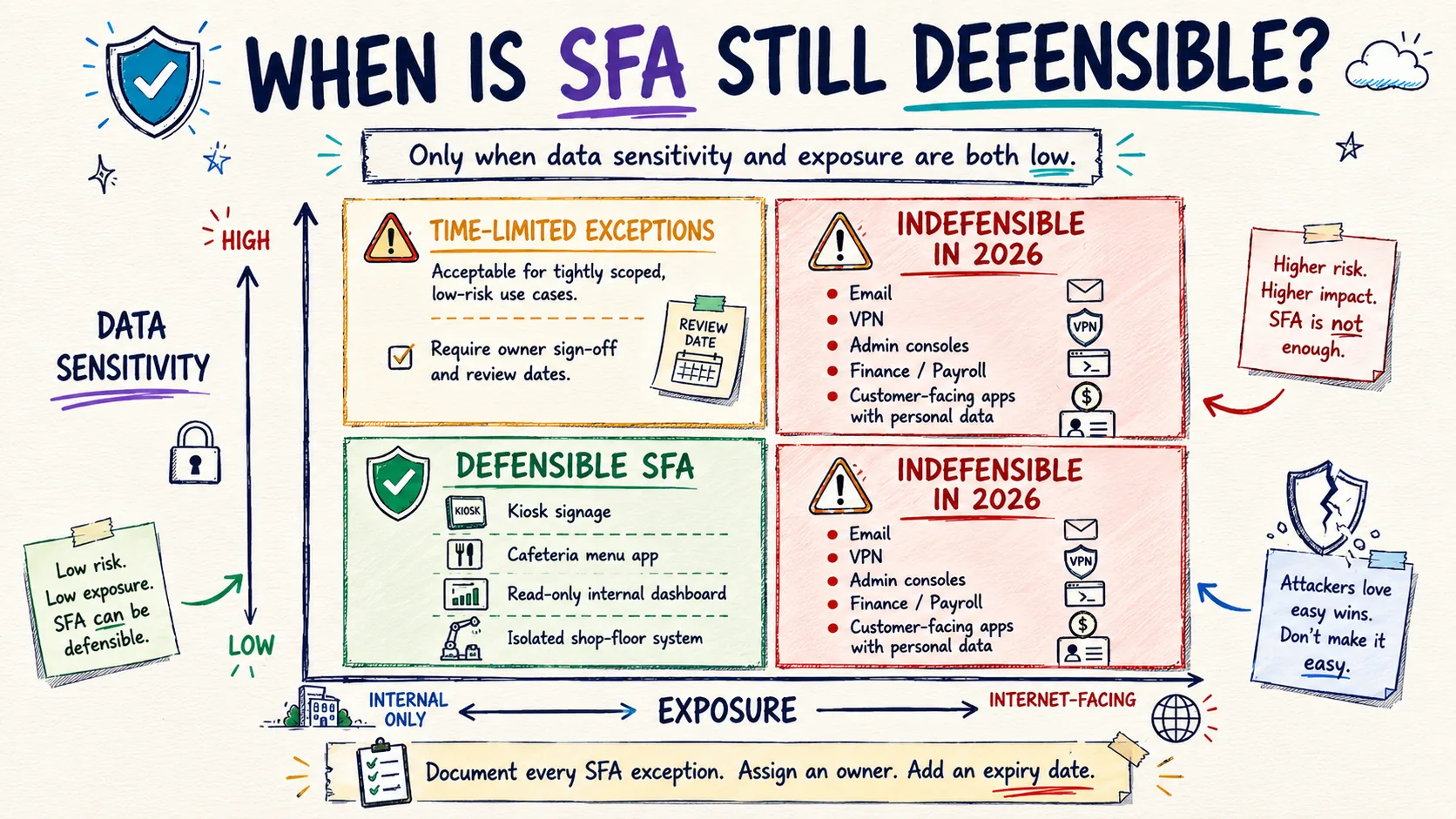 The two-axis test: only the low-sensitivity, internal-only quadrant defends single-factor in 2026 — email, remote access, admin, and finance are out.
Legitimate residents of the green quadrant: kiosk and digital-signage consoles, a cafeteria menu app, read-only internal dashboards with no personal data, lab equipment on an isolated segment, and the long tail of legacy estate — shop-floor systems and aging internal apps that predate modern identity protocols, where network segmentation rather than login ceremony is the real control. Shared-terminal kiosk flows in frontline environments also land here when the terminal exposes nothing sensitive; the moment the same terminal fronts clinical records or payroll, it leaves the quadrant.
The indefensible list is shorter and sharper: email, VPN and any remote access, administrative consoles, finance and payroll systems, and anything internet-facing that touches customer or employee data. Email deserves special emphasis because it is the recovery hub for everything else — a phished mailbox resets its way into the rest of the estate. These surfaces sit where the attacks from rungs one and two are cheapest and the blast radius is largest; password-only access there is not a trade-off, it is an unmanaged liability. The weak-password risk analysis on our Credential Governance blog covers what actually happens to the credentials themselves.
The operational discipline that makes the green quadrant defensible is an exception register: every SFA surface documented, owned, risk-accepted in writing, monitored, and stamped with an expiry or review date. "Defensible" describes a decision someone consciously made — not a surface nobody remembered to migrate.
The regulatory drivers — and the migration path off single-factor
Even where the risk argument fails to move budgets, three external forces are closing the SFA perimeter.
NIST SP 800-63B gives the vocabulary: Authenticator Assurance Levels. AAL1 permits single-factor. AAL2 requires two distinct factors. AAL3 requires hardware-based, phishing-resistant authentication. The framework's value outside government is that it converts "do we have MFA?" into the per-surface question "which assurance level does this application's risk demand, and does the deployed method meet it?" Email and remote access generally justify AAL2 as a floor; privileged access trends toward AAL3-class methods. (Those are claims about NIST's concepts and your surfaces — vendors, Avatier included, don't "hold" an AAL; deployments meet one per configuration.)
PCI DSS v4 made the compliance floor concrete: MFA is required for all access into the cardholder data environment — not just remote access, not just administrators — with the future-dated v4.0 requirements becoming mandatory on March 31, 2025. Any payment-adjacent surface still running single-factor is now a finding, not a preference.
Cyber insurance and CISA. Insurance questionnaires now gate coverage — and premium — on MFA for email, remote access, and privileged accounts; a "no" box on any of those is a declined application or an exclusion clause. CISA's guidance, from its long-running more-than-a-password campaigns through its phishing-resistant MFA publications, pushes the same direction: MFA everywhere, phishing-resistant MFA for the surfaces that matter most.
The migration those forces demand runs in risk order, and it is a two-hop journey — SFA to MFA, then MFA to phishing-resistant — that most enterprises should traverse as one program:
- Inventory and triage. Enumerate every authentication surface, place each on the sensitivity-exposure matrix, and open the exception register for the green quadrant.
- Kill indefensible SFA first. Email, VPN, admin, finance get MFA immediately — even OTP-class MFA, because rung two beats rung one — with privileged accounts going straight to hardware-backed FIDO2 rather than transiting the weak rungs.
- Climb the ladder deliberately. Treat OTP and push as transit camps, not destinations; move the workforce toward passkeys and FIDO2-compatible credentials per the deployment playbook.
- Fund the deployment reality. Three things decide whether the program lands. Enrollment: bind the first factor ceremony to verified identity, because an attacker who can enroll their own authenticator owns the account politely. Recovery: the reset and re-enrollment path is the soft underbelly — helpdesk-verified recovery that accepts a convincing phone voice quietly downgrades your entire MFA estate back to single-factor social engineering, which is why recovery channels need workflow-tied verification, not vibes. The excluded populations: frontline and deskless workers without corporate smartphones, shared-workstation environments, and legacy apps that speak no modern protocol are where MFA programs historically stalled — they need deviceless credentials and protocol bridging, not exemptions.
How the vendor landscape maps onto this sequence is its own evaluation problem — the deployment order above is the part that doesn't change with the vendor.
What Avatier ships toward this pattern
Avatier's contribution to this specific problem — getting everyone off indefensible single-factor, including the populations MFA programs usually strand — centers on the Identity Challenge Card: a deviceless, FIDO2-compatible card credential built for frontline and deskless workforces. Shared-workstation nurses, shop-floor operators, contractors without managed devices, and facilities where phones are prohibited get the same origin-bound cryptographic ceremony as a passkey user, from a card — a possession factor with no smartphone dependency, which removes the standard excuse for leaving those segments on passwords.
Around it, Avatier Identity Anywhere integrates MFA with self-service password reset and governed recovery channels, so the step-up ceremony and the recovery path enforce the same assurance — closing the helpdesk-reset downgrade path that quietly re-introduces single-factor trust behind a multi-factor front door. The Avatier Trust Center publishes the compliance posture behind the platform: SOC 2 Type II audited with zero exceptions noted, ISO/IEC 27001:2022 certified, PCI DSS v4.0.1 compliant, CSA STAR Level 1 attestation, NIST 800-53 Rev. 5 aligned, and CISA Secure-by-Design Pledge signatory.
The architecture argument stands regardless of vendor: an MFA program is only as strong as its weakest enrolled population and its most forgiving recovery flow.
The honest closing
Multi-factor authentication is the single highest-leverage upgrade for the surfaces that still run one factor — and it is not the end state, because three problems survive it untouched. A stolen session token after a successful login bypasses every factor you deployed; post-auth session security is its own discipline. An ungoverned recovery channel converts your strongest ceremony back into a phone call; recovery is part of the authentication perimeter whether you architect it or not. And authentication, however strong, only establishes who — it says nothing about the accumulated over-entitlement of what that identity can touch, which is the authorization side of the boundary and a governance problem no authenticator solves. Retire the indefensible single-factor surfaces, climb the ladder toward phishing-resistant, register and expire the exceptions — and then keep going, because identity security does not end at the login prompt.
About the author
More from MFA & Authentication
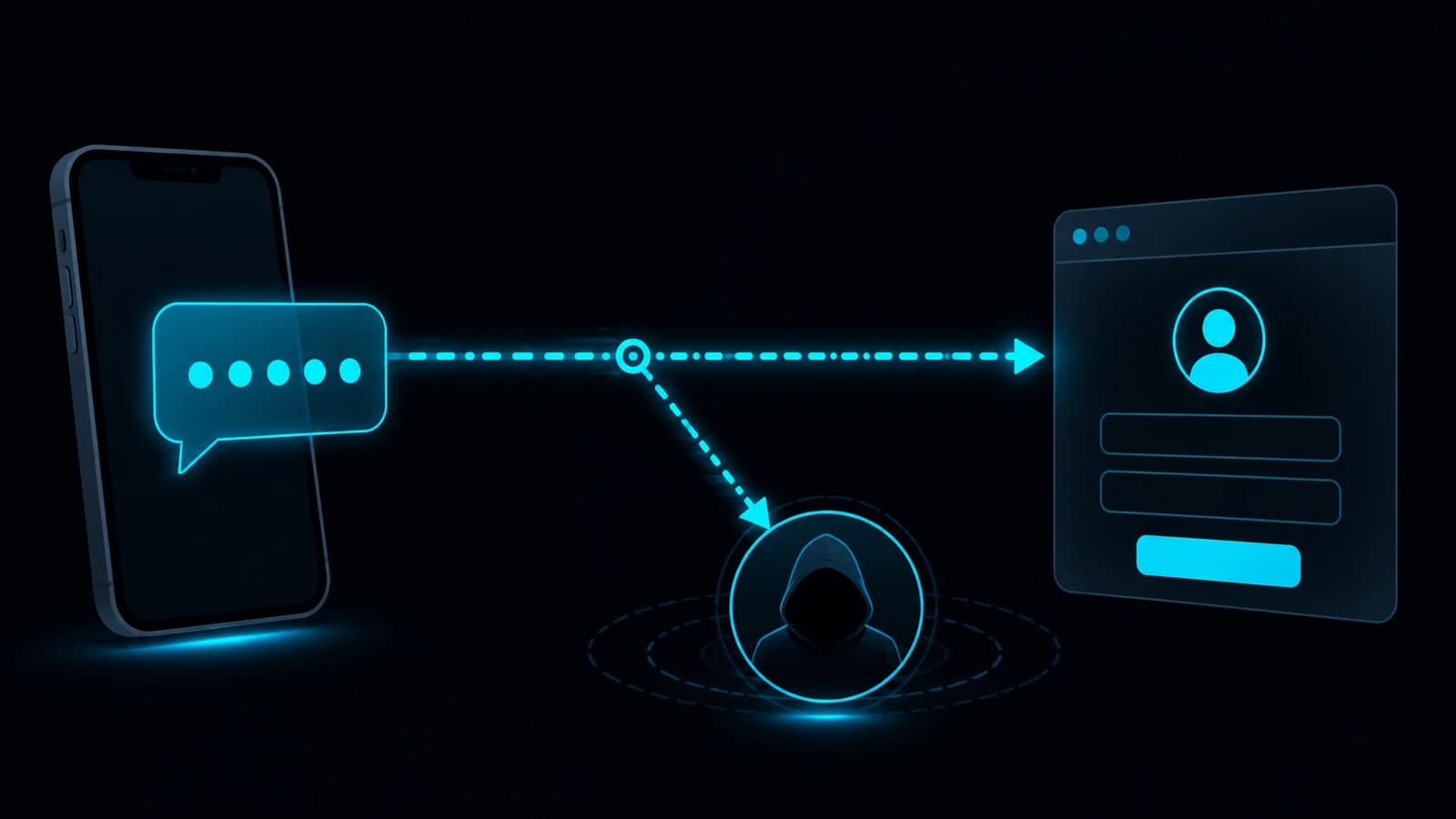
How Cybercriminals Exploit Weak OTP: The Attacker Playbook (2026)
Weak OTP fails at four specific points — SIM swap, real-time phishing relay, SS7 interception, and MFA fatigue — and every one of them is a known, repeatable attacker technique in 2026.

Advanced MFA in 2026: What Actually Counts as a Factor
Multi-factor authentication only works when the factors are genuinely different — this 2026 reference clears up what counts as a real factor and what advanced MFA actually means.
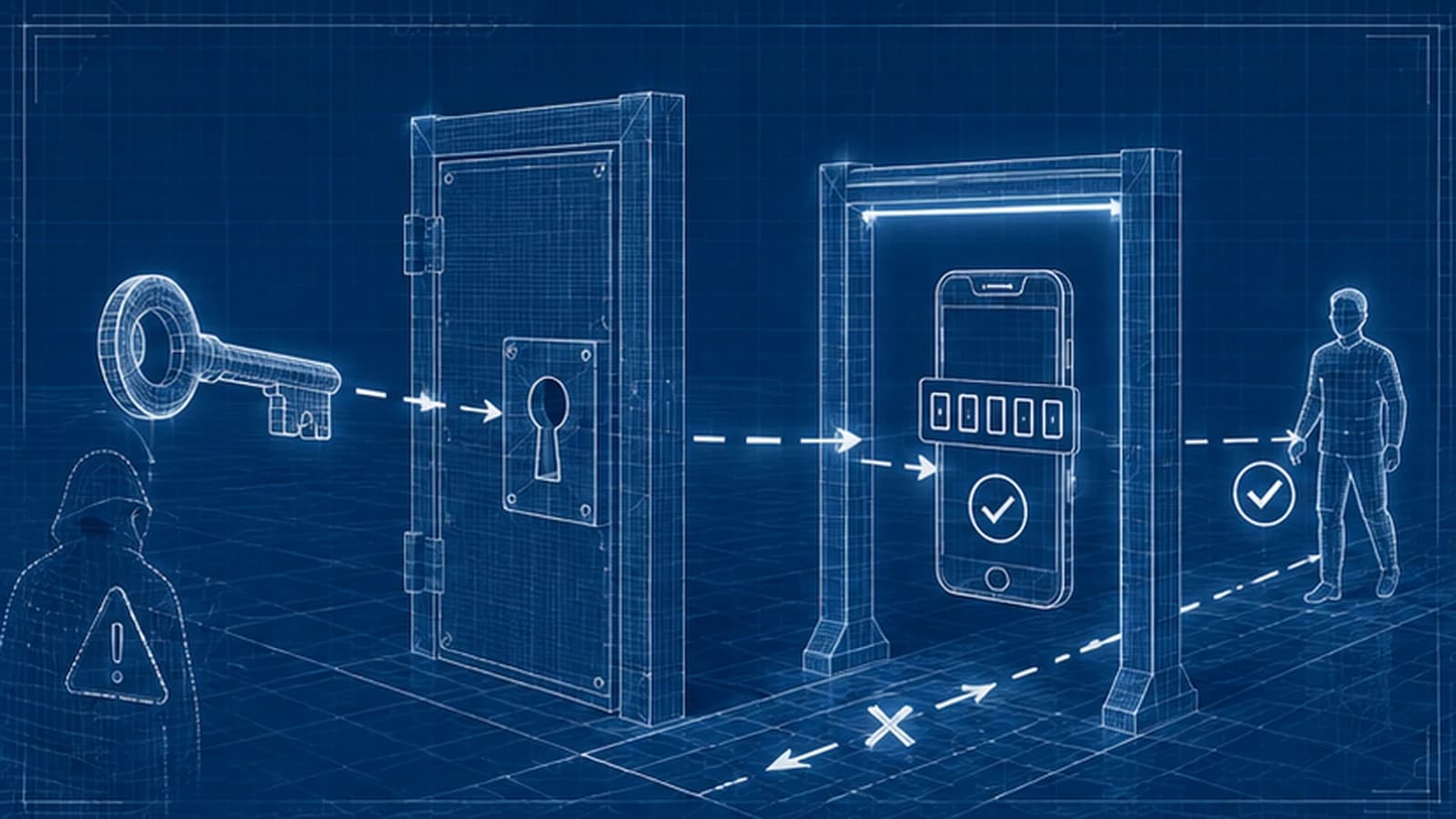
Does OTP Prevent Breaches? The Attacks It Actually Stops in 2026
OTP does not stop every attack, but it reliably defeats credential stuffing, password-spray, basic brute force, and stolen-password reuse from unrelated breaches. The 2026 breach-prevention case for OTP — the attack chains it breaks, the ones it doesn't, and how to deploy it so the prevention benefit actually lands.