Continuous Authentication for High-Risk Workforces 2026
Authentication at session establishment isn't enough for privileged users, financial-system operators, defense workloads, or executive accounts. Continuous authentication re-evaluates identity assurance at every protected resource access, every session checkpoint, every risk-signal change. The 2026 enterprise reference on the architecture, the signal stream, and the high-risk segments where the pattern is now expected.

Authentication at session establishment isn't enough for privileged users, financial-system operators, defense workloads, or executive accounts. Continuous authentication re-evaluates identity assurance at every protected resource access, every session checkpoint, every risk-signal change. The 2026 enterprise reference on the architecture, the signal stream, and the high-risk segments where the pattern is now expected.
- Episodic authentication — challenge at session start, then trust the session — leaves the long tail of mid-session resource accesses unprotected against credential theft, session hijack, and behavioral drift.
- Continuous authentication re-evaluates identity assurance at every protected resource boundary, every signal-stream change, every risk-context shift, and steps up when assurance decays below the threshold the resource demands.
- Five signal classes feed the continuous decision loop: device-posture deltas, behavioral pattern shifts, geographic and network anomalies, identity-context changes (role assignment, certification status, recent risk flags), and threat-intelligence updates flowing in real-time from the IdP.
- Four high-risk segments operationally need continuous auth in 2026: privileged operators (PAM-elevated accounts), financial-system users (trading, treasury, payment operations), executive accounts (whaling targets), and defense or regulated workloads where NIST 800-63B Rev. 4 expects continuous assurance evaluation.
- The 2026 architecture composes the IdP's continuous-evaluation signal stream with resource-server policy enforcement, phishing-resistant credentials for step-up ceremonies, and ITDR-layer behavioral analytics that watch for assurance-decay patterns the rule-based policy misses.
Most enterprise authentication architectures still treat sessions as binary — authenticated or not — with a single decision at the front gate. The user signs in with their credential, the IdP issues a session token, and the resource servers downstream trust that token until it expires. The model works for most users at most resources. It breaks at the high-risk segments where the cost of a compromised session is unbounded: privileged operators, financial-system users, executive accounts, defense workloads. For these segments, a single decision at session start is the wrong number of decisions.
Continuous authentication is the architectural answer. Instead of treating the post-sign-in session as uniformly trusted, the architecture re-evaluates identity assurance at every protected resource boundary, every signal-stream change, every risk-context shift. When assurance decays below the threshold a resource demands, the architecture steps up the credential requirement — requires a fresh MFA approval, requires a phishing-resistant credential, requires workflow-verified recovery, or denies the access outright. The user experience is mostly invisible because most assurance decays don't happen during most sessions. When they do, the architecture catches them.
This piece is the 2026 enterprise reference on continuous authentication and the high-risk workforce segments where the pattern is now operationally expected. The companion pieces handle adjacent territory. The Adaptive Authentication piece covers the session-establishment evaluation that continuous authentication extends; the Phishing-Resistant MFA piece covers the credential class that step-up ceremonies depend on; the SSO Architecture piece covers the federation layer that distributes the authentication decisions; and the ITDR piece on CGov covers the detection layer that produces the threat-intelligence signals continuous evaluation consumes. This piece is the continuous-specific layer.
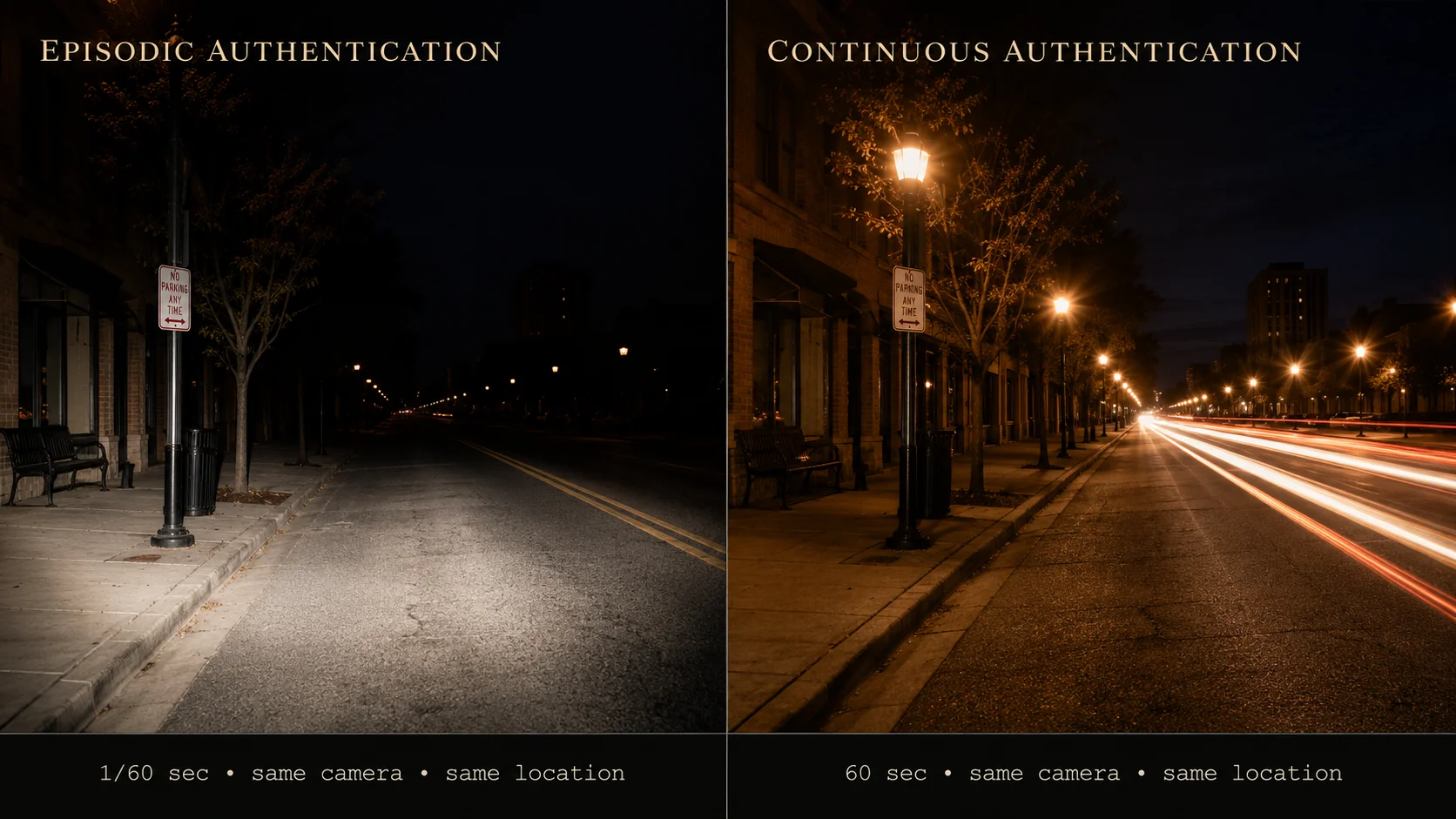 Episodic authentication makes one decision at sign-in. Continuous authentication makes many decisions throughout the session. Same session duration, fundamentally different assurance model.
What continuous authentication actually does, mechanically
Continuous authentication has three operational layers that compose into the runtime architecture. None is exotic in isolation; the composition is what produces the assurance model.
Layer 1: persistent signal-stream evaluation. The IdP — or a signal-aggregation layer in front of it — receives a continuous stream of risk-relevant events about the authenticated session. Device posture updates from the MDM (the device went out of compliance, an EDR alert fired, the OS shifted patch level). Behavioral telemetry from the endpoint (typing rhythm, mouse patterns, navigation flow). Geographic and network observations (IP changed, ASN reputation degraded, impossible-travel pattern emerged). Identity-context updates from the IGA layer (role changed, certification status updated, recent risk flag fired). Threat-intelligence updates from cross-tenant feeds (credential-stuffing pattern updated, federation-broker anomaly detected). The signal stream runs continuously, not just at session establishment.
Layer 2: continuous assurance re-evaluation. A policy engine maps the current signal state to a current assurance score. The score isn't a single number computed once at sign-in; it's a continuously updated estimate that responds to the signal stream. The score has a few stable inputs (the user's standing identity, the credential class used at sign-in, the device class) and many time-varying inputs (the signal-stream deltas). When a signal-stream event meaningfully changes the score, the policy engine re-evaluates whether the current assurance is sufficient for the resources the session is currently accessing — or about to access.
Layer 3: step-up at resource boundaries. When the assurance score falls below the threshold a resource demands, the architecture steps up the authentication requirement. Step-up can be transparent (a passkey ceremony that uses platform biometrics, completing in a few seconds), moderately disruptive (a push notification with number matching), or fully disruptive (require hardware FIDO2 key, require Identity Challenge Card present, require workflow-verified recovery). The step-up requirement matches the sensitivity of the resource being accessed and the magnitude of the assurance decay. For most assurance decays at most resources, the step-up is the moderate or transparent class. For privileged operations, the step-up requires the strongest credential the user has.
The three layers compose into an architecture where the user's authentication assurance is a continuous variable that responds to the signal environment, not a binary state that's set at sign-in and frozen until session end.
How continuous authentication differs from session refresh
Session refresh is the long-standing pattern of issuing a short-lived access token (15-60 minutes) and a longer-lived refresh token (hours to days) — when the access token expires, the refresh token is exchanged for a new access token. The refresh-token exchange is sometimes called "continuous authentication" in vendor marketing because it happens throughout the session. It isn't.
| Pattern | What it evaluates | When it evaluates | What changes the outcome |
|---|---|---|---|
| Session refresh | Token validity | At access-token expiration | Refresh-token expiration, explicit revocation |
| Adaptive at session start | Risk score | At session establishment | Signal state at sign-in moment |
| Continuous authentication | Current assurance vs current resource demand | At every signal-stream event and every protected resource boundary | Any signal-stream change, any resource-sensitivity boundary |
Session refresh is a credential-lifecycle pattern. It doesn't re-evaluate whether the user is still the user, whether the device is still trustworthy, whether the session context has shifted. It just re-issues the token. Adaptive evaluation at session establishment makes one risk-based decision at the sign-in moment but doesn't follow the session afterward. Continuous authentication makes many decisions throughout the session, evaluating the current signal state against the current resource demand at every checkpoint.
The three are complementary, not competing. The 2026 enterprise architecture for high-risk segments composes all three — session refresh handles credential lifecycle, adaptive evaluation handles the sign-in moment, continuous evaluation handles the rest of the session.
The five signal classes that feed the continuous decision
Continuous authentication is only as good as the signal stream feeding it. The five signal classes that matter operationally in 2026 deployments mirror the five categories that feed adaptive at session establishment — but the continuous case runs them persistently rather than once.
Device-posture deltas. The richest signal source in most 2026 deployments. MDM platforms (Intune, Jamf, Workspace ONE) emit continuous telemetry about device state: compliance status, OS patch level, EDR agent health, disk-encryption state, jailbreak detection, recent software installations. The IdP consumes the telemetry stream and updates the device-posture component of the assurance score when posture changes. The architectural test is whether the IdP actually consumes the MDM stream in real-time (rather than periodically polling at long intervals); the IdPs that do real-time MDM integration produce dramatically better continuous-authentication signal quality than those that don't.
Behavioral pattern shifts. Keystroke dynamics, mouse-movement patterns, scroll velocity, click timing, application-switching patterns — the behavioral biometrics that feed risk at session establishment also feed continuous evaluation throughout the session. The architectural pattern is to establish a behavioral baseline per user (over the first few days or weeks of activity) and watch for sustained deltas from baseline. A short-term divergence (the user is tired, sick, distracted) doesn't trigger step-up; a sustained divergence (the typing pattern looks like a different person) does. False-positive risk is the practical limitation; 2026 deployments use behavioral signals as a contributing factor to the aggregate score rather than as a sole-factor decision input.
Geographic and network anomalies. Mid-session IP changes, impossible-travel patterns emerging within the session (the user appeared to authenticate from New York and then made an API call from Madrid 10 minutes later), ASN reputation degradation, VPN-exit changes, proxy or Tor exit detection. The signals are well-calibrated in 2026 — the false-positive rate is bounded by corporate VPN allow-listing and the by-design tolerances for mobile-network IP changes. The continuous evaluation catches geographic anomalies that adaptive at session establishment would have caught at sign-in if they'd been present then but emerged mid-session.
Identity-context changes. Role updates from the IGA layer (the user was assigned a new privileged role, an existing role expired, a certification went out of date), recent risk flags from the IdP (the user's account appeared in a breach-corpus update, the user's password was recently flagged in a credential-stuffing pattern), lifecycle changes (the user is now in a leaver-process state, the user was reassigned to a different organizational unit). Identity-context signals depend on tight IGA-to-IdP integration — without that integration, the signal stream is delayed or absent. The Best Identity Governance buyer's guide on CGov (Best IGA Solutions 2026) covers the IGA layer this depends on.
Threat-intelligence updates. Cross-tenant attack pattern detection (a credential-stuffing pattern just emerged matching this user's environment), federation-broker anomalies (unusual SAML or OIDC patterns suggesting compromise), MFA-fatigue pattern detection (rapid repeated push prompts in the wider tenant), breach-corpus updates (a new credential-leak feed just published). Threat-intelligence signals are increasingly powerful because cross-tenant attack patterns surface here that no single tenant could see alone. The IdPs with broad customer bases (Microsoft Entra ID, Okta) produce substantial threat-intelligence depth in this signal class; smaller IdPs depend on third-party threat-intelligence feeds.
The five signal classes compose into a continuous assessment of session assurance. Most sessions stay stable across all five — the user's device, behavior, geography, identity context, and threat exposure don't change meaningfully during the session. The sessions that show meaningful change in one or more signal classes are the ones continuous evaluation intervenes on.
 Five signal classes, evaluated continuously. The dashboard view is illustrative — the policy engine processes the signal stream as inputs to the assurance score; the dashboard is the operator-facing summary.
The four high-risk segments where continuous authentication is operationally expected
Not every workforce segment needs continuous authentication. For most users at most resources, adaptive evaluation at session establishment plus reasonable session lifetimes covers the risk envelope adequately. Four segments are different — the cost of a compromised session is high enough that continuous evaluation has become operationally expected in 2026.
Privileged operators. PAM-elevated accounts, domain administrators, infrastructure operators, security engineers with broad access, database administrators. The segment whose sessions can cause significant operational damage if hijacked. The 2026 pattern is to apply continuous evaluation throughout PAM-elevated sessions — every signal-stream change re-evaluates whether the elevated session should continue at its current assurance level, and step-up triggers at every privileged-operation boundary. The CGov PAM piece covers the privileged-access layer this composes with.
Financial-system users. Treasury operations, payment processing, trading systems, accounting reconciliation, fund movements. The segment whose sessions can move money. The 2026 pattern is to apply continuous evaluation at every financial-system resource boundary, with step-up tuned to the magnitude of the action — routine queries proceed at standing assurance, balance-changing operations require step-up, high-value transactions require strong step-up plus additional approval workflow. Regulatory framings (PCI DSS v4.0, banking-specific guidance) increasingly assume this pattern.
Executive accounts. C-suite, board members, senior leadership — the whaling-target segment that attackers specifically pursue because of authority and influence. Continuous evaluation makes executive accounts harder to silently compromise: even if an attacker establishes a session through some path the architecture didn't anticipate, the continuous evaluation catches the behavioral, geographic, or contextual divergence that distinguishes the attacker from the executive. Executive accounts also commonly get the strongest credential class as the standing credential (hardware FIDO2 keys plus the Identity Challenge Card for travel scenarios) so step-up requirements are achievable without operational friction.
Defense and regulated workloads. Environments where NIST 800-63B Rev. 4 expects continuous assurance evaluation, FedRAMP guidance requires session-level controls, or industry-specific regulations (healthcare, critical infrastructure, defense industrial base) require ongoing assurance monitoring. The regulatory framing makes the architecture requirement explicit; the operational implementation follows the same pattern as the other three segments.
The four segments share an architecture but differ in operational tuning. Privileged operators tolerate frequent step-up because their actions are high-impact and step-up friction is part of the security envelope they expect. Executive accounts tolerate less step-up friction and need very low-friction step-up credentials (platform passkeys with rapid biometric unlock, hardware keys on the desk). Financial-system users tolerate step-up at the transaction-magnitude boundary, less elsewhere. Defense and regulated workloads accept whatever friction the regulation demands.
Where continuous authentication breaks: operational hazards
Three failure modes recur in 2026 continuous-authentication incident reports. Each has a known mitigation; the failure is usually skipping the mitigation rather than not knowing it exists.
Signal-stream gaps. The continuous evaluation is only as good as the signal stream. If the MDM telemetry has a 15-minute lag, the device-posture signal is 15 minutes stale, and a device compromise that started 5 minutes ago is invisible until the lag closes. If the behavioral analytics only sample at session start, the behavioral signal is effectively binary — present at sign-in or not — rather than continuous. If the threat-intelligence feed updates daily rather than in real-time, mid-session threat-feed changes don't reach the policy engine until tomorrow. The mitigation is real-time signal integration across all five categories, with explicit monitoring for signal-stream health (alerts when any signal source falls silent or stale). Most enterprises have the signal sources but not the real-time integration; closing that gap is often the highest-leverage continuous-authentication improvement available.
Step-up friction without step-up credential availability. Continuous evaluation triggers step-up — but if the user doesn't have a step-up credential available, the step-up fails, the session blocks, and the user can't complete their work. The failure mode is most acute for distributed workforces where the strongest credential class isn't always within reach: the executive on a long flight without their hardware key, the operator at a shared workstation without their personal smartphone, the contractor on a temporary device. The mitigation is multi-credential availability — every user in a continuous-authentication segment has at least two step-up credentials provisioned, ideally one platform-class (passkey on the device) and one portable (hardware key or Identity Challenge Card). The deviceless segments specifically need the Identity Challenge Card or equivalent FIDO2 device, because the alternative (operating without a step-up credential available) defeats the architecture.
Policy complexity without policy testing. Continuous authentication policy is more complex than session-establishment policy — many signal inputs, many resource-sensitivity thresholds, many step-up requirement variants. The policy can drift, develop unintended interactions, produce false-positives that train users to dismiss step-up prompts, or produce false-negatives that allow assurance decay without intervention. The mitigation is explicit policy testing — synthetic test sessions that exercise the signal-stream events and verify the policy produces the expected step-up behavior. Many enterprises have continuous-authentication policy in production without any systematic policy testing; the result is policy that works well in normal cases but fails unpredictably in edge cases.
The three failure modes compound. Stale signals reduce the architecture's sensitivity. Unavailable step-up credentials force the user to bypass step-up (often by re-authenticating at the lowest-assurance credential the session permits). Untested policy produces unpredictable behavior that erodes user and operator trust in the architecture. The mitigations have to layer — real-time signal integration, multi-credential availability per high-risk user, systematic policy testing.
How NIST 800-63B Rev. 4 frames continuous authentication
NIST 800-63B Revision 4, finalized in 2025 and operationally normative across federal and federally-regulated environments by 2026, formalizes the continuous-authentication pattern at the federal level. The relevant framing is the "reauthentication" guidance, which expects identity assurance to be re-established when assurance decays — and defines the conditions under which decay occurs.
The decay conditions in 800-63B Rev. 4 include session inactivity exceeding defined thresholds, signal-stream events indicating assurance degradation (device-posture changes, geographic anomalies, threat-context updates), and resource-sensitivity boundaries (access to higher-sensitivity resources requires fresh assurance evaluation). The reauthentication requirements scale with the assurance level — AAL2 sessions have certain reauthentication thresholds, AAL3 sessions have stricter thresholds, sensitive transactions have separate reauthentication requirements regardless of session age.
The architectural takeaway is that the federal framing now expects continuous-authentication patterns for environments operating at AAL2 or AAL3 — not just session-establishment authentication followed by session-lifetime trust. Enterprises that map to federal authentication assurance levels (because of FedRAMP, federal customer requirements, or defense-industrial-base regulation) operate under this framing in 2026. The architecture isn't optional for those environments.
For enterprises outside the federal framing, NIST 800-63B Rev. 4 still provides a useful reference for what continuous-authentication architecture should look like — the assurance decay conditions, the reauthentication thresholds, the resource-sensitivity-driven step-up patterns. Most 2026 enterprise deployments outside the federal envelope use the framing as a target architecture even when not strictly required.
The 2026 reference path
Treat continuous authentication as the natural extension of adaptive authentication at session establishment, not as a separate architectural category. The same five signal classes feed both; the difference is one evaluates once at the sign-in moment and the other evaluates persistently throughout the session. Compose the two — adaptive at session start, continuous throughout the session — for the high-risk segments where the architecture is operationally expected.
Build real-time signal integration. The continuous evaluation is only as good as the signal stream; signal-stream latency and gaps are the dominant practical limitation. Real-time MDM integration, behavioral telemetry sampling at session-level frequency, geographic and network observation throughout the session, IGA-to-IdP integration for identity-context updates, real-time threat-intelligence feeds. The signal sources usually exist; the real-time integration usually doesn't, and closing that gap is the highest-leverage improvement available in most 2026 deployments.
Provision multi-credential availability for every user in a continuous-authentication segment. The step-up requirement is only achievable if the credential is available. The deviceless segments — frontline operators, manufacturing floor users, healthcare clinicians who can't carry smartphones at the bedside, defense workforces in classified environments — need a portable phishing-resistant credential that doesn't depend on a smartphone. The Identity Challenge Card provides the deviceless FIDO2 ceremony documented in our Phishing-Resistant MFA piece.
Build the policy testing infrastructure. Continuous-authentication policy drifts and produces unpredictable behavior in edge cases without systematic testing. The mature 2026 deployments treat policy testing as a first-class engineering discipline — synthetic sessions exercising the signal-stream events, expected step-up behavior validated against actual step-up behavior, regression testing when policy changes.
Extend identity threat detection to the continuous-authentication layer. The behavioral anomaly detection that the ITDR piece on CGov covers increasingly includes patterns specific to assurance decay — sessions where the rule-based policy didn't trigger step-up but the behavioral signature suggests session hijack, sessions where step-up was completed but the post-step-up behavior diverges from the user baseline. The detection layer complements the policy layer rather than replacing it.
Continuous authentication is one of the load-bearing 2026 architectural decisions for organizations with high-risk workforce segments. The architecture is mature, the signal sources are available, the protocol building blocks are standardized. The implementation discipline is the gap. Close it deliberately — the four segments where the architecture matters are exactly the segments where attackers focus.
About the author

More from Zero Trust

Why MFA Alone Won't Stop Your Next Breach — And What IGA Adds 2026
MFA is the credential class that defeats phishing and credential theft. It cannot defeat the four attack patterns that don't require defeating MFA — toxic entitlement accumulation, insider misuse, shadow admin accounts, and privileged session abuse. The 2026 enterprise reference on the IGA layer above MFA that closes the gap MFA structurally cannot.

Compliance in a Passwordless Environment: The 2026 Audit Playbook
Going passwordless doesn't automatically satisfy an auditor. Here is what NIST, SOX, HIPAA, and PCI reviewers actually check in a passwordless deployment, and where the evidence gaps show up first.
How Cybercriminals Exploit Weak OTP: The Attacker Playbook (2026)
Weak OTP fails at four specific points — SIM swap, real-time phishing relay, SS7 interception, and MFA fatigue — and every one of them is a known, repeatable attacker technique in 2026.