Adaptive Authentication and Risk-Based MFA for Enterprise 2026
Adaptive authentication evaluates risk signals at every session and adjusts the authentication requirement to match — stronger MFA when risk is high, frictionless access when risk is low. The 2026 enterprise reference on the signals that actually matter, the architecture that composes risk with phishing-resistant MFA, and where adaptive deployments break.
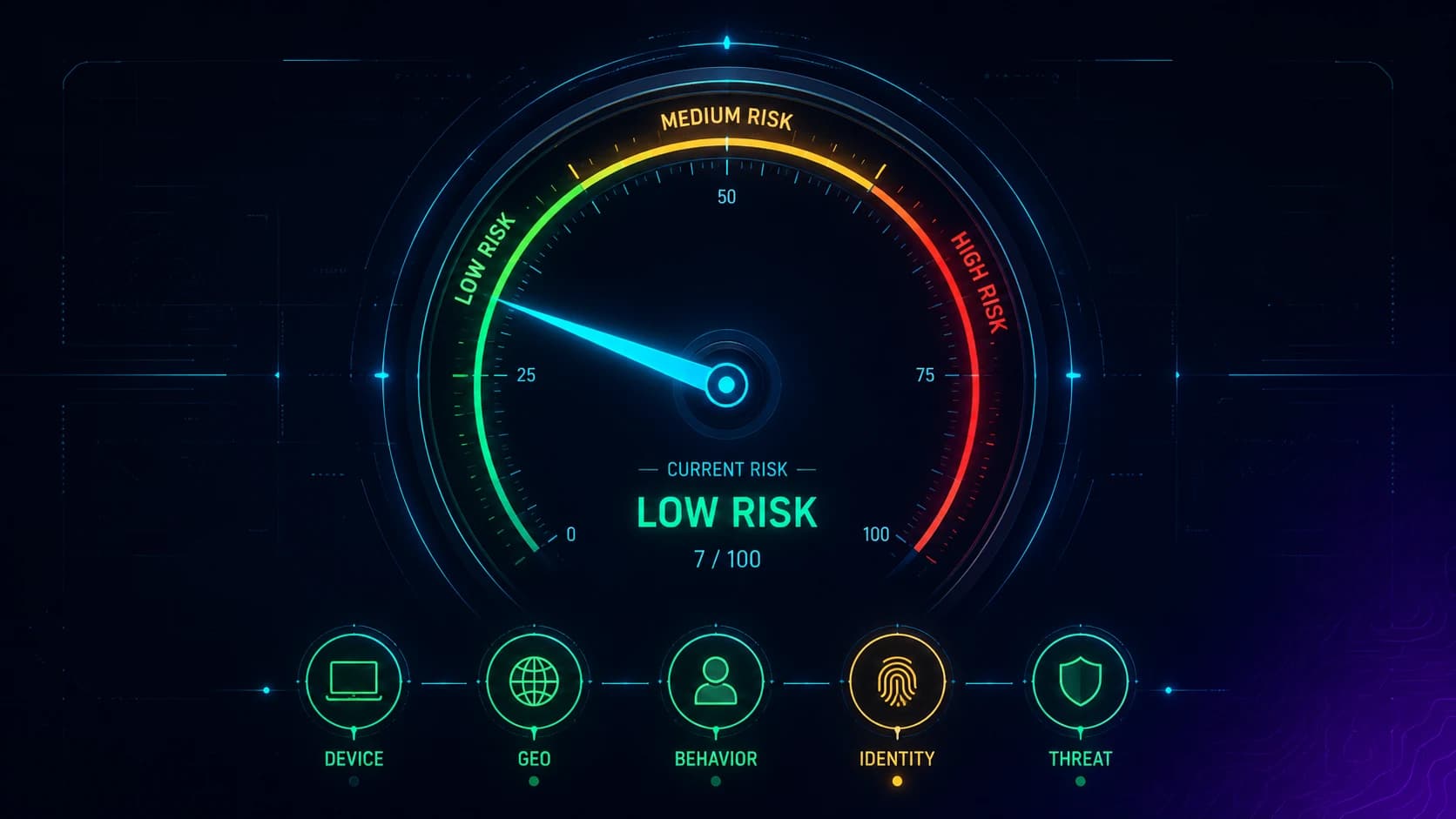
Adaptive authentication evaluates risk signals at every session and adjusts the authentication requirement to match — stronger MFA when risk is high, frictionless access when risk is low. The 2026 enterprise reference on the signals that actually matter, the architecture that composes risk with phishing-resistant MFA, and where adaptive deployments break.
Authentication architectures that prompt for MFA at every login annoy users into bypass behaviors. Architectures that prompt for MFA only at first login leave the long tail of subsequent sessions unprotected against credential theft. Neither extreme survives enterprise reality. The 2026 architectural pattern that does survive is adaptive authentication — evaluate risk at every session, prompt for additional verification when risk is elevated, allow seamless access when it isn't.
Adaptive authentication has been an analyst category since the mid-2010s and a feature category in most major IdP products since 2018-2020. What changed in 2026 is the breadth and quality of the risk signals available. Device posture signals from MDM platforms are richer than they were five years ago. Behavioral biometrics have improved enough to feed risk decisions at the millisecond layer. Threat-intelligence feeds (credential-stuffing patterns, MFA fatigue attempts, OAuth consent-grant abuse, federation-broker anomalies) provide pattern signals that didn't exist before. And the regulatory framing — CISA's "phishing-resistant MFA" guidance, NIST 800-63B Rev. 4's continuous-authentication patterns, Executive Order 14028's risk-based federal access requirements — pulled adaptive authentication from "nice to have" to "expected baseline."
This piece is the 2026 enterprise reference on adaptive authentication and risk-based MFA. The companion pieces handle adjacent territory: Phishing-Resistant MFA covers the credential layer adaptive systems compose with, MFA Fatigue Attacks covers one of the threats adaptive logic specifically defends against, the Identity Threat Detection and Response piece covers the detection layer that feeds adaptive signals, and Authentication vs Authorization covers the conceptual framework. This piece is the adaptive-specific layer.
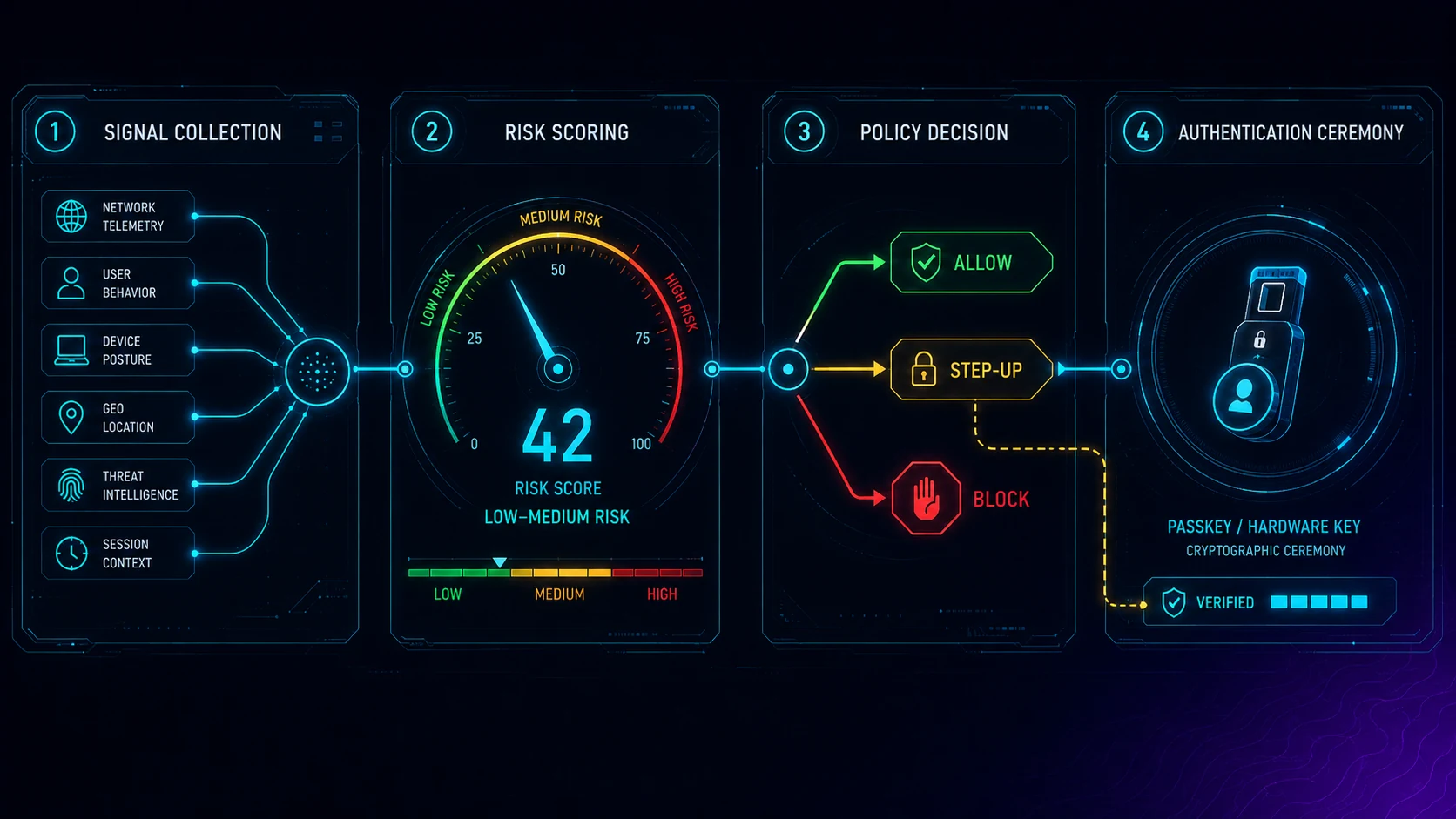 Four operational stages, one decision per session. Signal collection feeds risk scoring, scoring feeds policy decision, policy decision triggers (or doesn't) an authentication ceremony. Most sessions traverse the flow invisibly.
What adaptive authentication actually does, mechanically
Adaptive authentication has four operational stages that fire at every session establishment (and at progressively more checkpoints during the session as continuous-authentication patterns mature).
Stage 1: Signal collection. The authentication system collects context about the session before evaluating the risk. Device posture (managed/unmanaged, compliance state, OS version, jailbreak detection). Geographic context (sign-in location, GeoIP, ISP/ASN reputation). Network context (corporate VPN, residential ISP, mobile carrier, proxy/Tor exit). Identity context (recent authentication history, current role assignment, lifecycle stage). Behavioral context (if behavioral biometrics are enabled — keystroke dynamics, mouse patterns, scroll behavior). Threat intelligence (credential-stuffing pattern match, breach-corpus credential match, IP reputation flags, recent threat-feed entries).
Stage 2: Risk scoring. The risk engine combines the collected signals into an aggregate risk score. Most major IdPs use a numeric scale (0-100 in Microsoft Entra ID Identity Protection, low/medium/high in Okta ThreatInsight, similar patterns elsewhere). The scoring algorithms are typically vendor-proprietary, blending rule-based heuristics with machine-learning models trained on cross-tenant attack patterns. The scoring is per-session and per-user — the same user authenticating from different contexts gets different scores; the same context applied to different users may get different scores based on user-specific baselines.
Stage 3: Policy decision. A conditional-access policy maps the risk score to an authentication requirement. Low risk → proceed with standing credential (often platform passkey, syncable passkey, or recent MFA approval). Medium risk → require step-up MFA at higher assurance level (hardware FIDO2 key, biometric-unlocked passkey with recent enrollment). High risk → block, require workflow-verified recovery, or escalate to human review. The policy mapping is enterprise-configurable; the most common 2026 default is to allow low-risk to proceed, require step-up at medium, and block at high — but many enterprises tune this based on industry, regulatory requirement, and threat profile.
Stage 4: Authentication ceremony (when triggered). When the policy demands step-up authentication, the user is redirected through the appropriate ceremony — present hardware key, complete biometric unlock, approve via authenticator app with number matching. The result is an updated session with a fresher authentication context and (sometimes) a higher acr (authentication context class) value that downstream applications can see and respect. Step-up doesn't replace the standing authentication; it augments it for the specific session.
The four stages compose into an architecture where most user sessions experience no additional friction (because most sessions are low-risk), and the small subset that are genuinely high-risk get the elevated scrutiny that catches actual attacks. The productivity-vs-security tradeoff that uniform MFA forces is replaced with risk-proportional friction.
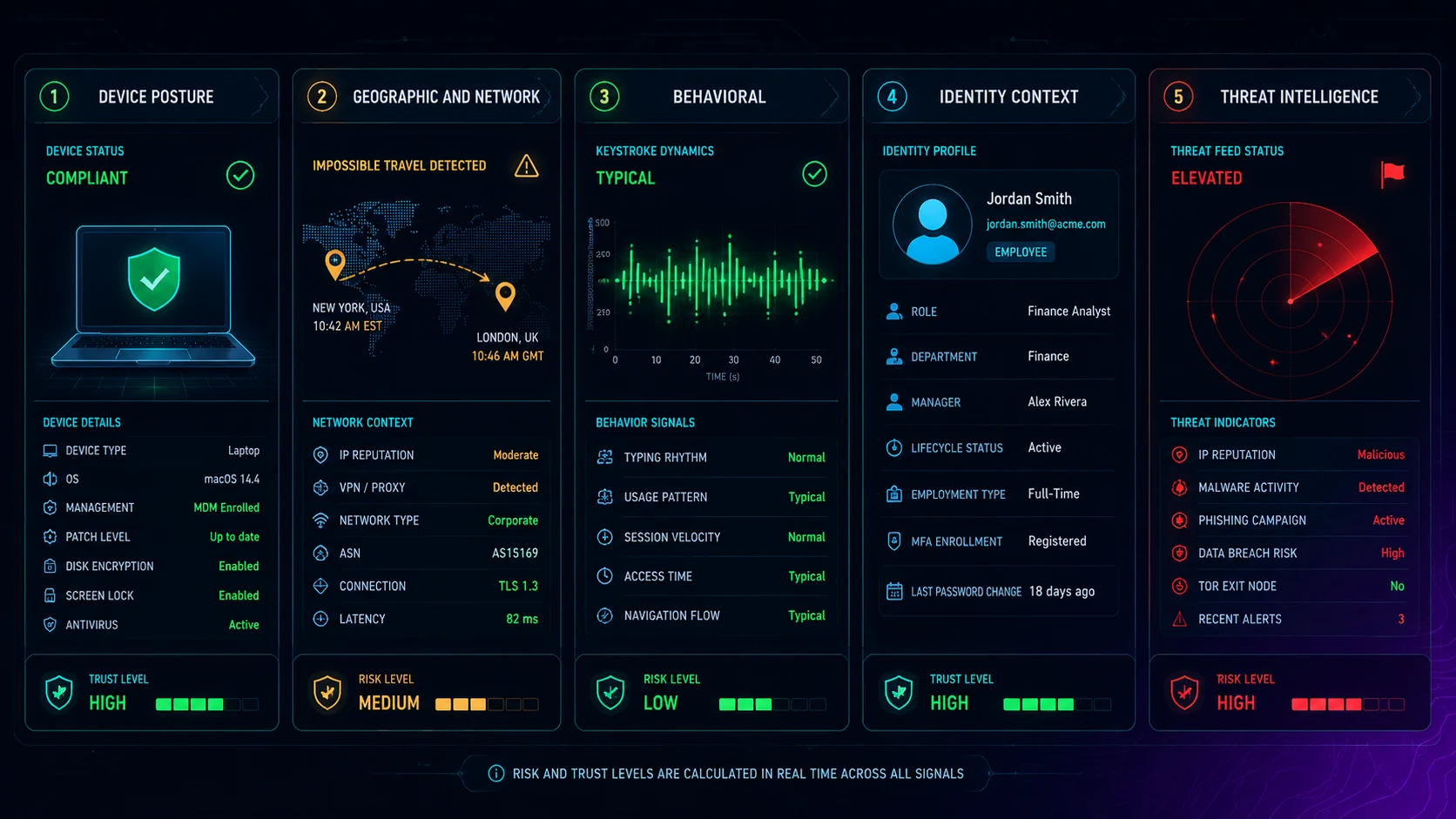 Five categories of signal, every session. Each panel shows a current evaluation in isolation; the policy engine combines them into the aggregate risk profile that drives the adaptive decision.
The five signal categories that matter operationally
Enterprise adaptive authentication deployments in 2026 produce useful risk signal coverage across five categories. The relative importance varies by industry and threat profile, but the five categories are consistent.
Device posture signals. The richest source of risk signal in most 2026 deployments. Managed-device telemetry from Intune, Jamf, Workspace ONE, or equivalent MDM platforms feeds the IdP with compliance state (is the device enrolled, is the OS at the patched baseline, is disk encryption enabled, is the EDR agent running, has the device been flagged for compromise). Unmanaged devices appear in the signal stream with limited posture data, which is itself a signal — unmanaged devices are higher-risk by default. The architectural test is whether the IdP actually consumes the MDM signal stream in real time; many enterprises have MDM deployed but haven't wired the posture signal into the IdP's risk evaluation.
Geographic and network signals. Sign-in location, impossible-travel detection (the user authenticated from New York 10 minutes after Madrid — physically impossible), IP reputation against known abuse databases, ASN reputation (sign-ins from hosting-provider IPs are higher-risk than residential ISP IPs), proxy and Tor exit detection. These signals are widely deployed and reasonably well-calibrated. False-positive risk is bounded — corporate VPN exits sometimes trigger geographic anomaly flags; the policy should allow-list known corporate VPN ranges.
Behavioral signals. Keystroke dynamics (typing rhythm, error rate, pause patterns), mouse-movement patterns (cursor trajectory, scroll velocity, click timing), session navigation patterns (which pages the user visits in which order). Behavioral signals are the experimental frontier — 2026 deployments are usable but not yet as accurate as device or geographic signals. The 2026 pattern is to use behavioral signals as a contributing factor to the aggregate risk score, not as a sole-factor decision input. False-positive rate for behavioral biometrics is still too high for sole-factor use; as a contributing signal feeding the aggregate score, the value is meaningful.
Identity-context signals. Recent authentication history (when did this user last authenticate, with what factor, at what assurance), current lifecycle state (recent joiner, role change, certification renewal), behavioral baseline (does this user typically sign in at this hour from this device class), permission scope (does this user normally access this resource). Identity-context signals depend on the IGA layer providing authoritative ground truth — without strong IGA, identity-context risk evaluation produces noise rather than signal. Our Best IGA Solutions buyer's guide covers the governance layer this depends on.
Threat-intelligence signals. Credential-stuffing pattern detection (many accounts attempted from a single source), password-spray detection (one password against many accounts), MFA fatigue pattern detection (rapid repeated push prompts), breach-corpus credential match (the user's password was recently disclosed in a breach), federation-broker anomaly (unusual SAML/OIDC patterns suggesting compromise), OAuth consent-grant abuse (illicit application authorization patterns). Threat-intelligence signals are increasingly powerful because cross-tenant attack patterns surface here that no single tenant could see alone. Major IdP vendors with broad customer bases (Microsoft Entra ID, Okta) have substantial threat-intelligence depth; smaller IdPs depend on third-party feeds.
The five signal categories compose into a risk profile per session. Most sessions score low across all five (managed device, familiar geography, normal behavior, healthy identity context, no threat-feed match). The sessions that score elevated across one or more categories are the ones adaptive logic intervenes on.
Where adaptive authentication breaks in 2026 production
Adaptive deployments have predictable operational breakage modes. Knowing them in advance is the difference between an adaptive deployment that ships value and one that produces noise.
False positives that train users to ignore the signal. If adaptive authentication triggers step-up too often on benign signals — corporate VPN making sign-ins look geographically anomalous, a user traveling to a new office, a managed laptop replacement triggering "new device" — users learn to dismiss the step-up prompts without reading them. This trains exactly the behavior that defeats the adaptive value. The mitigation is calibrating signal weights conservatively at first, allowlisting known-benign patterns (corporate VPN exit ranges, IT-issued device replacements, planned office travel), and tuning the score thresholds based on actual false-positive rates rather than theoretical ideals.
Signal-source gaps. Adaptive authentication is only as good as the signals it receives. Enterprises with multiple IdPs (a primary plus legacy holdovers), unmanaged devices in the workforce, contractor populations not under MDM, or no behavioral-biometric collection have signal gaps that reduce adaptive coverage. The 2026 pattern is to acknowledge the gaps explicitly — adaptive policies should fail-closed (require step-up) on sessions where critical signals are missing, not fail-open (assume low risk).
Recovery-channel blind spots. Adaptive authentication evaluates risk at session establishment but typically doesn't evaluate the recovery channel with the same rigor. An attacker who can defeat a user's standing authentication via social-engineering the help-desk into a credential reset bypasses adaptive logic entirely — the recovery establishes a new "legitimate" authentication that adaptive evaluation will respect. The mitigation is wiring workflow-verified recovery (the Storm-2949 mitigation pattern) into the adaptive policy framework so recovery events themselves trigger elevated scrutiny.
User-experience cliff edges. Some adaptive policies produce binary outcomes (allow vs deny) that frustrate legitimate users when the policy denies on borderline signals. The 2026 pattern is to use graduated responses — instead of binary allow/deny, the policy can require step-up MFA, restrict session scope, require workflow approval, or escalate to human review. Graduated responses preserve legitimate access while raising the bar for genuine attacks.
Compliance-vs-security tension. Adaptive authentication processes biometric and behavioral data that has privacy implications under GDPR, CCPA, Illinois BIPA, and EU works-council requirements. Some jurisdictions require explicit opt-in for behavioral biometric collection, alternative paths for biometric-objecting employees, and explicit purpose-limitation documentation. The 2026 deployment pattern is to bring legal/compliance into the adaptive deployment from the start — and to design the policy stack so that biometric and behavioral signals are recoverable-from-failure (the policy still works if biometric signals are unavailable for a specific user population).
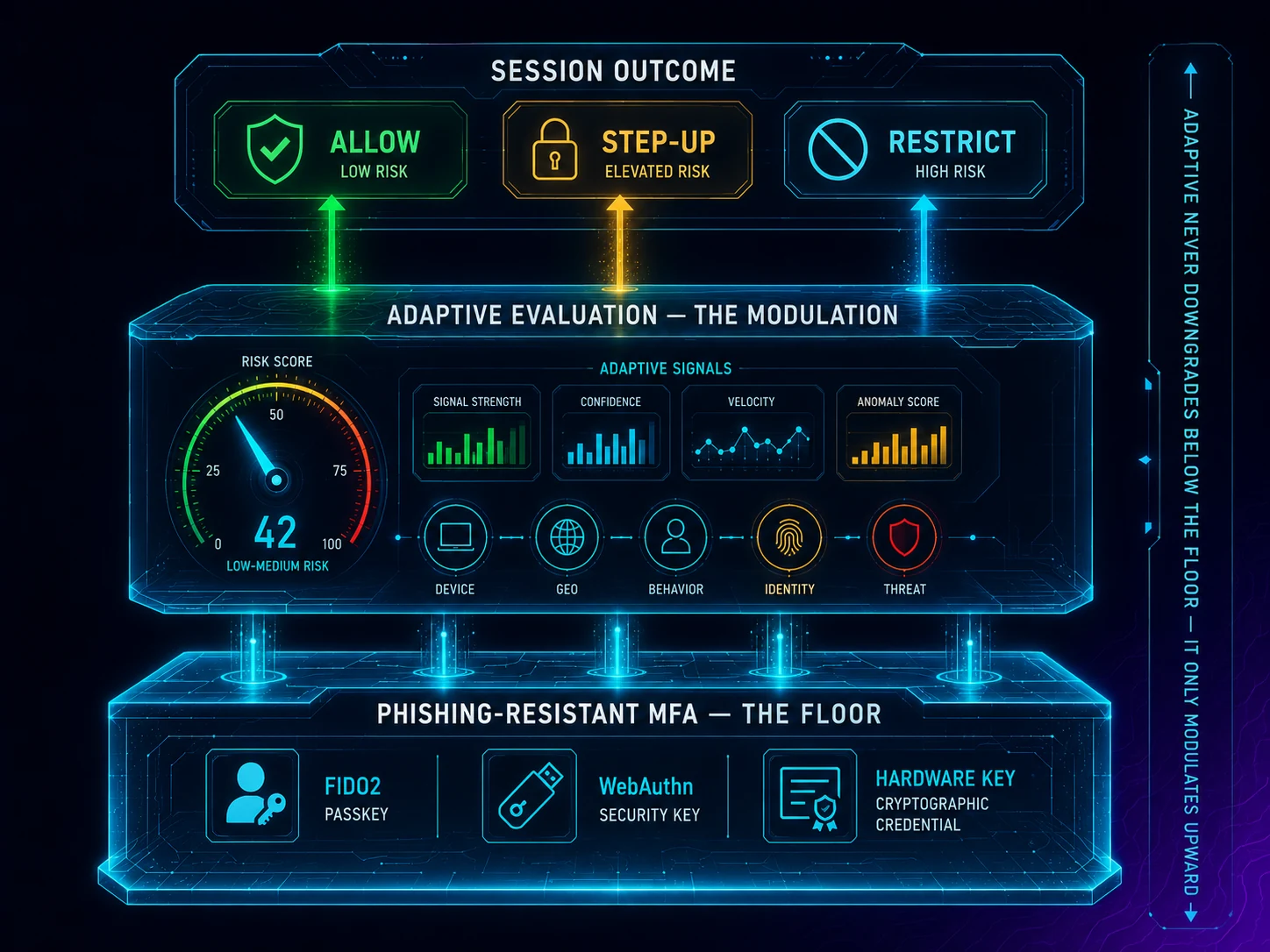 The composition that works. Phishing-resistant MFA is the floor adaptive logic builds on, not a feature adaptive logic can downgrade past. The modulation only goes up.
The architecture that composes adaptive with phishing-resistant MFA
The cleanest 2026 enterprise architectures compose adaptive authentication with phishing-resistant MFA as complementary layers, not competing ones. The pattern has four operational properties.
Property 1: Phishing-resistant MFA is the floor, adaptive is the modulation above it. Every user authenticates with phishing-resistant credentials (passkey, hardware key, or deviceless FIDO2 card). Adaptive logic doesn't downgrade below this floor — it modulates the requirement upward when risk is elevated (step up from syncable passkey to hardware key for high-risk sessions). The architectural separation matters because adaptive logic without phishing-resistant base is structurally weaker — an attacker can defeat adaptive evaluation via many paths if the credential floor is SMS OTP or push-with-approval.
Property 2: Risk signals are evaluated continuously, not just at session establishment. The 2026 pattern is to re-evaluate risk at meaningful checkpoints during a session — when accessing privileged resources, when the device posture changes, when behavioral signals shift, when threat intelligence flags the session. The conditional access policy can issue mid-session step-up challenges or session-scope restrictions in response to changing risk. The continuous-authentication pattern that NIST 800-63B Rev. 4 documents is the formal version of this.
Property 3: Step-up flows are wired through the standard authentication ceremony. When adaptive policy requires step-up, the user is redirected through the IdP's authentication flow with acr_values specifying the required context (hardware key, recent biometric unlock, workflow-verified). The IdP runs the ceremony; the updated session token reflects the fresher authentication. Step-up doesn't create a separate authentication path — it uses the same FIDO2/WebAuthn ceremony as the original session, just with stricter requirements.
Property 4: Recovery channels get the same adaptive evaluation as standing authentication. When a user initiates account recovery, the recovery flow itself triggers adaptive evaluation. Recovery from a known device with familiar context proceeds normally; recovery from anomalous context requires workflow-verified verification through the help desk. The Storm-2949 mitigation pattern composes with adaptive logic — recovery events are the highest-risk authentication events, and the policy should reflect that.
The four properties together produce an architecture where adaptive evaluation feels invisible to legitimate users in normal contexts and decisive against actual attack patterns. The architectural test is whether the policy framework actually composes the four — many adaptive deployments get phishing-resistant MFA and adaptive logic both deployed but never integrated, with the result that adaptive policies sometimes downgrade authentication strength rather than augmenting it.
What Avatier ships toward this pattern
Avatier Identity Anywhere implements adaptive authentication through risk-based conditional access policies that evaluate the standard five signal categories at every session establishment (and at configurable continuous-authentication checkpoints during the session). The policy engine composes with phishing-resistant MFA at the credential layer — FIDO2/WebAuthn passkeys for desk workers, hardware FIDO2 keys (YubiKey, Feitian, Token2, Google Titan) for privileged accounts, and the Avatier Identity Challenge Card for workforce segments where personal devices and managed laptops structurally don't fit (frontline shared workstations, contractor populations without MDM coverage, defense facilities where phones aren't viable).
The integration with Avatier Identity Anywhere Lifecycle Management provides the identity-context signals adaptive evaluation depends on — recent role changes, certification status, current lifecycle state, role-of-record from HRIS. The integration with the ITDR layer (documented in our ITDR piece) provides the threat-intelligence signal stream. Recovery flows tie through Password Station for workflow-verified resets, closing the Storm-2949 social-engineering vector with the same adaptive policy framework.
The platform exposes per-policy configuration of signal weights and score thresholds, so the enterprise can tune false-positive rates against actual deployment experience. The conditional access framework supports graduated responses (allow, step-up, restrict-scope, workflow-approval, deny) rather than binary outcomes, which preserves user experience for legitimate borderline sessions while still raising the bar against attacks.
The Avatier Trust Center publishes our compliance posture (SOC 2 Type II zero exceptions, ISO/IEC 27001:2022, PCI DSS v4.0.1, CSA STAR Level 1, NIST 800-53 Rev. 5 aligned, CISA Secure-by-Design Pledge signatory). The architectural pattern works regardless of vendor — the point of this piece is not that you have to buy Avatier — but the integrated pattern of phishing-resistant MFA + adaptive risk evaluation + lifecycle-context signals + ITDR threat intelligence + workflow-verified recovery is what separates an enterprise that has actually deployed adaptive authentication from one that has merely enabled a risk-based MFA toggle.
The honest closing
Adaptive authentication in 2026 is the architecture that makes authentication friction proportional to risk rather than uniform. The five signal categories — device posture, geographic context, behavioral patterns, identity context, threat intelligence — combine into a per-session risk profile that the conditional access policy maps to graduated authentication responses. The pattern composes with phishing-resistant MFA at the credential layer, with adaptive serving as the modulation above the floor that phishing-resistance establishes. Most enterprise sessions experience no friction because most sessions are genuinely low-risk; the sessions that score elevated get the targeted scrutiny that catches actual attacks. The enterprises that get this composition right will have a meaningfully better user experience AND a meaningfully stronger security posture than uniformly-strong-friction architectures. The enterprises that deploy adaptive logic without the phishing-resistant floor underneath will end up with adaptive policies that protect against fewer attacks than the marketing suggested.
About the author

More from MFA & Authentication
How Cybercriminals Exploit Weak OTP: The Attacker Playbook (2026)
Weak OTP fails at four specific points — SIM swap, real-time phishing relay, SS7 interception, and MFA fatigue — and every one of them is a known, repeatable attacker technique in 2026.

Advanced MFA in 2026: What Actually Counts as a Factor
Multi-factor authentication only works when the factors are genuinely different — this 2026 reference clears up what counts as a real factor and what advanced MFA actually means.
Does OTP Prevent Breaches? The Attacks It Actually Stops in 2026
OTP does not stop every attack, but it reliably defeats credential stuffing, password-spray, basic brute force, and stolen-password reuse from unrelated breaches. The 2026 breach-prevention case for OTP — the attack chains it breaks, the ones it doesn't, and how to deploy it so the prevention benefit actually lands.