Biometrics in Sci-Fi Movies: A 2026 Reality Check
For sixty years, sci-fi has been showing us biometric authentication — palm scans, retinal lasers, voice prompts, faces unlocking doors. Now most of us authenticate with biometrics every morning before we've finished our coffee. What did sci-fi get right, what did it get hilariously wrong, and what does workforce biometric authentication actually look like in 2026?
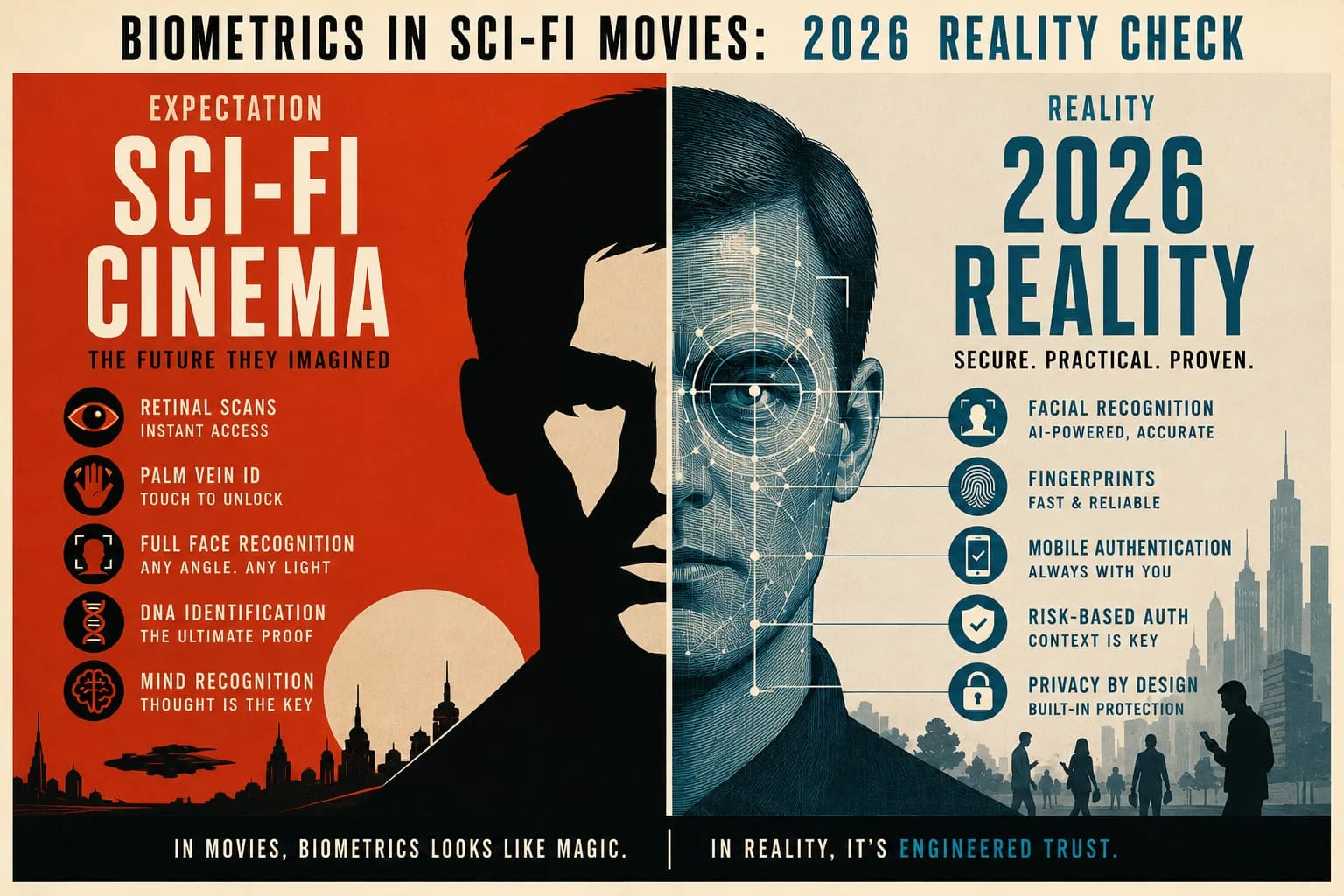
For sixty years, sci-fi has been showing us biometric authentication — palm scans, retinal lasers, voice prompts, faces unlocking doors. Now most of us authenticate with biometrics every morning before we've finished our coffee. What did sci-fi get right, what did it get hilariously wrong, and what does workforce biometric authentication actually look like in 2026?
- Sci-fi has been showing us biometric authentication for six decades — Star Trek voice prompts, Blade Runner Voigt-Kampff testing, Minority Report iris scanning, Demolition Man thumbprints, Her voice-bound ambient identity. Most of us now authenticate with biometrics every morning before we've finished coffee.
- What sci-fi got right: ubiquity (biometrics ARE everywhere now), seamlessness (touch and go, no PIN), centrality to enterprise identity, and the basic shape of the user experience — your body becomes the credential.
- What sci-fi got wrong: the dramatic infrastructure (no laser-scanning portals; it's all phone-based), the assumption of mandatory biometric (consent and opt-out matter), the absence of cryptographic ceremonies (real biometrics are FIDO2 cryptography, not pattern-matching), and the lack of multi-factor composition (real systems use biometric PLUS another factor, almost never biometric alone).
- Workforce biometric authentication in 2026 is mostly built into devices people already have — Touch ID on iPhone, Face ID, Windows Hello, the Galaxy Ultrasonic Sensor, biometric-unlocked passkeys synced through iCloud and Google Password Manager. The deviceless edge — frontline, healthcare, manufacturing, defense — is covered by hardware FIDO2 keys and the Avatier Identity Challenge Card.
- The serious enterprise treatment of biometric authentication lives in our [Biometric Authentication Workforce MFA piece](/en/blog/biometric-authentication-workforce-mfa-2026/) — this piece is the cultural counterpart. Both pieces converge on the same answer: the future sci-fi promised has mostly arrived, just with way fewer lasers.
For sixty years, sci-fi has been showing us biometric authentication. Star Trek's voice prompts to the ship's computer. Blade Runner's Voigt-Kampff test for replicant detection. Minority Report's predictive iris scanning at retail kiosks. Mission: Impossible's retinal locks on every facility door. Demolition Man's thumbprint-keyed cryogenic chambers. Her's voice-bound ambient identity that knew you before you spoke. The cinematic vision was consistent across decades and genres: your body becomes the credential, the system recognizes you instantly, no PIN, no password, no friction.
Now most of us authenticate with biometrics every morning before we've finished our first cup of coffee. We unlock the phone with our face or thumbprint. We sign into the laptop with Windows Hello or the Touch Bar. We log into corporate SSO with a biometric prompt that takes about two seconds. The future sci-fi promised has mostly arrived — just with substantially fewer lasers, dramatically less ominous music, and a notable absence of self-destructing facility access cards.
This piece is the cultural counterpart to our serious technical treatment of workforce biometric authentication. The Biometric Authentication Workforce MFA piece covers the architecture, the cryptographic protocols, the deployment patterns, the regulatory framing. This piece is the fun version — what sci-fi imagined, what 2026 actually delivered, where the two visions converge and where they diverge, and what the experience looks like from the inside of a workforce that's been quietly living in the sci-fi future for several years now.
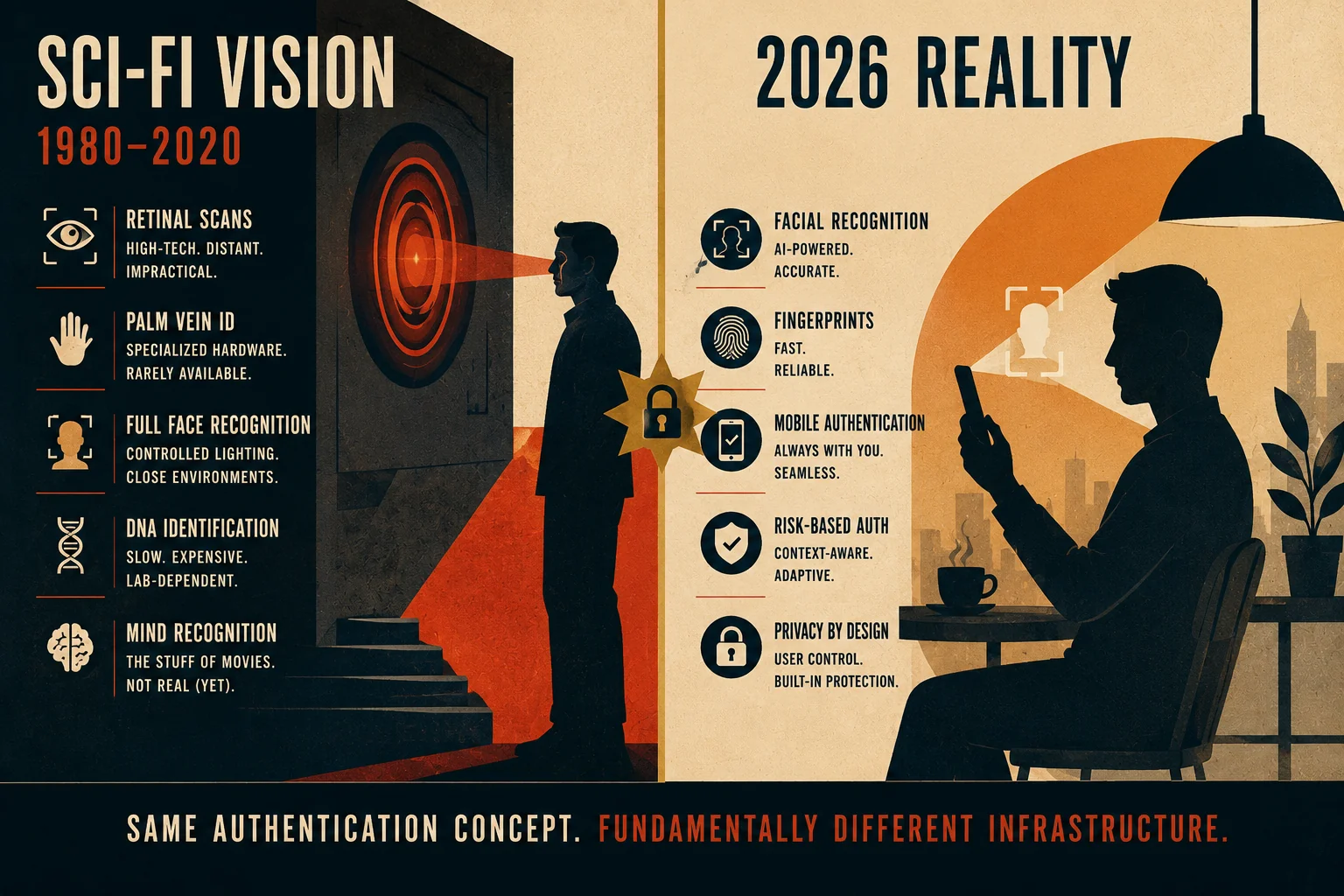 Sixty years of cinematic vision. Two seconds of 2026 reality. The basic shape was right; the infrastructure looks nothing like the movies promised.
A brief tour of biometric authentication in cinema
Six decades of sci-fi cinema have shown us biometric authentication in remarkable variety. A non-exhaustive tour, with commentary on what each got mostly right (✓) or hilariously wrong (✗):
Star Trek (1966–present). "Computer, identify." Voice-based authentication, ambient AI presence, no enrollment ceremony visible. ✓ Got the voice-as-credential direction right; voice biometrics are operational in 2026 (less common than fingerprint or face, but real). ✗ Got the lack of authentication challenge wrong — real voice systems require a specific phrase or short sample, not arbitrary commands; "Computer" alone isn't sufficient.
Blade Runner (1982) / 2049 (2017). The Voigt-Kampff test — not exactly biometric but a behavioral-affective identity check designed to distinguish replicants from humans. ✓ Got the behavioral-biometric direction right; modern systems use keystroke dynamics, mouse patterns, and behavioral baselines as risk signals. ✗ Got the time required wrong — Voigt-Kampff took 20+ minutes of focused interrogation; behavioral biometrics in 2026 happen passively in the background over thousands of micro-events.
Demolition Man (1993). Thumbprint authentication on the cryogenic chambers, on the credit chips, throughout the future Los Angeles. ✓ Got the ubiquity right — thumbprint sensors are now in every smartphone. ✗ Got the storage wrong — the film implied a centralized thumbprint database; modern systems store biometric templates locally on the user's device and never transmit them.
Mission: Impossible (1996–present). Retinal locks on every facility door, palm prints on every elevator, every Mission: Impossible action sequence involves Tom Cruise defeating a biometric system through some combination of contact lenses, latex molds, and dramatic music. ✓ Got the high-security-facility direction right; defense and intelligence environments do use retinal scanning. ✗ Got the defeat patterns wrong — modern biometric systems include liveness detection that defeats the contact-lens and latex-mold attacks the films relied on, and the cryptographic backing means even successful biometric spoofing wouldn't produce a valid authentication.
Gattaca (1997). DNA-based identity for every aspect of life — workplace authentication, public-space access, social stratification. ✓ Got the "biometric becomes destiny" warning right — the film's social-commentary about biometric-based discrimination remains relevant. ✗ DNA-based real-time authentication still doesn't exist in 2026; the analysis takes hours to days, not the seconds Gattaca implied.
The Fifth Element (1997). Fingerprint and retinal scanning throughout the future cityscape, casually integrated into commerce and transportation. ✓ Got the casual integration right; biometric payment (Apple Pay with Face ID, Google Pay with fingerprint) is now table stakes. ✗ The hand-wave on biometric privacy was real — and twenty-five years later, the regulatory framing (GDPR, BIPA, CUBI) has caught up.
Minority Report (2002). Predictive retinal scanning at retail kiosks, public-space surveillance, eyeball-replacement to evade tracking. ✓ Got the surveillance dimension right (though most 2026 enterprise environments specifically avoid this pattern for compliance reasons). ✗ Got the surgical eyeball swap completely wrong; the kind of person who would do that is the kind of person whose other biometric markers would already flag them at any system relying on multi-modal identity.
Total Recall (1990 and 2012). Fingerprint authentication on the Rekall booth, voice and palm prints on Martian transit systems. ✓ Got the multi-modal direction right; modern systems combine biometric factors. ✗ The 1990 version's fingerprint sensors were extraordinarily generous about what counted as a match — real sensors would reject Schwarzenegger's prosthetic finger in milliseconds.
Her (2013). Voice-bound ambient identity. The AI recognizes Theodore through voice and conversational pattern, no explicit authentication ceremony visible. ✓ Got the ambient-AI direction right; many 2026 systems support behavioral-baseline authentication where the user's pattern of interaction provides continuous identity signal. ✗ Got the security model wrong — pure voice/behavioral authentication without cryptographic backing is operationally too risky for enterprise; real systems compose ambient signal with strong cryptographic ceremonies.
The Matrix (1999). Plug-in identity, neural-direct authentication. ✓ Sci-fi got the direction right in a generalized way — modern systems do bind authentication to specific hardware that the user controls. ✗ Brain-computer-interface authentication remains firmly sci-fi in 2026; some experimental work, no production deployments.
Black Mirror (TV, 2011–present). Episode after episode of biometric authentication taken to dystopian extremes — social credit scores tied to facial recognition, ocular implants that monitor every interaction, voice prints used for blackmail. ✓ Got the surveillance-creep direction uncomfortably right; the regulatory frameworks emerging in the late 2020s exist partly because the Black Mirror scenarios stopped feeling like fiction. ✗ Most enterprise environments deliberately don't deploy the surveillance patterns Black Mirror depicts; the operational architecture in mature 2026 deployments emphasizes consent, opt-out, and limited-scope data collection.
Ex Machina (2014). Biometric admission to Nathan's facility through a single keycard that monitors the user's location and locks behind them. ✓ Got the badge-plus-biometric pattern right; modern access-control systems compose physical credential with biometric verification. ✗ The single-card-controls-everything pattern is operationally fragile and not what 2026 enterprise deployments use.
Ready Player One (2018). VR-bound identity tied to haptic suits and full-body authentication. ✓ Got the multi-modal embodied direction right; experimental work in 2026 includes biometric authentication tied to specific VR headsets, gait analysis, and hand-pattern matching. ✗ The seamless instant authentication remains aspirational; current VR auth is still primarily passkey-based with biometric unlock.
The pattern across the list: sci-fi consistently got the direction right (biometrics will be ubiquitous, will compose with other factors, will become the everyday authentication experience) and consistently got the infrastructure and security model wrong (no laser portals, no centralized databases, cryptographic ceremonies rather than pattern-matching, multi-factor composition rather than biometric-alone).
What 2026 enterprise biometric authentication actually looks like
The mundane truth is that workforce biometric authentication in 2026 is mostly built into devices people already have. The transformation happened gradually enough that most users barely noticed when biometrics became their primary authentication factor.
The platform-biometric era. Touch ID arrived in 2013, Face ID in 2017, Windows Hello in 2015. Each platform added biometric capabilities to devices users were already buying for other reasons. By 2026, every modern smartphone, laptop, and tablet has biometric authentication built in. The user experience is "touch the sensor" or "look at the camera"; the underlying ceremony involves the device-local secure element verifying the biometric match, unlocking a cryptographic key, and signing an authentication challenge that the IdP validates.
Passkeys synced through the OS. Apple's iCloud Keychain, Google Password Manager, and Microsoft's passkey synchronization handle the cross-device passkey distribution. A user enrolls a passkey on their iPhone for a corporate app; the same passkey becomes available on their iPad, Mac, and (with the appropriate cross-platform bridge) their Windows laptop. The biometric unlock happens per-device; the credential is portable across the user's ecosystem.
Hardware FIDO2 for higher assurance. YubiKey, SoloKey, Feitian, and similar hardware tokens remain the strongest credential class. The biometric on these devices (some have integrated fingerprint sensors) provides on-device user verification; the cryptographic signing happens in the hardware. Enterprise environments that need AAL3-class assurance deploy these for privileged users, executives, and developers with production access.
The deviceless edge: the Identity Challenge Card. The segment sci-fi never imagined — workforce users who can't carry a smartphone or hardware key for legitimate operational reasons. Manufacturing floor operators whose hands are dirty or in gloves. Healthcare clinicians who can't bring devices into sterile environments. Defense workforces in classified spaces where personal electronics are prohibited. Frontline retail workers whose corporate policy doesn't issue them devices. The Identity Challenge Card provides FIDO2 cryptographic authentication in a card form factor — the user taps the card to a reader, the cryptographic ceremony completes, the user is authenticated. No phone, no key, no laser-scanning portal. Just a card.
Behavioral biometrics as a layer. Keystroke dynamics, mouse-movement patterns, scroll velocity, session navigation patterns. These signals feed the adaptive authentication and continuous authentication layers covered in our Adaptive Authentication piece and Continuous Authentication piece. The behavioral signal isn't a primary authentication factor in most deployments; it contributes to the risk score that drives step-up decisions.
The composition is what produces the 2026 user experience. Platform biometric on the device, FIDO2 cryptography on the wire, passkeys synced across the user's ecosystem, hardware keys for higher assurance, the Identity Challenge Card for deviceless segments, behavioral biometrics for ongoing assurance. The user touches a sensor or looks at a camera; substantial cryptographic infrastructure does the rest invisibly.
Where sci-fi got it right
Three things sci-fi nailed despite the dramatic license.
Ubiquity. The cinematic vision of biometrics as universal authentication — at the workplace, at the bank, at the store, at the home, on every device — has substantially arrived. The average 2026 workforce user authenticates with biometrics dozens of times per day across personal and professional contexts. Sci-fi pictured this happening at dramatic kiosks; reality delivered it in pockets.
Seamlessness. The "no PIN, no password, walk up and you're recognized" experience that sci-fi consistently depicted matches what 2026 platform biometrics actually deliver. The user looks at the camera or touches the sensor; access happens. The cognitive load of authentication has dropped dramatically from the password era. Sci-fi promised this; the smartphone era delivered it.
Centrality to identity. Sci-fi consistently positioned biometric authentication as central to who-you-are-as-recognized-by-systems. That framing has held up. In 2026, the biometric stack is the gateway to an extraordinarily large share of digital identity — workplace access, financial transactions, government services, healthcare, communications. The centrality sci-fi imagined is real, even if the infrastructure looks different.
Where sci-fi got it hilariously wrong
Four things sci-fi missed by remarkable margins.
The infrastructure. No 2026 enterprise has laser-scanning retinal portals at the front entrance. No facility-wide palm-print readers at every elevator. No dramatic ceiling-mounted biometric apparatus. The infrastructure is the device in the user's pocket plus the cryptographic protocol over the network. Sci-fi production designers had to invent dramatic visual props for an authentication experience that, in practice, is invisible. The closest 2026 analogue to the sci-fi vision is the badge reader at the data center door — and even those are mostly NFC chips, not retinal lasers.
The absence of consent frameworks. Sci-fi almost universally depicted mandatory biometric authentication. No opt-out, no consent screen, no privacy framework. The 2026 reality has dramatically more regulatory and ethical infrastructure around biometric collection — GDPR Article 9 in Europe, BIPA in Illinois, CUBI in Texas, the FTC's emerging guidance, state-level statutes in California, New York, Washington. Workforce biometric deployment requires consent, opt-out paths, and bounded data collection. The sci-fi vision of "everyone is biometrically tracked all the time" exists in some surveillance-state futures depicted in fiction, but the mature 2026 enterprise practice is the opposite — minimal data collection, on-device storage, no biometric template ever leaves the user's device.
The lack of cryptographic backing. Sci-fi biometric scenes are essentially pattern-matching: the system has a database of authorized faces or retinas or thumbprints, it compares the incoming biometric to the database, it either matches or it doesn't. Real biometrics in 2026 don't work that way. The biometric unlocks a cryptographic key stored on the device's secure element. The cryptographic key signs an authentication challenge issued by the relying party. The relying party validates the signature against the public key registered during enrollment. The biometric is local; the authentication is cryptographic. The implication is that "spoofing the biometric" doesn't compromise the authentication — even if an attacker somehow obtained the user's face or thumbprint, they'd need physical possession of the device to use it.
The biometric-alone authentication. Sci-fi consistently depicted biometric as the entire authentication. Real systems in 2026 almost never use biometric alone. The standard pattern is biometric + device possession (the biometric unlocks the device, the device performs the cryptographic ceremony, both factors compose into the authentication). Higher-assurance contexts add a third factor (a PIN as fallback for situations where the biometric fails, a hardware key as a separate possession factor, a continuous-authentication signal). The single-factor biometric scenes that drove decades of cinematic drama are operationally not how it works.
The cultural footnote: where this is going
The trajectory from now to whatever's next is increasingly clear. Biometric authentication will become more invisible (the user won't be aware of the biometric ceremony at all in many contexts), more composed with behavioral signal (continuous authentication will increasingly replace point-in-time authentication for routine access), more device-bound (the biometric authenticates the user to the device; the device authenticates to the network), and more regulated (consent frameworks will continue to expand and bind enterprise practice).
What's interesting about 2026 specifically is that the workforce-biometric experience is now mature enough that the cultural vocabulary has shifted. Five years ago, the user-facing language was "use Touch ID" or "use Face ID" — branded, distinct, novel. In 2026, the language is "sign in" — the biometric is the default, the underlying mechanism doesn't need to be named. The cultural shift is what sci-fi was trying to depict: biometric authentication becomes so woven into the experience that talking about it specifically feels weird.
Sci-fi got the destination right. The journey, predictably, looked nothing like the movies.
The serious counterpart
This piece is the cultural treatment. The serious enterprise architecture lives in our Biometric Authentication Workforce MFA piece — the cryptographic protocols, the deployment patterns, the regulatory framing, the operational deployment guidance. Both pieces converge on the same answer: biometric authentication has substantially arrived in the workforce, the user experience is mostly seamless, the underlying architecture is FIDO2 plus device-local biometric verification, and the deviceless edge is covered by the Identity Challenge Card.
If you came for the film list and want the architecture, that's the next click. If you came for the architecture, hopefully the film list at least entertained on the way through.
The future sci-fi promised has mostly arrived. With substantially fewer lasers.
About the author

More from Identity & Access Trends

Identity for AI Agents and Agentic Authentication 2026
AI agents need identities, credentials, and authentication ceremonies of their own — separate from the humans they act on behalf of, separate from the service accounts they're often confused with. The 2026 enterprise reference on the architectures that issue agent identity, the protocols that authenticate them, the delegation chain that keeps user authority intact, and where agentic auth deployments break.
SSO Architecture for Distributed Workforces in 2026
Single Sign-On for a distributed workforce — remote employees, hybrid schedules, contractor populations, partner organizations, and education-sector users — isn't the same problem it was when SSO meant SAML inside a corporate intranet. The 2026 reference on what SSO actually solves, where the architectural breakage modes live, and the federation patterns that survive contact with mixed workforces.
Authentication vs Authorization: The 2026 Enterprise Reference
Authentication proves who you are; authorization decides what you can do. The boundary sounds clean — but the implementation decisions that follow are where most enterprise identity systems break. The 2026 reference on the boundary, the protocols that span it, and the architecture that gets both layers right.