Compliance in a Passwordless Environment: The 2026 Audit Playbook
Going passwordless doesn't automatically satisfy an auditor. Here is what NIST, SOX, HIPAA, and PCI reviewers actually check in a passwordless deployment, and where the evidence gaps show up first.

Going passwordless doesn't automatically satisfy an auditor. Here is what NIST, SOX, HIPAA, and PCI reviewers actually check in a passwordless deployment, and where the evidence gaps show up first.
- Auditors don't grade a passwordless deployment on whether passwords are gone — they grade it on whether the authentication ceremony, enrollment, and recovery flow produce reviewable evidence.
- NIST SP 800-63B's Authenticator Assurance Levels (AAL1-AAL3) are a framework auditors reference to classify authenticator strength; they are not a certification a vendor or deployment can claim to hold.
- The most common audit finding in passwordless rollouts isn't weak authentication — it's a recovery flow, a shared-device exception, or a legacy fallback path that never got brought under the same logging standard as the primary sign-in.
- SOX, HIPAA, and PCI DSS auditors each pull a different evidence slice from the same underlying passwordless architecture — access logs, enrollment records, and factor-strength documentation do double duty across frameworks.
- Removing passwords does not remove the need for audit logging, recovery-flow governance, or lifecycle controls — passwordless changes the authentication method, not the audit obligation.
Auditors don't grade a passwordless environment on whether the passwords are gone. They grade it on whether the authentication ceremony, the enrollment record, and the recovery flow produce evidence a reviewer can independently verify — who authenticated, with what, when, and under whose approval when something went wrong. An enterprise that has removed passwords but can't produce that evidence trail will still fail a SOX, HIPAA, or PCI DSS access-control review, sometimes worse than a password-based environment with mature logging would have. Compliance in a passwordless environment is a documentation and evidence-architecture problem layered on top of an authentication-architecture problem, and the two get conflated constantly.
This is the 2026 update of an earlier Avatier post, Meeting Compliance Requirements in Passwordless Environments. The original leaned on vendor-attributed breach statistics and a head-to-head vendor comparison that don't hold up as a compliance reference — the actual regulatory and audit landscape has also moved since then, with PCI DSS v4.0.1's expanded MFA scope now in force and NIST's assurance-level framework getting cited more precisely in enterprise audits. This piece strips the unverifiable numbers and the vendor-versus-vendor framing and rebuilds around the one thing that holds up across every audit cycle: what a reviewer actually asks for.
How auditors evaluate authentication controls in passwordless deployments
An auditor reviewing a passwordless environment is not evaluating the cryptography — that's implicitly trusted once the method is identified as FIDO2/WebAuthn, a hardware key, or a deviceless card. What gets evaluated is the control's operational integrity: is the authentication method consistently enforced, is enrollment tied to a verified identity, and does every authentication event leave a record that ties back to a specific person, credential, and outcome.
The review typically works backward from a sample of access events. The auditor picks a handful of accounts — often including at least one privileged account and one recently offboarded account — and asks the organization to produce the full authentication trail: when the credential was enrolled, what verification gated that enrollment, every successful and failed authentication attempt in the review window, any recovery or reissuance events, and confirmation that access was revoked on the correct date if the account was terminated. A passwordless deployment that can answer all of this cleanly for a random sample passes. One that has gaps in any link of that chain — an enrollment nobody can explain, a recovery event with no verification record, a terminated account whose passkey was never revoked — gets flagged regardless of how strong the underlying cryptography is.
This is also where the distinction between "phishing-resistant" and "compliant" matters. Our reference on phishing-resistant MFA for enterprise covers what qualifies technically — passkeys, hardware FIDO2 keys, deviceless cards, PIV/CAC. That qualification is necessary but not sufficient for an audit pass; it answers "is this method strong," not "can you prove this method was used correctly, by the right person, every time."
The organizations that struggle most are the ones mid-migration — part of the workforce on passkeys, part still on password-plus-OTP, a scattering of legacy applications that can't support FIDO2 yet. That's a normal, expected state, and auditors don't penalize a migration in progress on its own. What they do penalize is a migration in progress with no documented boundary — no clear record of which accounts, applications, or workforce segments are on which authentication tier, and no plan or timeline for closing the gap. A messy but honestly documented hybrid state passes more often than a "we're basically passwordless now" claim that can't survive a sample pull.
Evidence and audit-trail requirements
The evidence packet an auditor wants from a passwordless environment breaks into four categories, and the gap between organizations that pass cleanly and those that don't is almost always in how completely these four are covered — not in the strength of the authentication method itself.
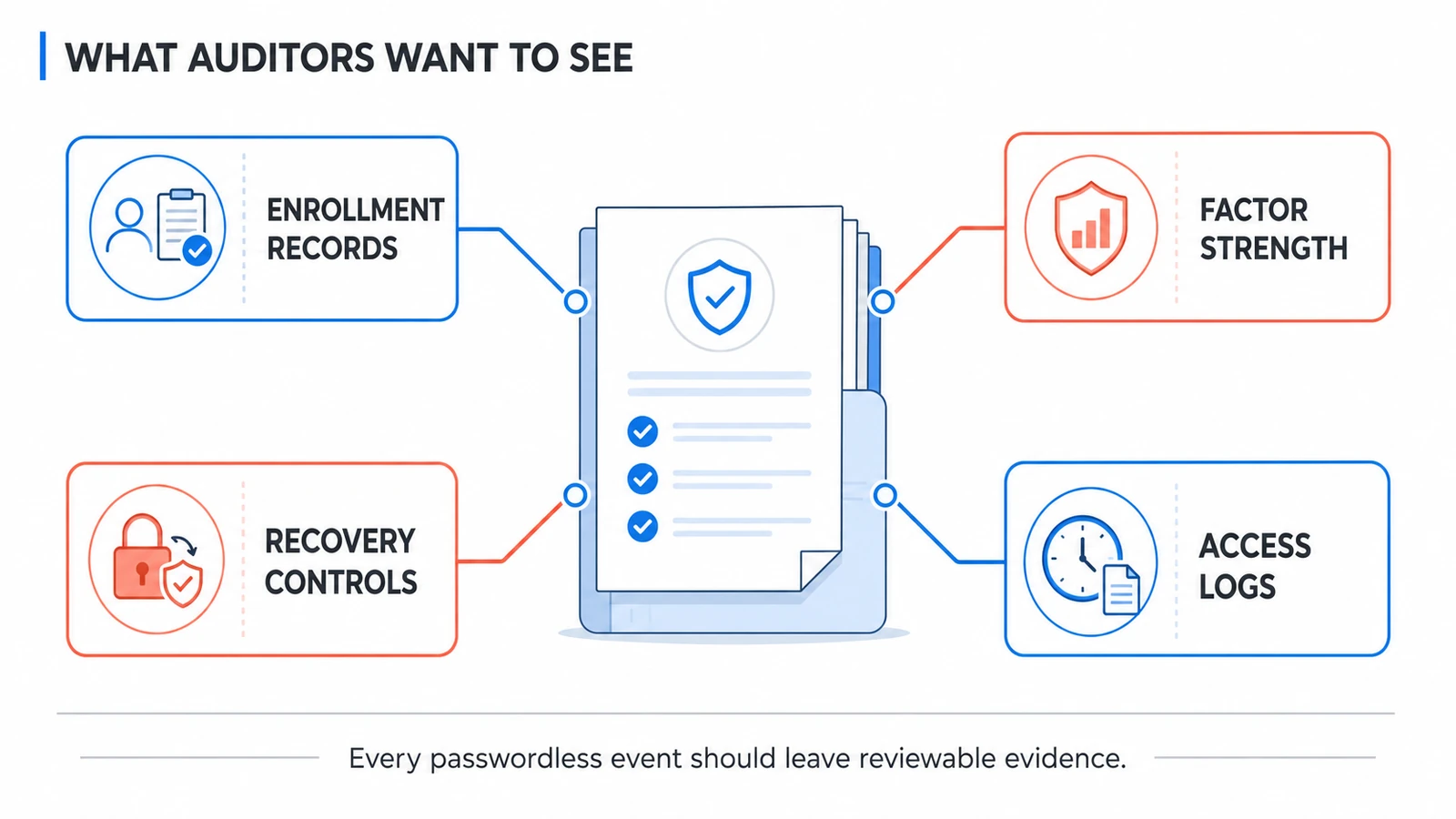 Four evidence categories, one document: enrollment, factor strength, recovery controls, and access logs all have to trace back to the same reviewable record.
Enrollment records establish that a credential was issued to the right person through a verified process — not self-attested, not silently provisioned by an MDM tool outside the identity platform's visibility. The record should show the verification method used at enrollment (in-person, verified video, existing strong-authenticator re-enrollment) and who or what approved it.
Factor-strength documentation shows that the credential deployed matches organizational policy for the sensitivity of what it protects — hardware keys for privileged access, platform or syncable passkeys for standard workforce access, and an explicit, reviewed list of any account still running a weaker fallback method and why.
Recovery controls — covered in depth further down — need to produce the same class of evidence as primary authentication: a timestamped record of who requested a credential reissuance, what verification gated it, and who approved it.
Access logs need to be complete, tamper-evident, and retained per the applicable framework's retention window (typically one to seven years depending on the regulation and the account's sensitivity). A log that captures successful sign-ins but drops failed attempts, step-up challenges, or session-termination events is incomplete for audit purposes even if it's complete for security-monitoring purposes.
Mapping passwordless authentication to compliance frameworks
Different frameworks pull different slices of evidence from the same underlying passwordless architecture, and understanding the mapping helps a team scope evidence collection instead of building four disconnected compliance programs.
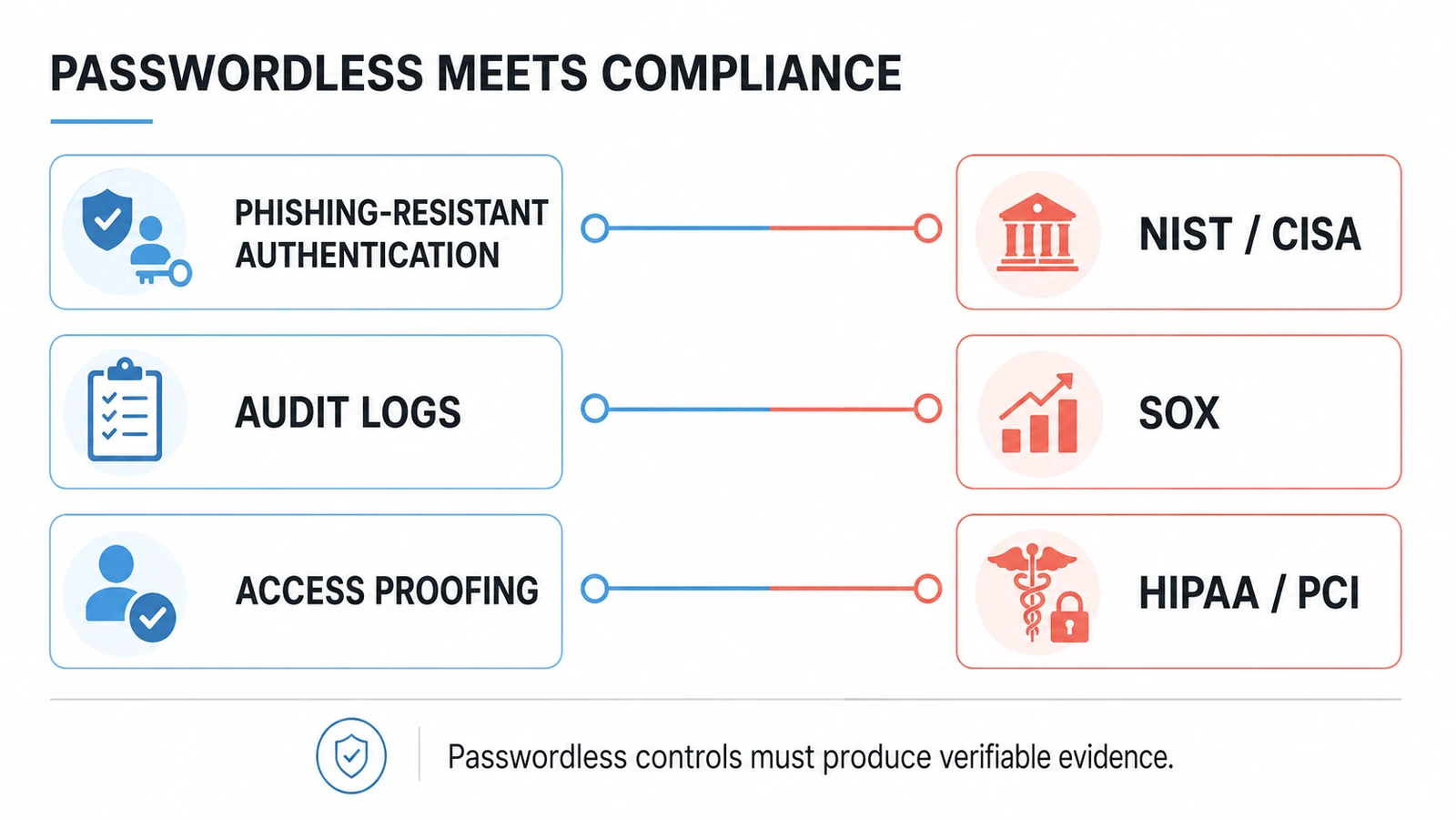 The same three controls — strong authentication, complete logging, and verified access proofing — satisfy different frameworks' evidence requests.
NIST and CISA guidance is where the technical assurance-level framing lives. NIST SP 800-63B's Authenticator Assurance Levels (AAL1 through AAL3) describe the confidence a verifier can place in an authentication ceremony based on the authenticator's cryptographic properties and the verifier's configuration. It's important to be precise here: AAL is a property of an assessed deployment — a specific authenticator, configured a specific way, in a specific environment — not a certification a platform or vendor holds in the abstract. An organization's own assessed environment can be described in AAL terms after review; a vendor's product cannot honestly claim to "be" AAL2 or AAL3 on its own. Our OTP under NIST 800-63B piece covers the AAL framework in more technical detail, including why OTP structurally caps out below the top level.
SOX cares about access-control evidence tied to financial-reporting systems. A passwordless authentication event that reaches a general-ledger or financial-close system needs an audit trail showing who accessed it, when, and whether that access was appropriately provisioned and reviewed. Passwordless doesn't change what SOX asks for; it changes how the "who" gets proven — cryptographically rather than by password possession, which if anything strengthens the evidentiary weight of the "who" claim, provided the logging captures it.
HIPAA's Security Rule technical safeguards (45 CFR §164.312) include person-or-entity authentication and access control as two of five required categories, directly implicated by any passwordless authentication decision touching systems with ePHI. Avatier's sister-site reference on HIPAA §164.312 access controls covers the healthcare-specific evidence expectations in more depth; our own passwordless authentication in healthcare piece covers the deployment side for clinical and shared-workstation environments.
PCI DSS v4.0.1 expanded multi-factor authentication requirements to cover all access into the cardholder data environment, not just remote access as in prior versions — a change that makes passwordless architecture directly relevant to PCI scope for many enterprises that previously only needed MFA at the network perimeter.
Common audit gaps in passwordless rollouts
The failure pattern is consistent enough across passwordless audits to be predictable: the primary authentication ceremony is strong and well-logged, but the surrounding lifecycle has weak links that break the evidence chain.
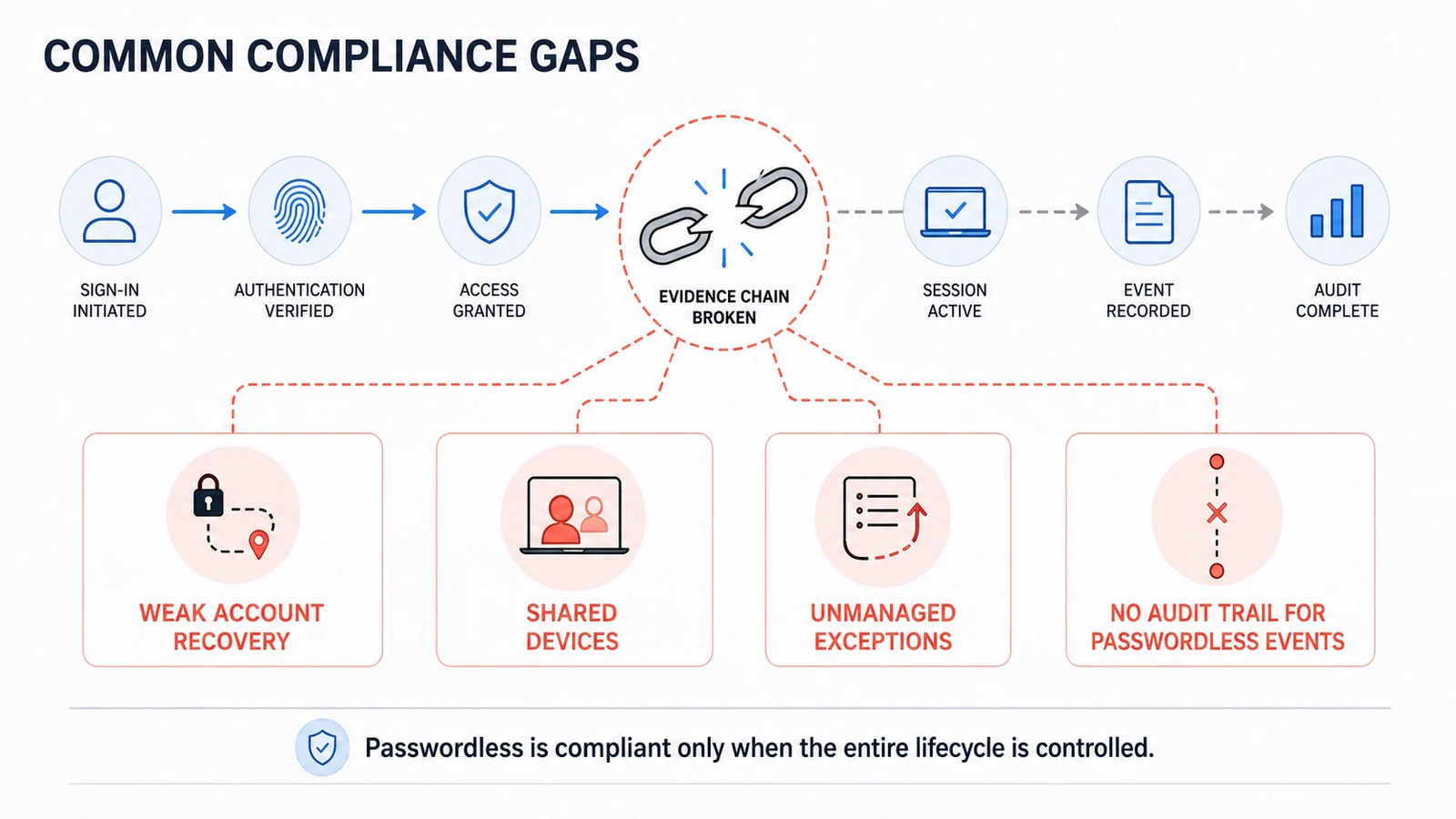 The chain breaks after access is granted, not before it — recovery, shared devices, and unmanaged exceptions are where the evidence trail goes cold.
Weak account recovery is the single most common finding. The primary sign-in is phishing-resistant and logged, but the "I lost my device" path routes to a help-desk process with weak or no verification, and that process either isn't logged at all or is logged inconsistently with the primary path.
Shared devices — frontline, clinical, retail, warehouse workstations where multiple employees authenticate on the same hardware across a shift — need session boundaries that are unambiguous in the log. If the log shows "workstation 14 authenticated" without a clean per-user boundary, an auditor can't attribute an access event to an individual, which breaks person-or-entity authentication requirements outright.
Unmanaged exceptions accumulate during any migration. A pilot group, a legacy application that can't support FIDO2, a vendor account that still uses a shared password — these get created as temporary workarounds and then never get tracked, reviewed, or brought back under the passwordless standard. Auditors specifically ask for the exception inventory, and "we don't have one" is itself a finding.
No audit trail for passwordless-specific events happens when logging was built for password-era events (login, failed login, password reset) and never extended to cover passkey enrollment, hardware-key registration, or deviceless-card issuance as first-class logged events. If the identity platform doesn't emit a structured event for "credential enrolled," that gap shows up immediately when an auditor asks for enrollment records.
None of these four gaps require ripping out the authentication architecture to fix. Each one is closed by extending the same logging and verification discipline the primary sign-in already has to the surrounding lifecycle events — recovery, shared-session boundaries, exceptions, and enrollment. The remediation is almost always cheaper than the initial passwordless rollout itself; the reason it doesn't happen by default is that it's rarely scoped as part of the rollout project in the first place.
Recovery-flow compliance considerations
Recovery is worth its own section because it's where passwordless compliance programs most often fail, and because the failure mode is the same regardless of which authentication method sits at the front door. A recovery flow is, functionally, a re-enrollment event — the organization is issuing a new credential to someone claiming to be an existing employee whose device, key, or card is lost or broken. If that re-enrollment isn't held to the same verification standard as original enrollment, the recovery path becomes the actual security and compliance boundary of the environment, regardless of how strong the primary authenticator is.
The compliance-relevant recovery controls an auditor looks for: a defined, documented verification procedure for recovery requests (not "call the help desk and describe yourself"); a record of who approved each recovery event and what evidence they checked; time-bound temporary access if an interim credential is issued, with automatic expiration; and a log entry for the recovery event itself, retained on the same schedule as primary authentication logs. Our beyond foundational MFA piece and the recovery-channel architecture discussion there cover the broader operational pattern; the compliance angle is narrower — every element of that pattern needs to leave the same kind of evidence primary authentication does.
Vendor and attestation documentation auditors ask for
Beyond the organization's own configuration and logs, auditors — and increasingly, procurement and vendor-risk teams doing pre-audit due diligence — ask for a specific documentation packet from any identity platform in scope.
Third-party attestations of the vendor's organizational security posture come first: SOC 2 Type II reports covering the relevant trust-service criteria, ISO/IEC 27001 certification, and where the platform touches cardholder data, PCI DSS attestation. Product-level documentation follows — a description of the authentication ceremony's cryptographic properties (is it FIDO2/WebAuthn compliant, how are keys stored, does the ceremony bind to origin), data-retention policy for authentication and access-log data, and incident-notification commitments in the event of a security event affecting the platform.
Auditors are also starting to ask about development-practice attestations — whether a vendor is a signatory to something like the CISA Secure-by-Design Pledge — as a proxy for engineering discipline, though this speaks to how the platform is built rather than a specific technical control. None of this vendor documentation substitutes for the customer's own evidence; a platform with a clean attestation packet deployed with a weak recovery flow or incomplete logging still produces a non-compliant environment. A useful pre-audit exercise is simply requesting this packet from every identity vendor in scope before the review starts, rather than during it — the gaps in what a vendor can and can't produce tend to surface faster that way, and they surface on a schedule the compliance team controls instead of the auditor's.
What Avatier ships toward this pattern
Avatier Identity Anywhere is built to make the evidence side of passwordless compliance the default output of the platform rather than a bolt-on reporting project. Every authentication event — passkey, hardware FIDO2 key, or deviceless Identity Challenge Card — generates a structured, timestamped log entry that includes the method, the outcome, and the credential identifier, so enrollment and factor-strength evidence exists as a byproduct of normal operation rather than something a compliance team has to reconstruct after the fact.
Recovery flows tie through Password Station, which requires workflow-verified identity checks before issuing or reissuing a credential and logs the verification method and approver for every recovery event — closing the specific gap that shows up most often in passwordless audits. Lifecycle integration with Identity Anywhere's provisioning platform ties credential issuance to joiner events and credential revocation to leaver events, so a terminated account's passkey or card access is removed on a schedule an auditor can verify rather than left to a manual checklist.
To keep the compliance framing accurate: the Avatier Trust Center publishes the organizational attestation posture — SOC 2 Type II with zero exceptions noted, ISO/IEC 27001:2022 certified, PCI DSS v4.0.1 compliant, CSA STAR Level 1 attestation, NIST 800-53 Rev. 5 aligned, FedRAMP-aligned, and a CISA Secure-by-Design Pledge signatory, with FIDO2-compatible authentication across the platform. None of that constitutes an assurance-level attestation for any specific customer deployment — AAL, as covered above, describes an assessed environment, not a vendor posture, and Avatier does not claim one on a customer's behalf.
The honest closing: what passwordless does not solve
Removing passwords closes a specific, well-understood attack surface. It does not close the compliance gap on its own, and it's worth being direct about what it structurally cannot do by itself.
It does not eliminate the need for a governed recovery flow — if anything, it raises the stakes on recovery, because the recovery path becomes the weakest link in an otherwise strong chain. It does not eliminate the need for audit logging discipline extended to cover enrollment, factor-strength, and recovery events, not just sign-in success and failure. It does not eliminate the need for an exception inventory — pilot groups, legacy applications, and shared-device workarounds accumulate in every migration and have to be tracked and remediated, not forgotten. And it does not, on its own, satisfy any specific framework's requirements — NIST's AAL framework, SOX's access-control evidence standard, HIPAA's technical safeguards, or PCI DSS's MFA scope — each of which asks for a documented, evidenced control, not just a strong authentication method sitting behind it.
The enterprises that pass passwordless audits cleanly are the ones that built the evidence architecture — logging, enrollment records, recovery governance, exception tracking — at the same time as the authentication architecture, rather than treating compliance as a report to generate after the rollout was declared done. Passwordless is a real security improvement. It is not a compliance shortcut, and treating it like one is exactly what shows up as a finding.
About the author

More from NIST & Compliance
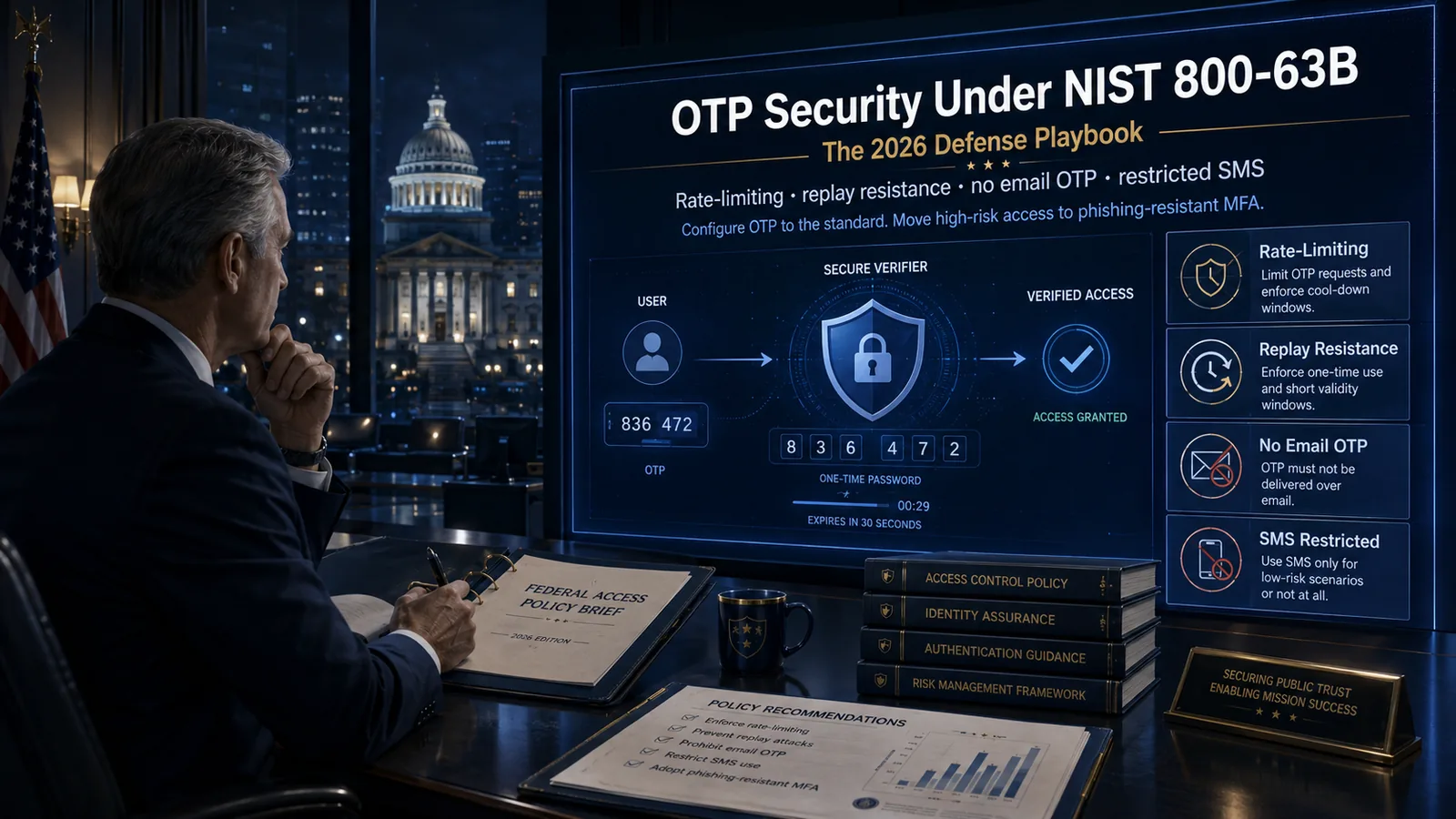
OTP Security Under NIST 800-63B: The 2026 Defense Playbook
One-time passwords live or die by NIST SP 800-63B verifier rules — rate-limiting, replay resistance, no email OTP, restricted SMS. What the standard requires in 2026, and when to move past OTP.
How Cybercriminals Exploit Weak OTP: The Attacker Playbook (2026)
Weak OTP fails at four specific points — SIM swap, real-time phishing relay, SS7 interception, and MFA fatigue — and every one of them is a known, repeatable attacker technique in 2026.

Advanced MFA in 2026: What Actually Counts as a Factor
Multi-factor authentication only works when the factors are genuinely different — this 2026 reference clears up what counts as a real factor and what advanced MFA actually means.