Scaling OTP Authentication in Large Organizations: A 2026 Guide
How to scale OTP across an enterprise in 2026 — channel selection, recovery design, workforce segmentation, and where OTP belongs in a phishing-resistant architecture.
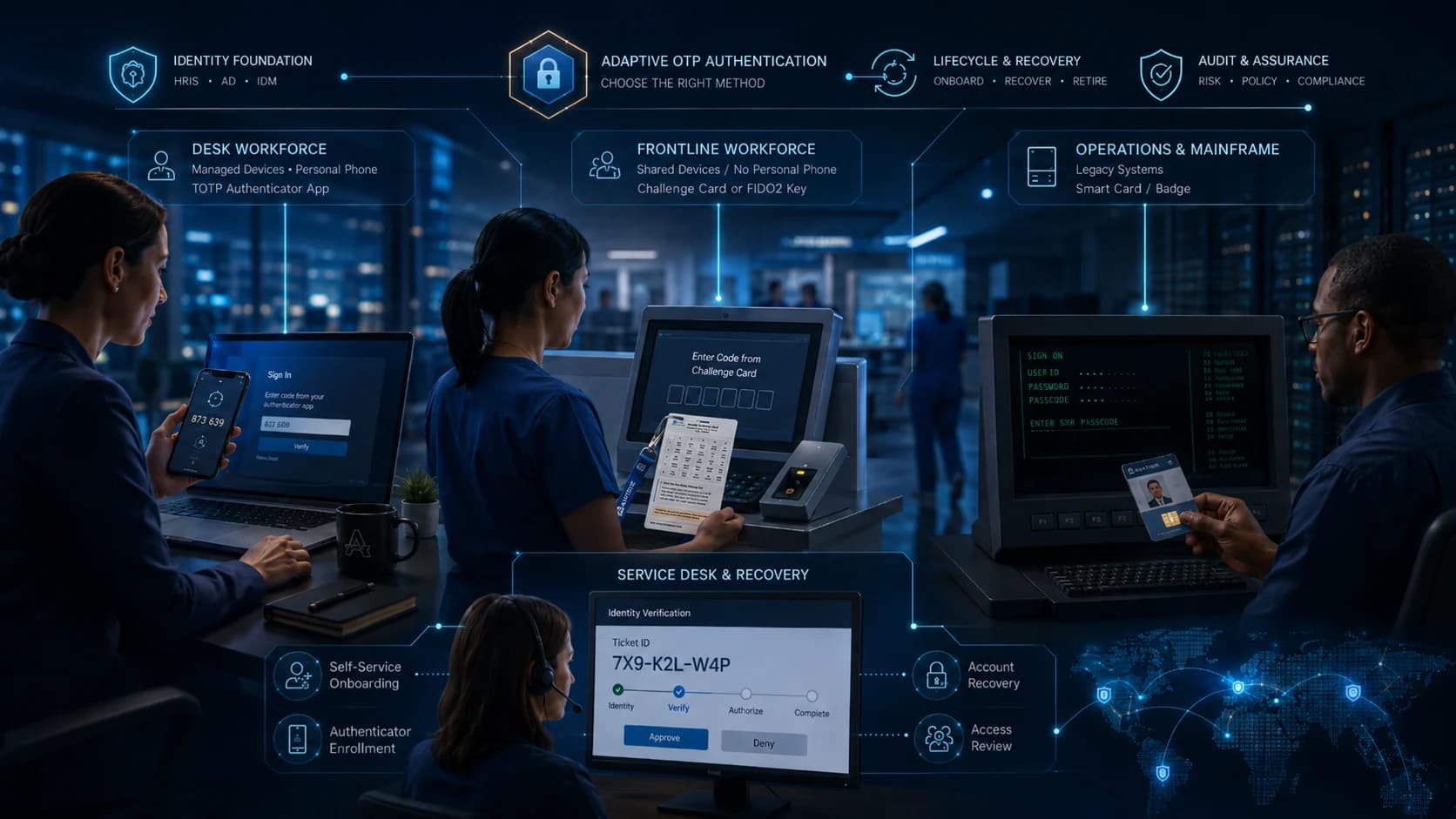
How to scale OTP across an enterprise in 2026 — channel selection, recovery design, workforce segmentation, and where OTP belongs in a phishing-resistant architecture.
Scaling OTP across a large enterprise is mostly an operational problem, not a cryptographic one. The OTP standards have been stable for years. The decisions that determine whether a deployment succeeds are about channel selection, workforce segmentation, recovery design, and the service-desk processes that handle the inevitable lost devices and account lockouts. This piece is the playbook we recommend to enterprises rolling out OTP at scale, updated for the 2026 threat landscape and the phishing-resistant alternatives that have changed the calculus since the original version of this guide.
This is a 2026 refresh. The OTP fundamentals are unchanged. What changed is the threat landscape (adversary-in-the-middle phishing made OTP-typing structurally vulnerable for high-impact accounts), the regulatory bar (CISA and NIST tightened the phishing-resistant MFA expectation), and the alternatives now available (FIDO2 and passkeys are operationally mature). The recommendations below reflect the 2026 reality.
Our companion piece OTP Authentication in 2026: Pros, Cons, and Better Alternatives covers the channel-by-channel comparison in depth. This guide is about deployment — how to actually scale OTP across a 10,000-employee workforce without breaking it.
Why scaling OTP is harder than it looks
The challenge with enterprise OTP is not the protocol. TOTP from an authenticator app is a five-page RFC. Hardware OTP tokens have been operationally durable since the 1980s. The cryptographic primitives are settled.
The challenge is everything around the authenticator. Provisioning at onboarding. Re-provisioning when a user loses their phone. Service-desk identity verification when the user calls in. Workforce segmentation between desk workers who carry phones and frontline workers who do not. Integration with legacy on-premises applications that pre-date federated identity. Helpdesk costs that scale faster than headcount when OTP recovery becomes a daily volume issue. Each of these is a discipline; collectively they are why most enterprise OTP deployments take twice as long and cost twice as much as the initial plan.
Three forces have changed the 2026 calculus from where it was in 2024. Adversary-in-the-middle phishing — covered in our Stryker breach analysis — made OTP-typing structurally vulnerable for high-impact accounts. CISA's published guidance on phishing-resistant MFA and NIST SP 800-63B's recent revisions tightened the bar; SMS OTP no longer meets AAL2. And the phishing-resistant alternatives became operationally credible — FIDO2 passkeys and platform biometrics now ship at workforce scale, and Avatier's deviceless Identity Challenge Card covers the segments they can't reach.
The result is that a 2026 enterprise OTP deployment is not a 2018 enterprise OTP deployment. It is a layered architecture where OTP carries some workforce segments and some recovery flows while phishing-resistant methods carry the others. The scaling discipline is choosing the right method per segment and not letting operational pressure collapse the architecture into a single channel for everyone.
Pick the right channel for the right segment
The first scaling decision is channel selection. The temptation in a large rollout is to standardize on one channel for everyone, because uniformity simplifies operations. The 2026 architecture is the opposite — segment-aware channel choice, with consistent service-desk patterns across all of them.
For desk workers on managed laptops, TOTP from an authenticator app is the workforce baseline. Microsoft Authenticator, Google Authenticator, 1Password, and Authy all implement RFC 6238 correctly; choose based on your MDM posture and the rest of the IdP stack. The user installs the app once, scans a QR code at enrollment, and reads a six-digit code at every sign-in. AAL2 ceiling under NIST 800-63B. Still phishable to AiTM; pair with phishing-resistant primary authentication where possible.
For frontline and shared-device workers — nurses' stations, factory floors, retail POS, call centers — TOTP does not work because the user does not have a personal phone available during their shift. The 2026 alternatives are shared FIDO2 hardware keys with per-user PINs, Windows Hello on shared kiosks with per-user enrollment, smart card / PIV credentials tied to a badge, and Avatier's Identity Challenge Card. We cover the workforce-segmented architecture in detail in the Best Passwordless Solutions guide.
For contractors and third parties, the operational pattern is OTP during onboarding (when the contractor is not yet ready to enroll a long-term authenticator) plus phishing-resistant credentials once the engagement passes the trust threshold. The lifecycle controls are more important than the channel — the contractor's OTP should expire at contract end automatically, not require a service-desk ticket.
For mainframe operators, OTP into a green-screen z/OS session is operationally awkward; the production answer is usually PKI smart cards tied to RACF or ACF2. Our RACF vs ACF2 comparison covers the mainframe access-control architecture in depth.
For executives and high-privilege accounts, the strong pattern is phishing-resistant primary (FIDO2 security key) with no OTP fallback. The convenience trade-off is real; the alternative is the recovery channel becoming the attack surface, which is what we documented in our Beyond Foundational MFA analysis.
What does NOT belong in a 2026 workforce deployment: SMS OTP as primary authentication, email OTP for privileged accounts, push without number-matching, and any channel where the user types a six-digit code that could be valid on a look-alike domain. These belong in the recovery toolkit, not the primary-auth toolkit.
Phase the rollout by workforce segment, not by application
Most enterprise OTP rollouts are phased by application — the IdP first, then high-priority SaaS, then critical infrastructure, then long-tail apps. This is operationally familiar but architecturally backwards. The user experience that matters is per-segment, not per-application; a phased rollout that gives desk workers OTP on Okta in March but does not enable frontline workers on the shop floor system until November creates the worst kind of architectural inconsistency.
The pattern that works is phase by workforce segment. Pick the segment whose deployment unblocks the most downstream applications — usually IT admins and security operations, then desk workers on the IdP-protected SaaS estate, then privileged business users, then frontline staff, then contractors. Each segment gets the full authenticator suite at once: primary credential, recovery channel, service-desk verification process.
The segment-first phasing produces a coherent user experience per segment from the start. It also reveals the recovery and service-desk gaps earlier, when the volume is still manageable and the support team can adapt before the next segment goes live.
Design the recovery channel deliberately
The recovery channel is the part of the deployment most enterprises under-design and under-budget. Five percent of users lose their phone, change devices, or get a new SIM in any given quarter. At 10,000 employees that is 500 recovery cases per quarter, every quarter, in steady state.
The recovery pattern that survives audit is workflow-tied identity verification at the service-desk. The agent sees a verification code in the IT ticket system. The user reads it back during the call. The agent confirms the code matches and proceeds with the reset. An impersonating caller cannot produce the code because the impersonator does not have access to the ticket system.
The recovery pattern that fails audit is knowledge-based verification (employee ID, manager name, last project) and email-link fallback. Both can be socially engineered against publicly-knowable facts about the employee. Storm-2949 — covered in detail in our governance failure analysis — used exactly this pattern against Entra ID Self-Service Password Reset; the user had legitimate MFA enrolled, the attacker socially engineered the recovery step, and the OTP infrastructure did its job correctly while the architecture failed around it.
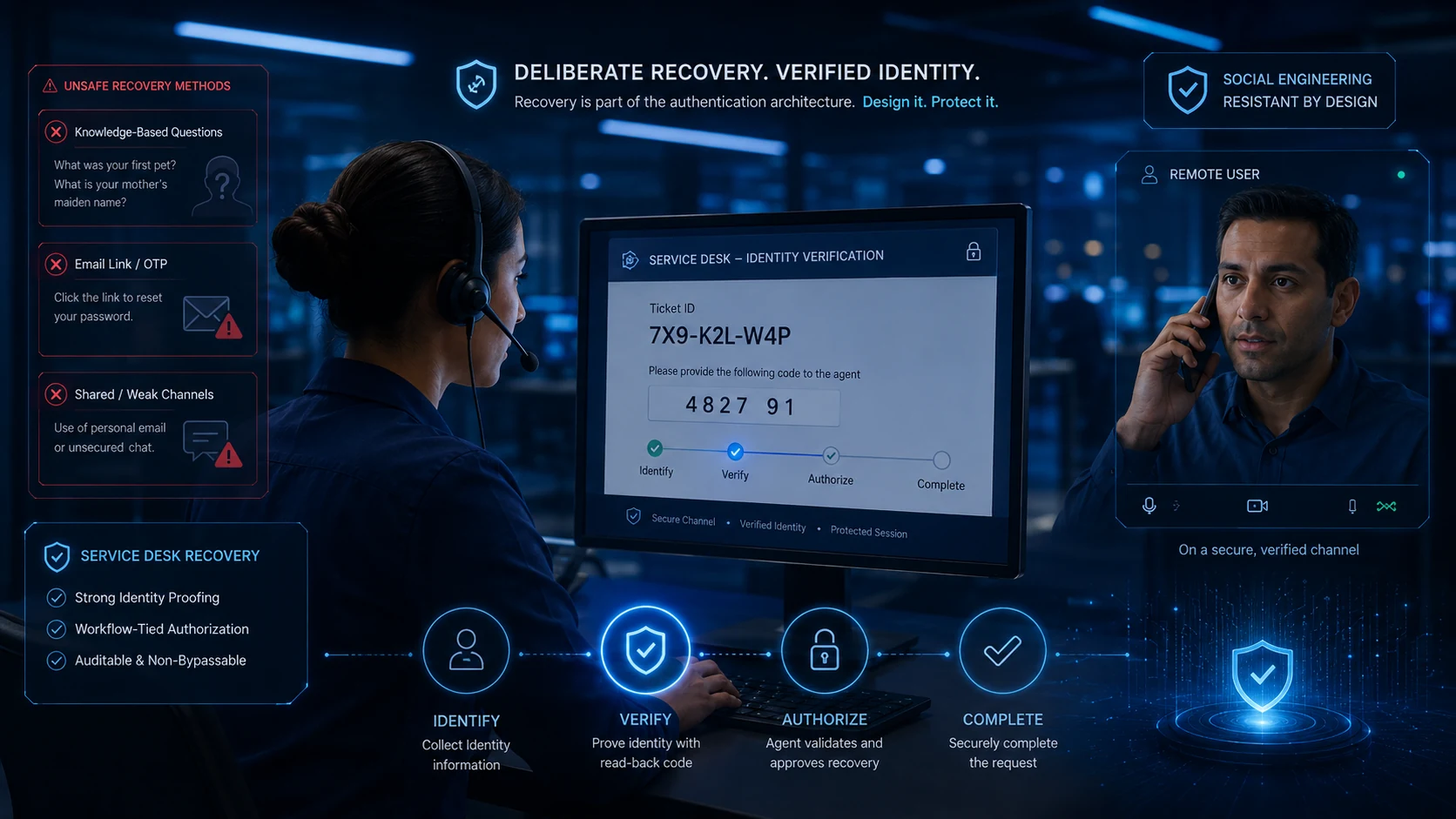 The recovery channel is part of the authentication architecture, not an exception to it. Workflow-tied codes the impersonator cannot reproduce; verification the audit can defend.
Avatier ships the workflow-tied verification pattern in Identity Anywhere Password Station, which we use ourselves for our own service-desk recovery flows. The pattern is implementable on top of any major IT ticket system; the product is not the only path to it. The architectural point is that the recovery step has to be tied to the workflow rather than to the user's memory.
Integrate with the joiner/mover/leaver lifecycle
OTP at scale is fundamentally a lifecycle problem. The user gets an authenticator at onboarding, switches devices at some point, loses access during travel, changes roles, and eventually leaves the company. Each of those events touches the OTP infrastructure, and the cumulative quality of the deployment depends on how well the lifecycle controls handle each transition.
The pattern that works is integration with the HRIS as the source of truth. New hire fires in Workday or SuccessFactors → IdP creates account → user receives enrollment ticket → authenticator app provisions during first sign-in. Role change → no OTP impact unless the new role demands a different authenticator class (frontline user moving to desk role, contractor converting to FTE). Termination → all OTP credentials revoked within minutes, including refresh tokens, including any backup hardware tokens issued.
The pattern that fails is OTP provisioning that depends on manual help-desk ticket creation. The new hire arrives Monday, the ticket is created Tuesday, the authenticator app is provisioned Friday, and the user has been signing in with a temporary password all week. The cumulative quality drops fast at scale.
Our Best IGA Solutions guide on CredentialGovernance covers the buyer-guide framing for the lifecycle layer. The relevant point for an OTP rollout is that the lifecycle platform and the authentication platform have to integrate cleanly — bidirectionally, in real time — for the deployment to survive contact with normal workforce churn.
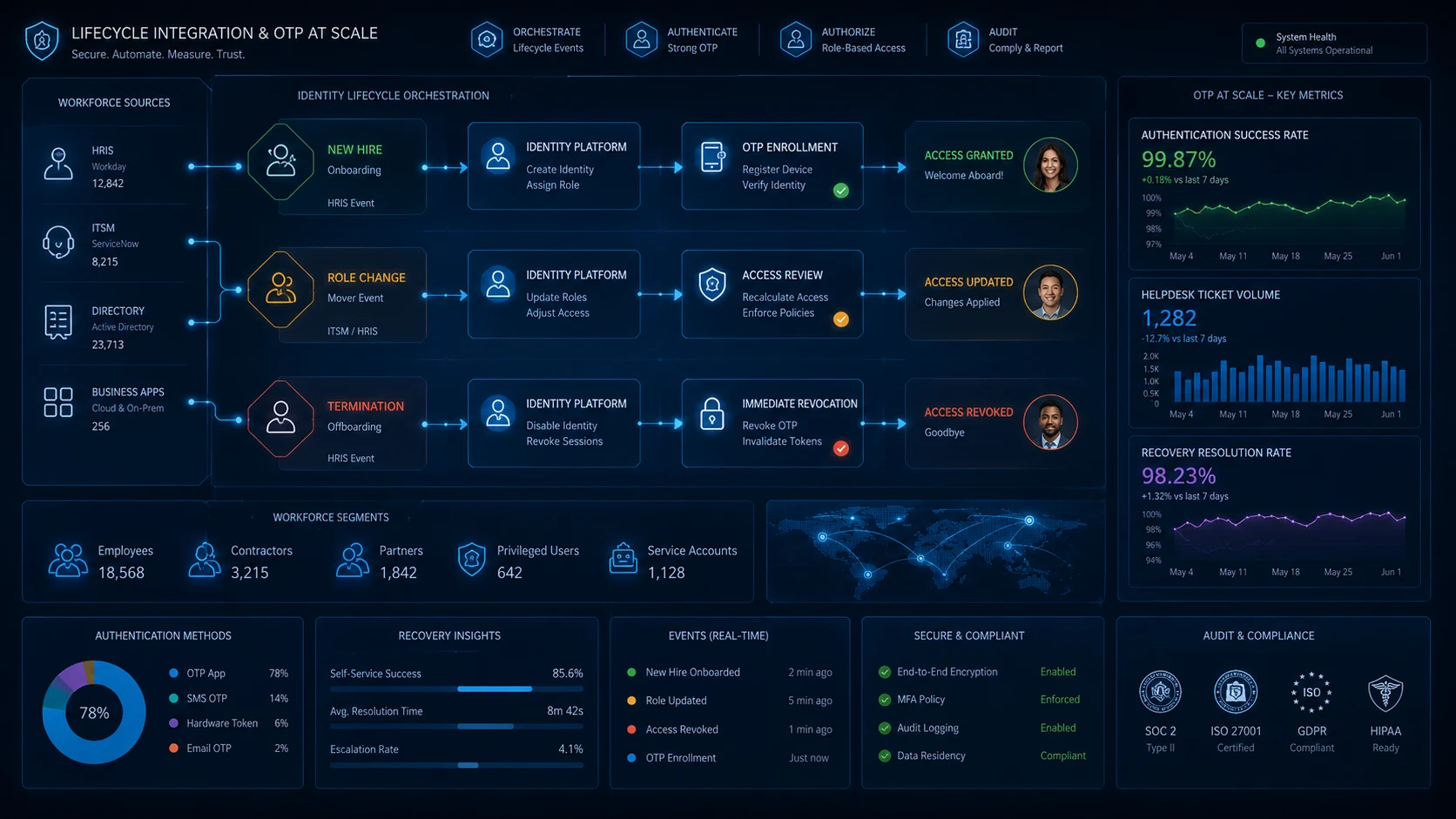 OTP at scale is fundamentally a lifecycle problem. The dashboard view of a working deployment: lifecycle events propagating in real time, recovery resolved deterministically, audit evidence captured continuously.
Measure the right things
Three metrics are load-bearing for OTP at scale.
Authentication success rate, measured per workforce segment per channel. A 99 percent authentication success rate sounds good until you realize that the remaining 1 percent corresponds to 100 users per day at 10,000-person workforce, mostly hitting the helpdesk. Segment-level visibility surfaces the channels that are degrading the user experience before they show up as helpdesk volume.
Helpdesk ticket volume from OTP issues, baselined before rollout and tracked weekly during phasing. Most rollouts see ticket volume spike during each segment's onboarding and decay over the following month. Persistent ticket volume above baseline signals a deployment problem worth diagnosing — typically channel choice, recovery flow design, or integration with a specific application.
Recovery-flow conversion rate — the percentage of recovery requests that resolve at the first service-desk touch versus the percentage that escalate. Low first-touch resolution often signals that the workflow-tied verification is too cumbersome for the agent or for the user; very high first-touch resolution sometimes signals that the verification is too easy, which becomes a social-engineering exposure.
What NOT to measure as primary KPIs: "MFA coverage" expressed as a single number across the workforce. The single-number framing obscures the segment-by-segment quality that determines whether the deployment actually defends the organization. Coverage at 95 percent that includes desk workers but excludes frontline staff is worse than 70 percent coverage that includes both, because the gap segments are usually the ones an attacker targets.
When to call OTP done
A 2026 enterprise OTP deployment is "done" when:
- Every workforce segment has a designated primary credential and a defined recovery flow
- Recovery flows are workflow-tied, not knowledge-based, and meet at least the assurance level of the primary credential
- The OTP infrastructure is integrated with the joiner/mover/leaver lifecycle so termination revokes within minutes
- Helpdesk ticket volume is at baseline plus a manageable steady-state increment, not spiking
- The architecture has a documented path to phishing-resistant primary for the segments that need it (desk workers, privileged accounts, high-impact CIAM), with OTP retained as the recovery channel and the low-impact-account default
Most enterprises are not "done" in this sense even after a successful rollout. The architecture is a moving target — phishing-resistant alternatives improve, threats evolve, segments shift as the workforce composition changes. The discipline is treating OTP at scale as a sustained operational program, not a one-time deployment project.
Avatier is a CISA Secure-by-Design Pledge signatory; we ship Identity Anywhere with the default-secure expectations that pledge represents, and our Trust Center publishes the SOC 2 Type II, ISO/IEC 27001:2022, PCI DSS v4.0.1, and CSA STAR Level 1 attestations the platform meets. The procurement signal matters because the OTP infrastructure your enterprise picks needs to be one whose vendor commits to the same default-secure direction you are committing to.
For the buyer-guide framing of the broader MFA category, our Best MFA Solutions 2026 guide covers the vendor landscape; the Best Passwordless Solutions guide covers the phishing-resistant alternatives. This guide is the deployment-side companion — how to take OTP from initial decision through workforce-wide steady state without the architecture collapsing under operational pressure.
About the author

More from MFA & Authentication

Retiring MFA Exceptions: Full-Workforce MFA with Avatier
An MFA exception register lists the workers device MFA can't reach. How Avatier's Identity Challenge Card lets policy route each of them to a method, so exceptions can be retired.

Multilingual MFA in 34 Languages: Avatier's Identity Challenge Card
Avatier's Identity Challenge Card ships in 34 languages, including right-to-left Arabic and CJK scripts. Same card, same three-factor flow, localized for every worker.

The Identity Challenge Card in Apple, Google and Samsung Wallet
Avatier's Identity Challenge Card can be added to Apple Wallet, Google Wallet or Samsung Wallet, alongside the printed card. When to reach for the wallet card, and when for the printed one.