Articles in

Passwordless

FIDO2, passkeys, WebAuthn, and the path past shared secrets.

Showing 5 posts

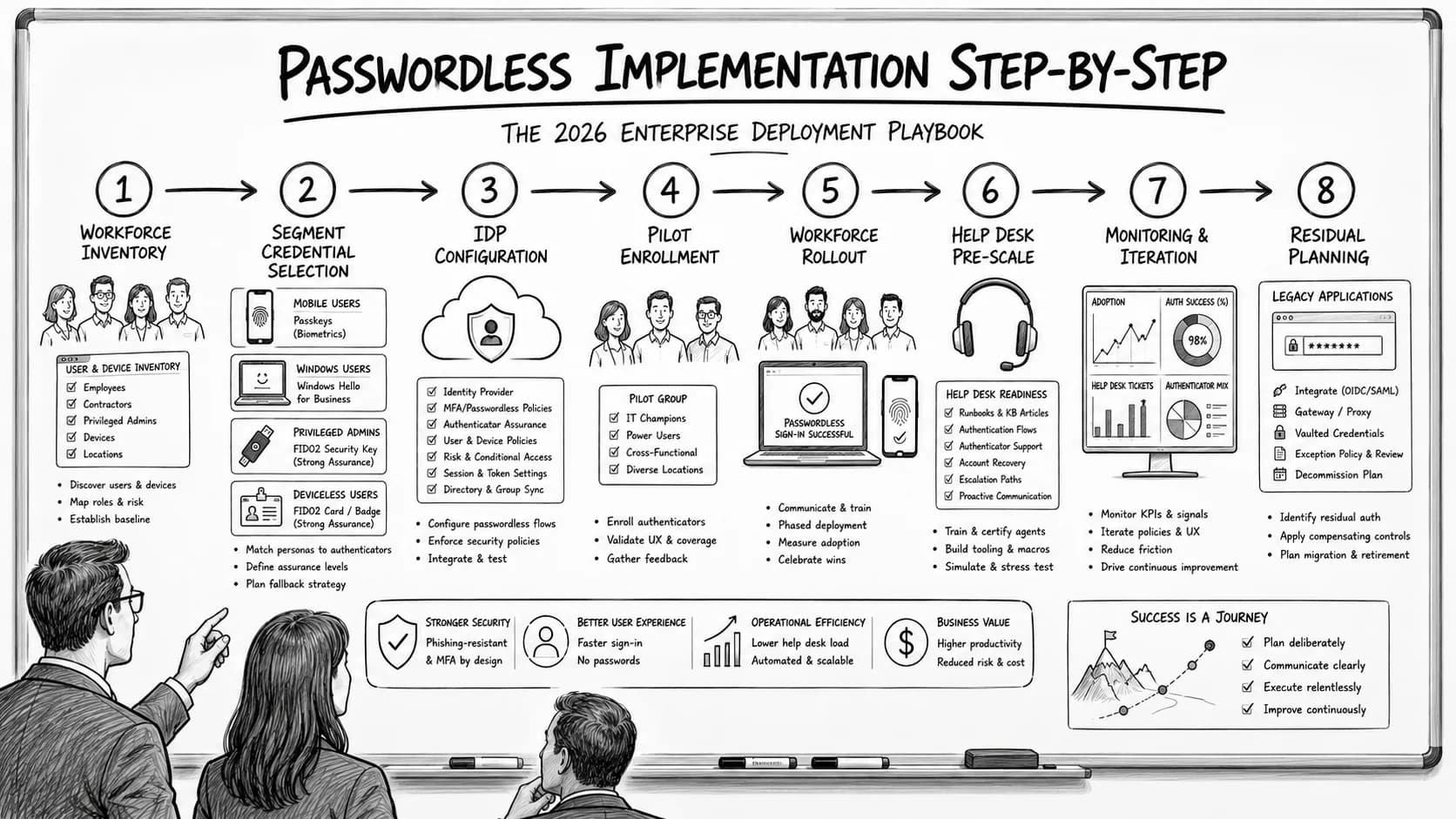
Passwordless implementation step-by-step enterprise 2026 deployment playbook — the eight-step deployment sequence (workforce inventory and segmentation, credential-class selection per segment mapping platform passkeys to smartphone workforce and Windows Hello for Business to Windows workstations and hardware FIDO2 for privileged step-up and deviceless FIDO2 via Identity Challenge Card for smartphone-unavailable segments, IdP configuration for Conditional Access and passkey enrollment policy, pilot enrollment with 5-15% of workforce, workforce rollout with change management and role-targeted communication, help desk pre-scaling for first 90 days of cutover, monitoring and iteration against pilot feedback, and passwordless-fallback residual planning for legacy applications and service accounts), the go/no-go criteria at each phase gate, and the deployment discipline that produces successful passwordless rollout at workforce scale.
Passwordless

Passwordless Implementation Step-by-Step: The 2026 Enterprise Deployment Playbook

Enterprise passwordless implementation runs on a specific eight-step deployment sequence — workforce inventory, credential-class selection per segment, IdP configuration, pilot enrollment, workforce rollout with change management, help desk pre-scaling, monitoring and iteration, and passwordless-fallback residual planning. The 2026 enterprise reference on the step-by-step deployment playbook, the go/no-go criteria at each phase gate, and the discipline that produces successful passwordless rollout at workforce scale.

July 15, 2026Andre Arantes
Read more
Passwordless authentication for Microsoft enterprise 2026 reference — the Microsoft-stack passwordless architecture composing Windows Hello for Business as the primary Windows authentication factor with TPM 2.0 attestation, Entra ID as the identity broker for cloud application access with SAML and OIDC federation, Windows Autopilot and Intune for device provisioning with automated WHfB enrollment, the hybrid deployment patterns bridging on-premises AD to Entra ID via Azure AD Connect and Password Writeback, FIDO2 security keys and platform authenticators via Microsoft-supported passkey providers, and the deployment discipline that produces phishing-resistant workforce authentication across the Microsoft estate including step-up patterns for privileged access and deviceless FIDO2 for smartphone-unavailable segments.
Passwordless

Passwordless Authentication for Microsoft Enterprise: The 2026 Reference

Microsoft enterprise environments have a specific passwordless deployment architecture — Windows Hello for Business as the primary Windows authentication factor, Entra ID as the identity broker for cloud application access, Windows Autopilot and Intune for device provisioning, and the hybrid deployment patterns that bridge on-premises AD to Entra ID. The 2026 enterprise reference on the Microsoft-stack passwordless architecture, the WHfB enrollment ceremony discipline, and the deployment pattern that produces phishing-resistant workforce authentication across the Microsoft estate.

July 14, 2026Andre Arantes
Read more
Passwords to biometrics enterprise shift 2026 — the organizational migration architecture for the workforce authentication rewrite that most enterprises are somewhere in the middle of, distinct from the mobile-biometric-specific technical architecture that dominates operator-level attention, covering the six-phase migration sequence (opt-in enablement, privileged-account hardening, default biometric preference, onboarding-first, workforce-wide enrollment, application-class deprecation), the risk-tiered rollout that prioritizes high-impact applications and high-privilege accounts first, the federation-parallel-run architectural pattern that lets password and biometric authentication coexist during the multi-year transition without forcing a big-bang cutover, the fallback design for scenarios where biometrics aren't operationally available (workforce segments without smartphones, biometric enrollment failures, temporary access needs, sensor damage or degradation), the change management discipline that determines whether the migration succeeds at workforce scale or produces support-burden crisis, and the metrics that show whether the migration is actually converting the workforce or accumulating opt-in adoption without displacing password reliance.
Passwordless

Passwords to Biometrics: The Enterprise Shift 2026 — Migration Architecture for the Workforce Authentication Rewrite

The enterprise shift from passwords to biometrics isn't a technology purchase — it's a multi-year architectural migration with distinct phases, risk-tiered rollout, federation-parallel-run patterns, and fallback design that determines whether the shift succeeds or produces a support-burden crisis. The 2026 organizational reference on how the migration actually runs at workforce scale, distinct from the mobile-biometric-specific architecture that dominates operator-level attention.

July 1, 2026Andre Arantes
Read more
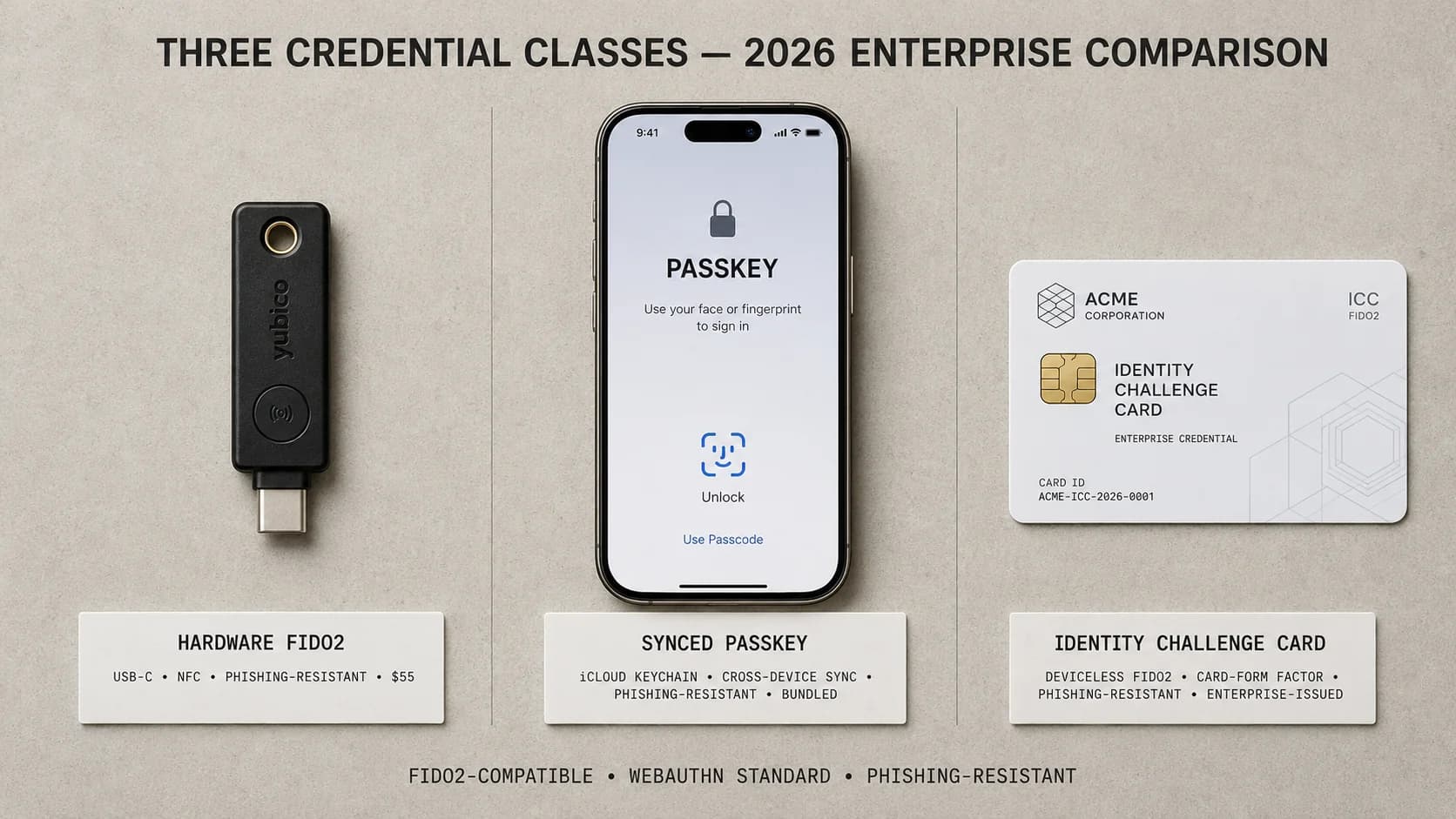
Hardware FIDO2 keys vs passkeys for enterprise 2026 — the four buyer dimensions that distinguish hardware keys from passkeys at the operational layer (portability, recovery, cost at scale, credential sovereignty), the five enterprise use cases mapped to the credential class that fits each (privileged operators favor hardware keys, distributed workforces favor synced passkeys, deviceless segments use the Identity Challenge Card, regulated environments compose multiple classes, AI agents need scoped delegation tokens), the failure modes of each, and the composition pattern that mature 2026 deployments use to cover the workforce comprehensively without forcing a single credential class across all segments.
Passwordless

Hardware FIDO2 Keys vs Passkeys for Enterprise 2026

Both hardware FIDO2 keys and passkeys deliver phishing-resistant authentication using the WebAuthn standard. Operationally they're substantially different — portability, recovery patterns, cost at scale, and credential sovereignty all diverge. The 2026 enterprise buyer's reference on which credential class fits which workforce segment, where each breaks, and why most mature deployments compose both.

June 25, 2026Andre Arantes
Read more