Does OTP Prevent Breaches? The Attacks It Actually Stops in 2026
OTP does not stop every attack, but it reliably defeats credential stuffing, password-spray, basic brute force, and stolen-password reuse from unrelated breaches. The 2026 breach-prevention case for OTP — the attack chains it breaks, the ones it doesn't, and how to deploy it so the prevention benefit actually lands.
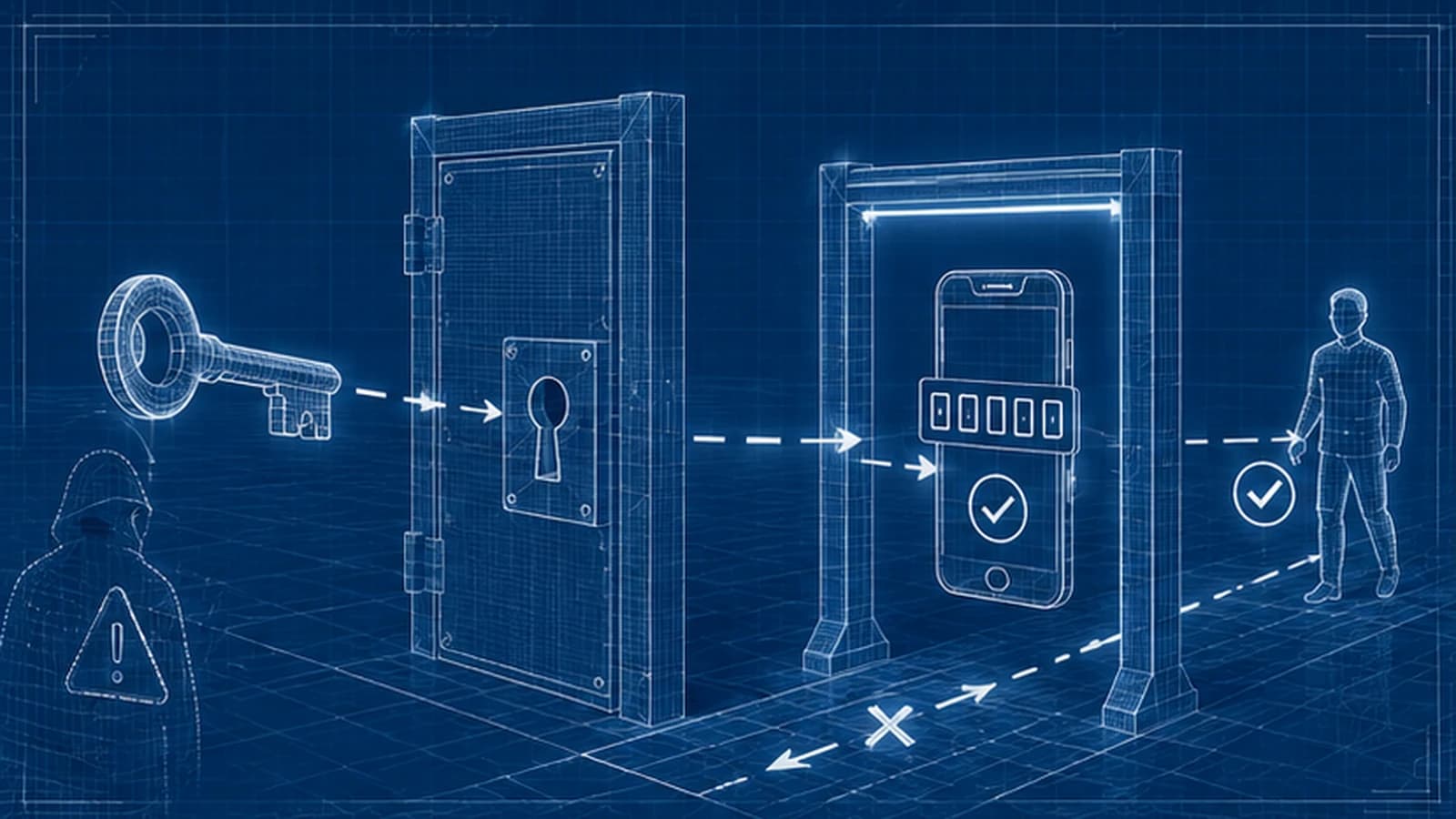
OTP does not stop every attack, but it reliably defeats credential stuffing, password-spray, basic brute force, and stolen-password reuse from unrelated breaches. The 2026 breach-prevention case for OTP — the attack chains it breaks, the ones it doesn't, and how to deploy it so the prevention benefit actually lands.
- OTP prevents breaches by breaking a specific class of attack chain: any attack that depends on a correct username/password pair being sufficient for access. Credential stuffing, password-spray, basic brute force, and stolen-password reuse from unrelated breaches all fail at the OTP step because the attacker has the password but not the second factor.
- The mechanism is the same across all four attack classes — the attacker's automation can test millions of password guesses or replay millions of leaked credentials, but it cannot produce the time-boxed, device-bound, or possession-based code the OTP step requires. Scale that makes password attacks cheap does nothing to help the attacker clear the OTP gate.
- OTP has an explicit boundary. It does not stop real-time phishing with adversary-in-the-middle (AiTM) relay, SIM-swap against SMS delivery, or MFA-fatigue push-bombing — these attacks target the OTP step itself rather than trying to skip it, and they're covered in depth in the companion failure-modes piece.
- The prevention benefit depends on deployment discipline: mandatory enrollment with no exception path, no SMS-only fallback for any account with standing access to sensitive systems, and backup-code hygiene that doesn't quietly recreate a password-only bypass.
- OTP is a floor, not a ceiling. It closes the automated credential-attack surface that accounts for the bulk of opportunistic breach attempts, but phishing-resistant methods — FIDO2 and passkeys — close the real-time relay and fatigue gaps that OTP structurally cannot.
Does OTP prevent breaches? Yes — for a specific, large class of attacks. One-time passwords reliably stop credential stuffing, password-spray, basic brute force, and stolen-password reuse from unrelated breaches, because every one of those attack chains depends on a correct password being sufficient for access, and OTP makes it insufficient. That's not the whole story — OTP has a real boundary, and attacks that target the OTP step directly (real-time phishing relay, SIM-swap, MFA fatigue) still work — but the prevention case for correctly-deployed OTP is stronger than the current wave of "OTP is dead" commentary suggests. This piece makes that case specifically: which attack patterns OTP defeats, the mechanism behind each, and how to deploy it so the prevention benefit actually shows up in production.
This is the 2026 update of an earlier Avatier piece on OTP and major breaches. The original leaned on breach statistics and incident detail that don't hold up to scrutiny by 2026 standards — unattributed cost figures, a named "study" without a verifiable source, and incident descriptions vague enough that they can't be tied to any specific, publicly documented breach. This version drops all of that and argues from attack mechanics instead: what OTP structurally breaks, what it structurally can't, and why the distinction matters for how you deploy it.
The core mechanism: why a correct password stops being enough
Every attack this piece covers shares one structural feature: the attacker's goal is to produce a valid password, and password-only authentication treats a valid password as sufficient proof of identity. OTP changes the sufficiency condition. Authentication now requires the password and a second factor — a time-boxed code from an authenticator app, an SMS code delivered to a specific device, or a push approval on a specific enrolled device — that the attacker's password-focused attack doesn't produce as a side effect of finding or guessing the password.
This is a narrow but powerful claim. It doesn't require OTP to detect the attack, rate-limit the attacker, or recognize anomalous behavior. It just requires the attacker to lack a credential they don't have. Attacks built entirely around producing correct passwords at scale walk directly into that gap, which is why the next four sections all resolve the same way: the attack succeeds at the password step and fails at the OTP step.
It's worth being precise about why this matters more than it might first appear. Detection-based defenses — anomaly scoring, geo-velocity checks, impossible-travel alerts, device fingerprinting — all work by recognizing that an attack is happening and responding to it. They're valuable, but they're also a contest: the attacker adapts to whatever signal the defense is keying on, and the defense has to keep adapting back. OTP doesn't enter that contest. It doesn't need to recognize that a login attempt came from a credential-stuffing bot, a password-spray script, or a brute-force loop — it just needs the attacker to be missing something they structurally cannot fabricate from a stolen or guessed password alone. That's a categorically different kind of defense, and it's why OTP's prevention effect against these four attack classes holds up even as the attacker's tooling gets more sophisticated on the password side.
Credential stuffing at scale
Credential stuffing takes username/password pairs leaked from one breach — a retailer, a forum, a SaaS vendor, anywhere credentials were exposed — and replays them against unrelated services, betting on password reuse. It's cheap to run: the attacker already has verified-working credentials from somewhere, and the only cost is automating the replay across target after target. Because password reuse across services is common, a stuffing run against a large enough user base statistically produces some number of valid hits on a password-only system.
Against an OTP-protected account, a "valid hit" stops being a login. The replayed pair authenticates the first factor correctly — the password matches — but the attacker's stuffing script has no OTP code to submit, because it never had access to the target account's authenticator, phone, or push-enrolled device. The attack chain, which was designed entirely around producing correct passwords, has nothing to do at the second step. This is the single highest-leverage attack class OTP defeats, because credential stuffing is high-volume, low-cost, and depends entirely on an assumption — password sufficiency — that OTP eliminates.
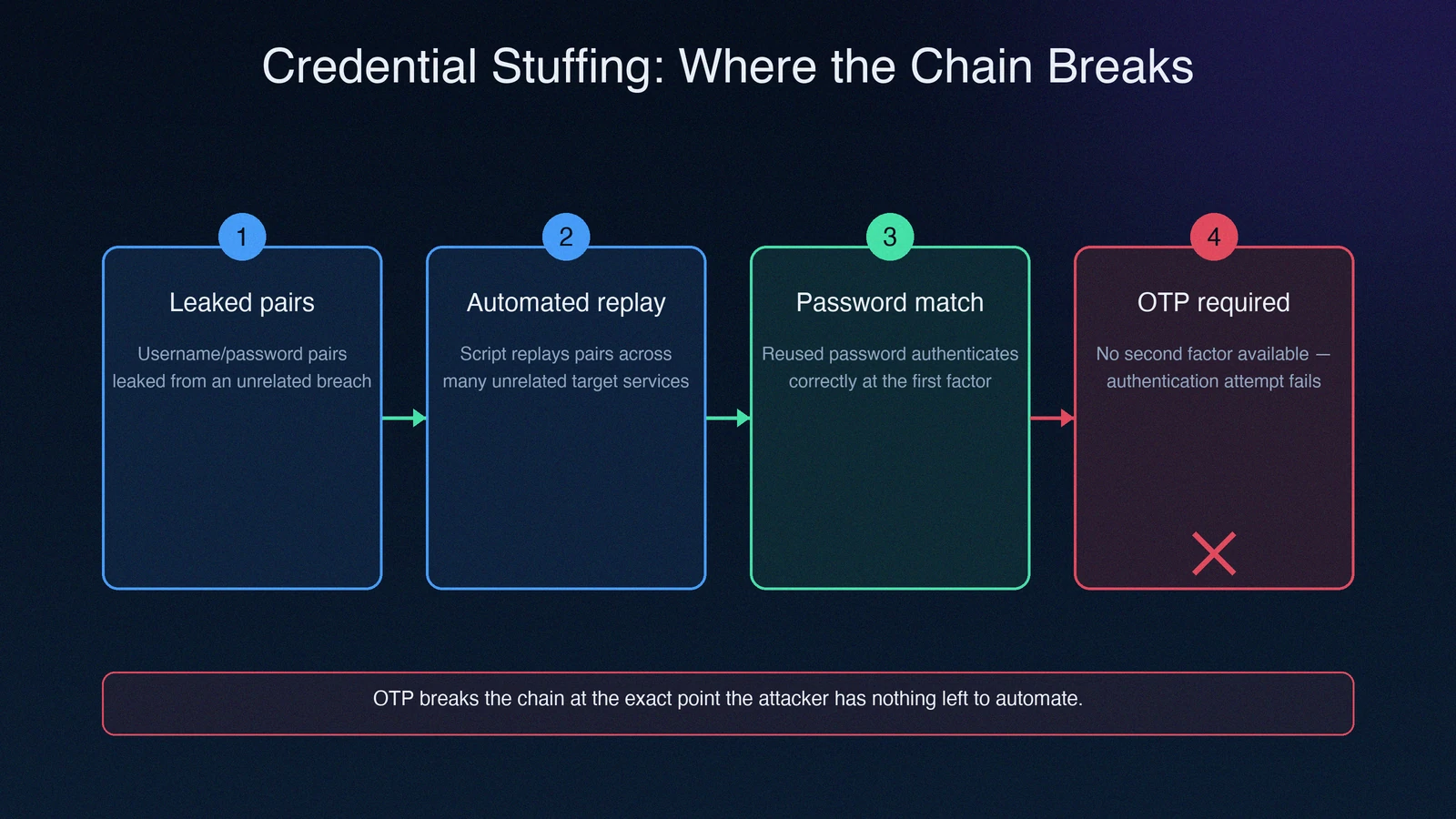 Credential stuffing wins on password reuse alone. OTP inserts a step the leaked-and-replayed password can't satisfy — the attack stalls exactly where it expected to walk in.
Password-spray: the low-and-slow inversion
Password-spray inverts the brute-force approach specifically to evade detection. Instead of guessing many passwords against one account — which trips lockout thresholds and shows up as an obvious burst of failed attempts — the attacker tests a small number of common or seasonal passwords (Summer2026!, CompanyName123, Password1) against a large number of accounts, one guess per account, staying comfortably under any per-account lockout threshold. Spray campaigns are popular precisely because they're hard to catch with naive rate-limiting: no single account sees enough failed attempts to trigger a lockout.
The defense OTP provides doesn't depend on catching the pattern at all. If the sprayed guess happens to match an account's real password — and across a large enough user base, some will — a password-only system authenticates immediately. An OTP-protected account requires the same missing second factor. The attacker doesn't need to be detected to be stopped; they need to be unable to produce a code they never had access to. This is a meaningful distinction from detection-based defenses (anomaly scoring, geo-velocity checks, lockout thresholds), all of which the attacker can tune around. OTP doesn't need to be tuned around — it needs a credential the attacker structurally can't produce.
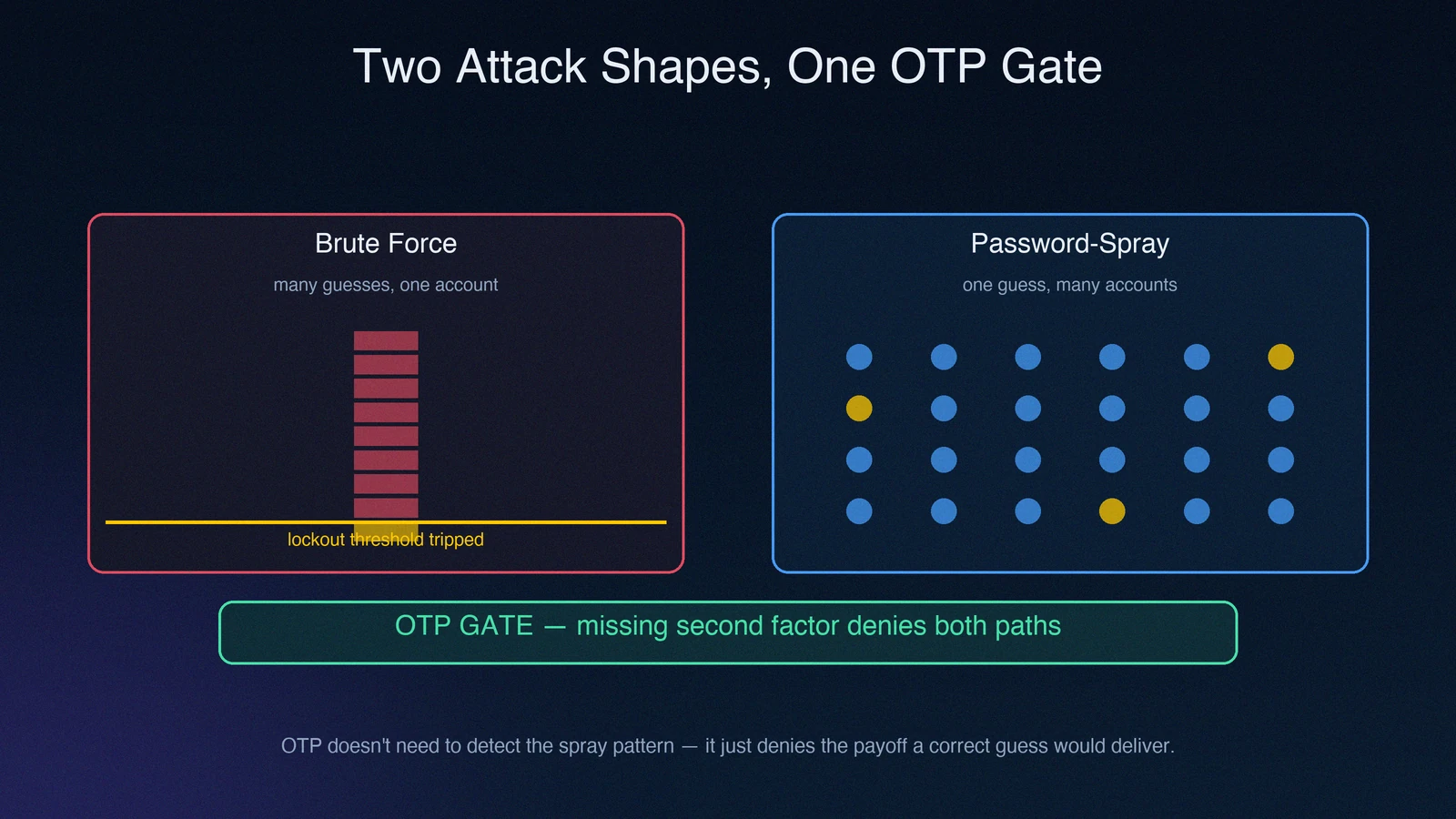 Password-spray is built to evade lockout detection. OTP doesn't rely on detecting the pattern — it just removes the payoff a correct guess would otherwise deliver.
Basic brute force and stolen-password reuse
Basic brute force — systematically guessing a single account's password through automated character or dictionary combinations — is the oldest attack in this set and the easiest to reason about. Modern rate-limiting and lockout policies have made pure brute force increasingly impractical against any account with reasonable password complexity requirements, but weak or default passwords on legacy systems, service accounts, and forgotten test environments still fall to it. OTP adds a second, independent layer that brute-forcing the password does nothing to satisfy — even a successfully cracked password produces the same dead end at the OTP prompt that credential stuffing and password-spray hit.
Stolen-password reuse is the broader category underneath credential stuffing: any case where a password compromised through a breach, malware infostealer log, phishing kit, or insider leak shows up somewhere else — reused by the same person across services, or sold and tried by an unrelated attacker. Infostealer logs deserve a specific mention because they're a growing source of this problem: malware that harvests saved browser passwords, session cookies, and autofill data from an infected device produces a working credential set without the victim's organization ever being breached directly. Those harvested passwords get aggregated, sold, and tried everywhere the victim might have an account. The mechanism is identical to credential stuffing because it's the same underlying assumption (a stolen password is sufficient) failing against the same gate — OTP requires a second factor the theft didn't include, whether the password was pulled from a breach dump, a phishing kit's harvest, or an infostealer log.
This is also why security teams increasingly treat OTP enrollment rate, not password strength policy, as the more load-bearing control against reuse-driven compromise. Password strength reduces how often brute force and guessing succeed against any single account, but it does nothing against a password that was correct and simply exposed somewhere else. OTP is what stops a successfully obtained password — cracked, guessed, or stolen — from being enough on its own, regardless of how the attacker obtained it.
The explicit boundary: what OTP does not stop
None of the above should be read as "OTP stops everything." It doesn't, and pretending otherwise is how enterprises end up under-investing in the credential classes that close the remaining gap. Three attack patterns specifically target the OTP mechanism rather than trying to route around it, and OTP does not stop any of them:
Real-time phishing with adversary-in-the-middle (AiTM) relay. The attacker runs a proxy site between the victim and the real login page. The victim enters their password and OTP code into what looks like the legitimate site; the proxy captures both and replays them against the real service within the code's validity window. The victim supplied a real, correctly-timed OTP code — it just went through the attacker first.
SIM-swap against SMS-delivered OTP. The attacker socially engineers the victim's mobile carrier into porting the phone number to an attacker-controlled SIM, then receives the SMS-delivered code directly. The code is real and correctly delivered — just to the wrong physical device.
MFA-fatigue push-bombing. The attacker triggers repeated push-approval prompts against the victim's enrolled device until the victim approves one, out of frustration, confusion, or successful social engineering. The approval is a real action from the real device — the attacker just waited out the user's judgment.
All three defeat OTP by targeting the second factor directly instead of trying to skip it, which is the opposite failure mode from stuffing, spray, and brute force. The mechanics, real-world incident patterns, and mitigations for each are covered in depth in the OTP Failure Case Scenarios piece and the Hidden Challenges of OTP Authentication piece — this piece won't re-explain them, since duplicating that ground would bury the prevention case this post is making.
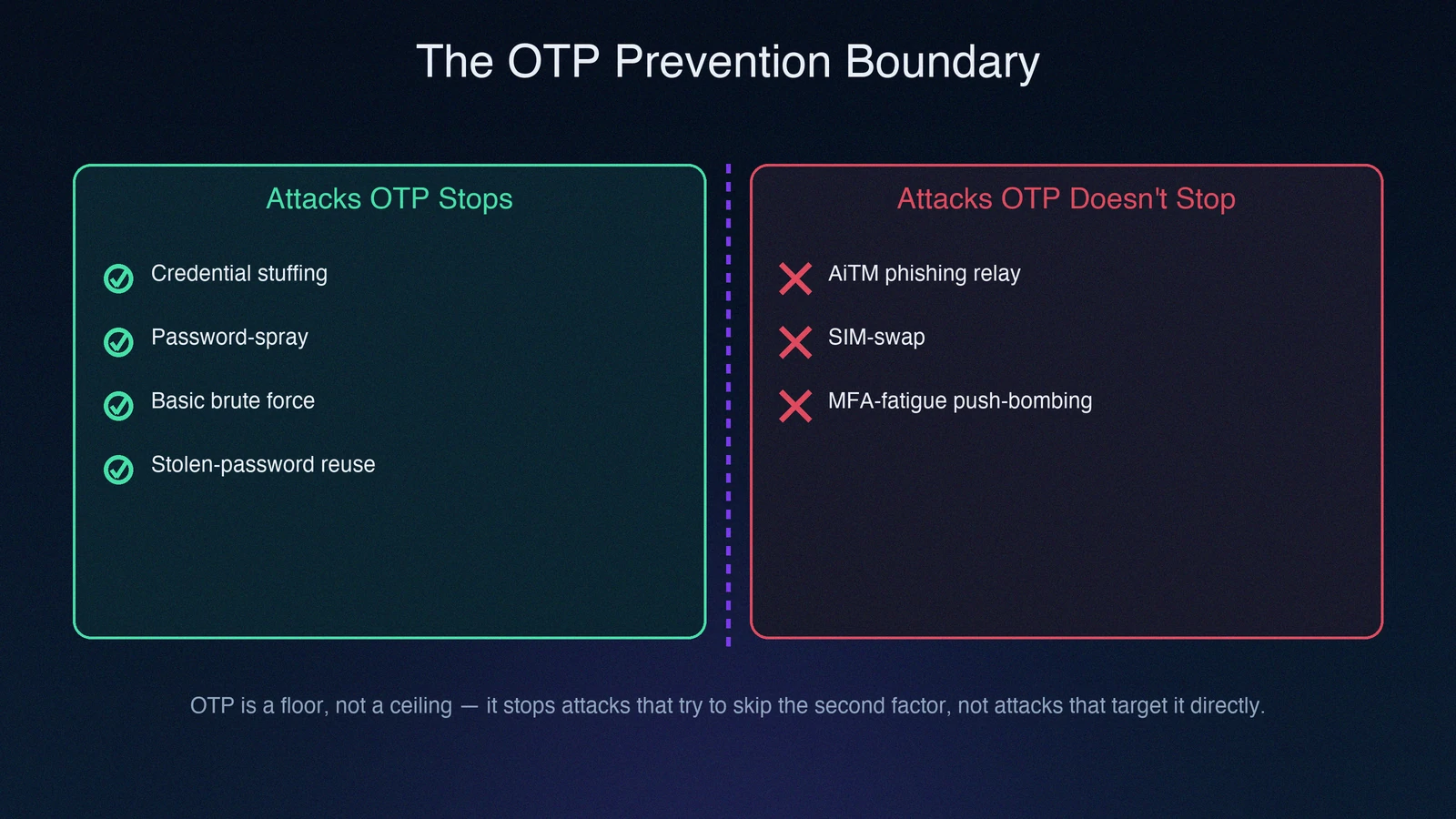 The dividing line isn't "OTP works" versus "OTP is broken" — it's attacks that try to skip the second factor versus attacks that target it directly. OTP only defeats the first kind.
Deployment patterns that maximize the prevention benefit
The prevention case above assumes OTP is actually enforced everywhere it needs to be, with no quiet exceptions. In practice, three deployment gaps are the most common way enterprises deploy OTP but don't get the benefit.
Mandatory enrollment, no exception path. If any meaningful segment of accounts — contractors, service accounts, legacy applications that "don't support MFA yet," VIP exemptions — can authenticate on password alone, that segment is exactly as exposed to stuffing and spray as if OTP were never deployed, and attackers find these gaps reliably because they're often the accounts with the weakest password hygiene to begin with.
No SMS-only fallback for accounts with standing access to sensitive systems. SMS-delivered OTP still stops stuffing, spray, and brute force — those attacks don't touch the delivery channel. But an account permanently parked on SMS-only never graduates past SMS's specific exposure to SIM-swap. The deployment pattern that captures the full benefit treats SMS as a bridge, not a destination — enrollment starts there for accessibility, but there's a documented path to app-based TOTP, push, or a phishing-resistant credential for any account with elevated access.
Backup-code hygiene that doesn't recreate a bypass. Backup codes exist for legitimate device-loss recovery, but codes generated once and never rotated, shared across a team, stored in an unsecured location, or accepted without rate-limiting quietly rebuild a password-only bypass path everywhere they're honored. Treat backup codes as a monitored, rate-limited, single-use credential — not a permanent side door that undoes the enforcement everywhere else.
Get these three right and OTP's prevention effect against the four attack classes above is close to complete for the accounts it covers. Get any of them wrong and the gap is exactly where an attacker who's done basic reconnaissance will look first.
How OTP fits the broader authentication-architecture picture
OTP's role in a 2026 authentication architecture isn't "the answer" or "obsolete" — it's a specific, well-understood layer that handles a specific class of attack cheaply and reliably. The architecture question isn't whether to deploy OTP; it's where OTP is sufficient on its own and where it needs to be paired with or replaced by phishing-resistant credentials.
For the bulk of workforce accounts, correctly-deployed OTP closes the automated credential-attack surface — which is where the overwhelming majority of opportunistic breach attempts originate — at a fraction of the deployment cost and user friction of a full passkey rollout. For privileged accounts, public-facing high-value accounts, and any account that's been targeted by phishing before, the boundary section above is the reason to move faster to phishing-resistant methods. The Scaling OTP Authentication guide covers how to sequence that rollout across a large workforce without stalling on the accounts that need OTP today.
This tiering matters operationally because treating every account identically usually means one of two mistakes: either the whole workforce waits for a slow, all-at-once phishing-resistant rollout while password-only exposure sits open in the meantime, or OTP gets treated as "done" everywhere and privileged accounts stay parked on a defense that was never designed to stop AiTM relay or fatigue attacks. The architecture that avoids both mistakes segments by risk first — service desk and general workforce accounts get OTP as the durable baseline, privileged and internet-facing accounts get prioritized for FIDO2 or passkeys — and treats the segmentation as an ongoing risk-based process rather than a one-time migration checklist.
What Avatier ships toward this pattern
Avatier Identity Anywhere MFA enforces OTP as a mandatory baseline — no standing password-only exception path for any workforce account — which is the deployment discipline the prevention case above depends on. On top of that baseline, the platform supports the phishing-resistant credential classes that close the gaps OTP structurally can't: platform passkeys and biometric authentication on managed devices, hardware FIDO2 security keys for step-up on privileged and high-assurance workflows. Alongside those, the Avatier Identity Challenge Card covers deviceless workforce segments — healthcare bedside staff, manufacturing floor workers, shared contact-center workstations — where a personal smartphone isn't operationally available for OTP delivery in the first place. Adaptive, risk-based step-up moves the accounts with the most exposure to phishing-resistant factors first, rather than waiting for a uniform, all-at-once migration.
Password hygiene still matters underneath all of this — a credential that never gets exposed is one less test case for stuffing and spray campaigns to run — and the weak-password risk analysis on Avatier's Credential Governance blog covers what actually happens once a password is exposed, independent of whichever second factor sits in front of it. The Avatier Trust Center publishes the compliance posture behind the platform — SOC 2 Type II with zero exceptions, ISO/IEC 27001:2022, PCI DSS v4.0.1, CSA STAR Level 1, NIST 800-53 Rev. 5 aligned, CISA Secure-by-Design Pledge signatory.
The bottom line: a floor, not a ceiling
OTP prevents real breaches. Credential stuffing, password-spray, basic brute force, and stolen-password reuse are not edge cases — they're the bulk of opportunistic, automated attack volume most enterprises face, and correctly-deployed OTP closes that door reliably. That's a genuine, defensible prevention claim, and it doesn't need an inflated breach-cost statistic or an unverifiable named incident to make the case.
But OTP is a floor, not a ceiling. Real-time phishing relay, SIM-swap, and MFA-fatigue push-bombing all target the OTP mechanism directly, and no amount of OTP deployment discipline closes those gaps — they require phishing-resistant credentials that don't have a shared secret or an approve/deny decision for the attacker to intercept or exploit. The right 2026 posture treats OTP as the mandatory baseline everywhere it isn't yet phishing-resistant, and treats FIDO2 and passkeys as the direction every account eventually moves, starting with the ones that carry the most risk today.
About the author

More from MFA & Authentication

Three-Factor Authentication Explained: The Identity Challenge Card
What three-factor authentication is, how 3FA differs from 2FA, and how Avatier's Identity Challenge Card checks three factors: a printed grid card, a private PIN and a directory identity.

When Your IdP or MFA Goes Down: Avatier's Identity Challenge Card
When the identity provider, MFA service or devices go down, people still have to prove who they are. A runbook for verifying, restoring and recording access with Avatier's printed card.

Air-Gapped MFA for Phone-Free Sites: Avatier's Identity Challenge Card
Air-gapped MFA for sites where phones are banned or networks don't reach. How Avatier's printed Identity Challenge Card verifies a worker locally, with no phone, no app and no network.