MFA for Frontline Workers Without Phones: The Identity Challenge Card
Frontline and shared-device workers can't always use a phone for MFA. How Avatier's Identity Challenge Card gives them a printed factor for login, password reset, and the service desk.
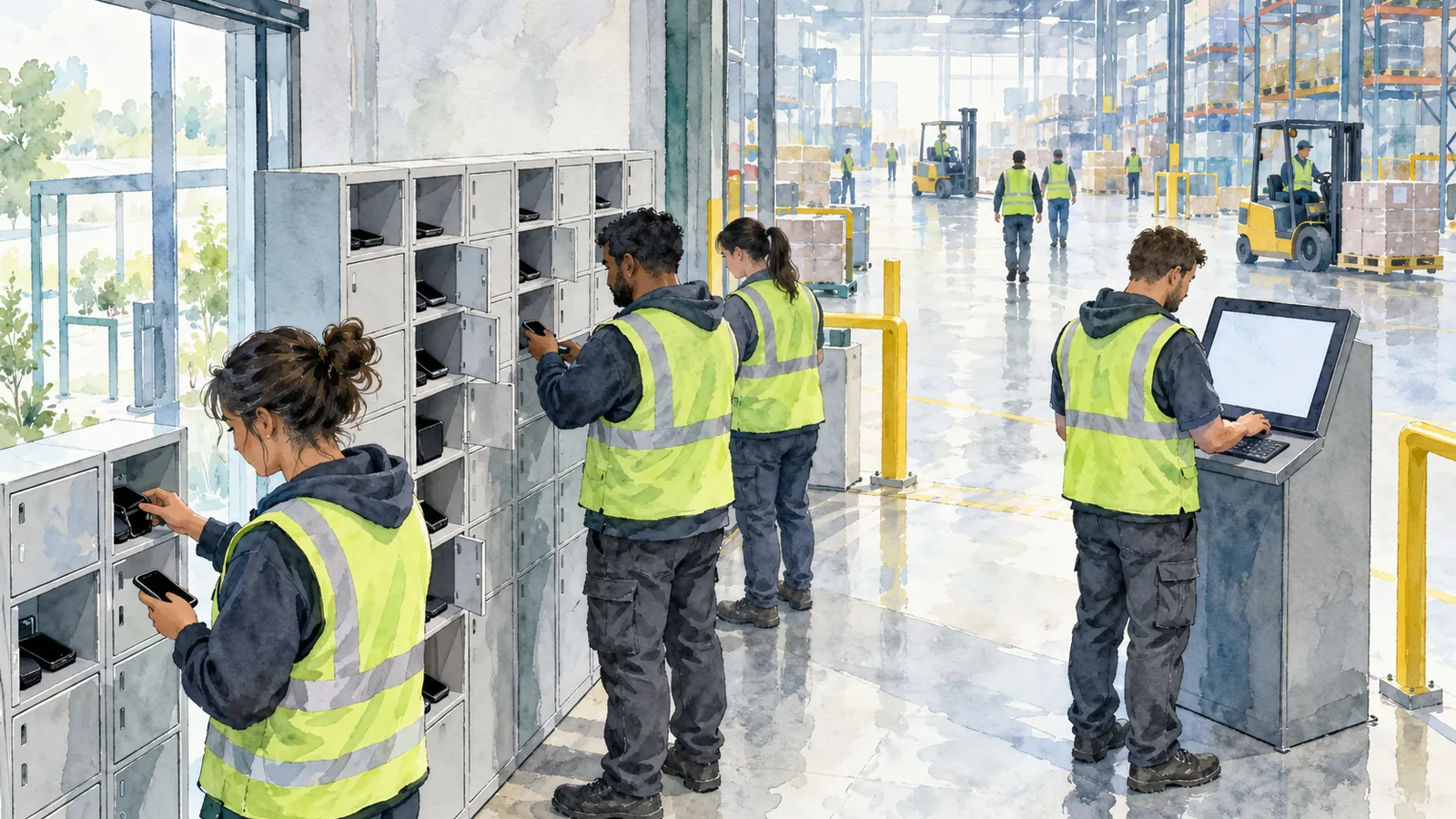
Frontline and shared-device workers can't always use a phone for MFA. How Avatier's Identity Challenge Card gives them a printed factor for login, password reset, and the service desk.
- Frontline workers can get MFA without a phone: Avatier's Identity Challenge Card is a printed grid of word pairs, with no phone, no app, and no network.
- Phone-based MFA misses shared devices, roles with no company phone, workers who won't use a personal phone, and phones that are dead, out of signal, or in a locker.
- The card combines three factors: a word read off the card at a named coordinate, a private PIN, and the worker's directory identity. Each coordinate value is one-time.
- One card covers login (with or without a password), self-service password reset, and service desk verification.
- Avatier describes deployment in under an hour, with no MDM, app, or hardware, and the card ships in 34 languages.
MFA for frontline workers without phones means giving every worker a second factor that doesn't live on a device they carry. Avatier's Identity Challenge Card™ does it with a printed grid of word pairs: no phone, no app, no network. The worker reads back a one-time coordinate, and their identity resolves locally at login, at a password reset, and at the service desk.
That's the gap for workers on shared stations, workers whose role doesn't come with a work phone, and workers whose phone is dead, out of signal, or in a locker. Phone-based MFA assumes a phone in hand. Below is where that assumption breaks and how a card fills in. For the category the card belongs to, see What Is an Identity Continuity Layer?
Why phone-based MFA misses frontline workers
Avatier's comparison of MFA methods lists SMS and voice codes, TOTP apps, push authenticators, FIDO2 security keys, hardware tokens, biometrics, passkeys, and smartcards, and concludes that none of them are deviceless. For a worker with a managed laptop and a company phone, that's fine. For frontline and shared-device workers, four gaps show up.
| Gap | What happens on shift | Why a phone factor fails |
|---|---|---|
| Shared devices | The workstation or virtual desktop had a different worker an hour ago | The device belongs to the shift, so it can't prove which person is using it |
| No company phone | The role doesn't come with a work phone | The authenticator has to live on a personal device, or nowhere |
| Personal-phone refusal | The worker won't put a work app or work number on a phone they own | There's no approved device to hold the factor |
| Dead zones and lockers | The phone is dead, out of signal, or stored off the floor | A code or prompt can't reach a phone that isn't reachable |
The shared-device row is the hardest one, because the problem isn't the password. As Avatier puts it, the question is "which one of you this is." A factor bound to the machine can't answer that.
When a policy can't reach a group of workers, the workaround is an MFA exception. Avatier describes those exceptions as "the attack surface cyber adversaries map first." The goal of a frontline rollout is to replace the exception list with a factor every worker can carry.
The stakes are credentials. Avatier's Identity Attack Ledger reads every breach notification filed with the California Attorney General from January 2023 through August 14, 2026. Of the 53 incidents whose letters say how the attacker got in, 31, or 58.5%, name phished or stolen credentials.
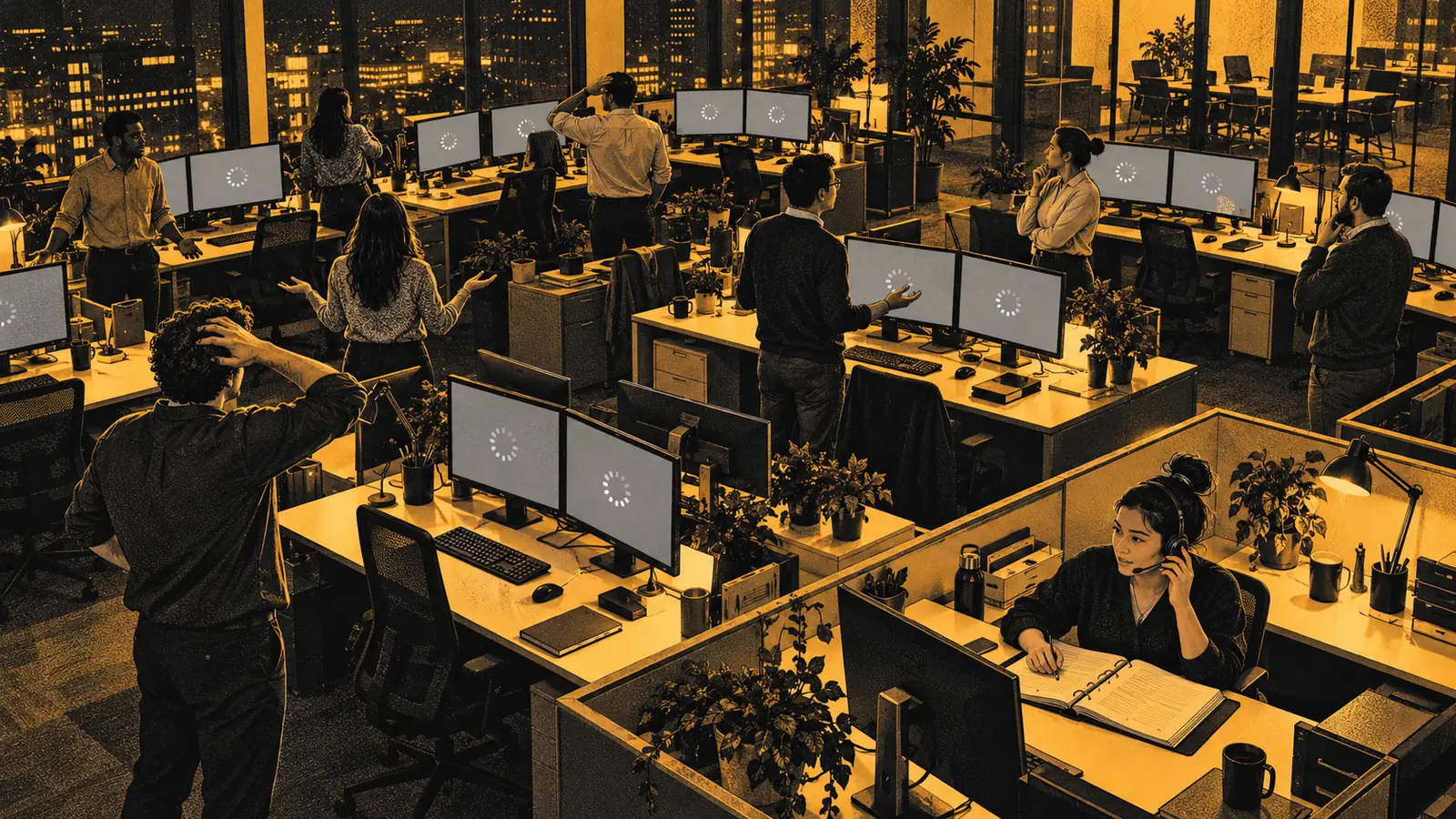
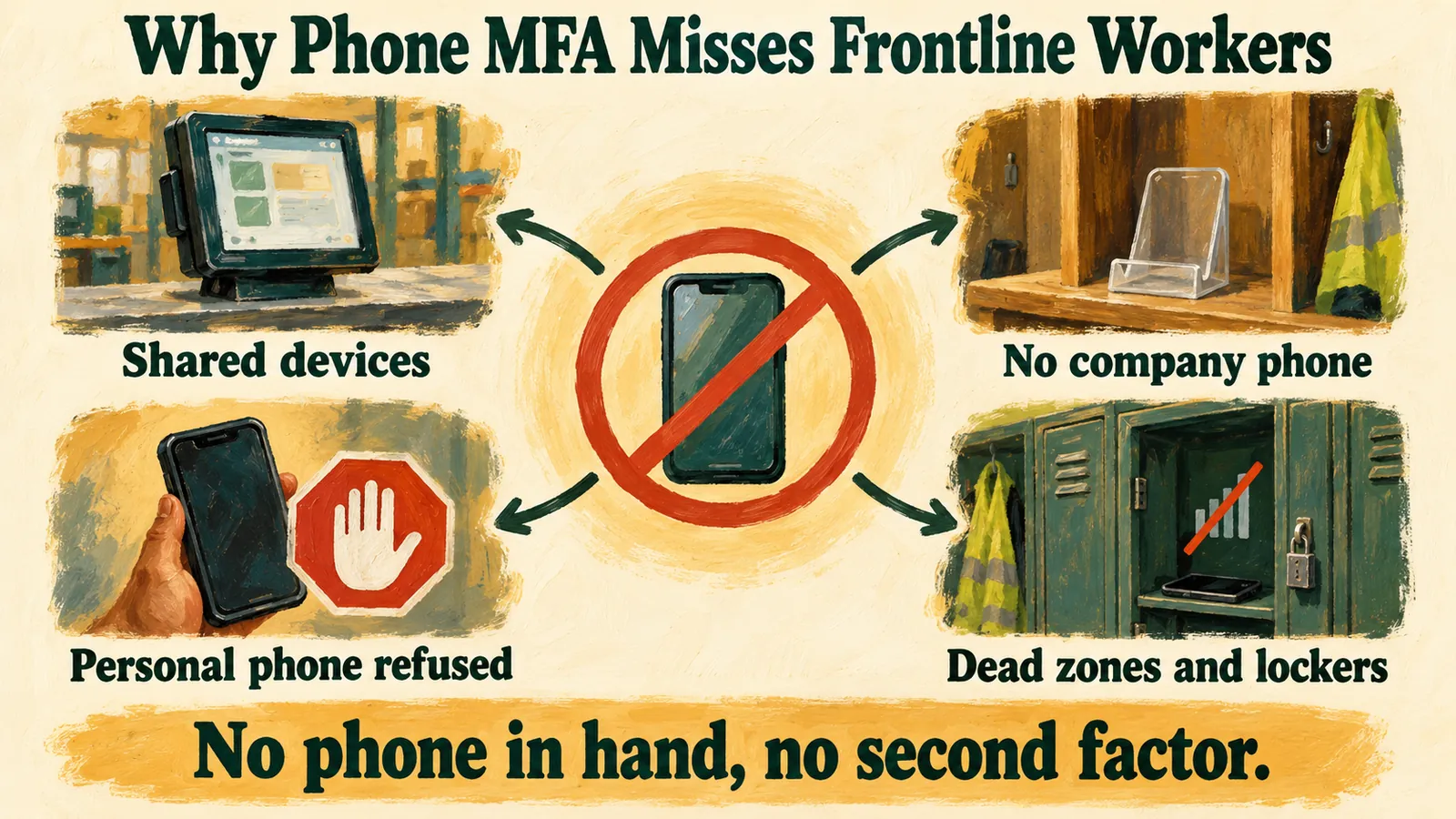 Four ordinary shift conditions, one result: a phone-based factor that isn't there when the frontline worker needs to sign in.
How a printed card works as a second factor
In Avatier's framing, the Identity Challenge Card defines the Identity Continuity Layer, an infrastructure layer that ensures authentication persists when device-dependent systems fail. The definitional post covers the category. For frontline workers, the practical question is what the card asks of them.
Avatier describes three factors, resolved locally, without a device, in under 10 seconds:
- The card. A printed grid organized by coordinates such as A1 or C2, with a top and a bottom word at each. The system asks for a coordinate, and the worker reads the answer off the card.
- A private PIN. A short PIN only the worker knows, bound to the card through policy.
- The worker's directory identity. An Employee ID, a badge, or a SCIM-provisioned principal, which ties the challenge to a specific person.
All three are required: the word and the PIN both have to be correct. Each coordinate value is one-time, so a used word is spent. There are no push notifications, so push fatigue has no surface. And no phone number, biometric, or personal data touches the card.
The rollout fits a frontline workforce. Avatier describes deployment in under an hour, with no MDM, no app, and no hardware. Workers can self-enroll, or an organization can auto-enroll everyone at once. Cards are issued through the existing IGA workflow, and issuance, expiration, re-enrollment, and revocation are logged and policy-enforced. A lost card carries no personal data and is useless without the PIN. It's revoked in seconds and replaced the same day, with no device pairing to redo.
Language matters too, because the worker has to find a coordinate and read a word, sometimes aloud to an agent. The card ships in 34 languages, including right-to-left Arabic and the CJK scripts for Chinese, Japanese, and Korean, with the same three-factor flow in each.
The card at three moments: login, password reset, and the service desk
Avatier positions one card across the three moments a credential gets proven, replaced, or recovered.
- Login, with or without a password. Some sites keep the password and add a factor, and some sign in without one. The card is the factor either way. With a password, once it's accepted the screen shows a coordinate, the worker reads the matching word off the grid and adds the PIN, and their directory identity resolves automatically, with nothing to approve. Without a password, on shared workstations and virtual desktops, the factor isn't provisioned into the machine. It's in the worker's pocket.
- Password reset. A locked-out worker resolves it themselves. A coordinate appears, the worker reads the word and adds the PIN, the employee ID is verified automatically, and then the password changes. There's no call and no ticket, and it still works when the phone is dead, out of signal, or in a locker. Every challenge and re-issue lands in the identity governance the organization already runs.
- The service desk. A worker calls asking for their access back. The agent names a coordinate, the caller reads the word off their printed card, and that value is spent. The desk resolves the answer against the grid locally, with no identity-provider call. In Avatier's words, the old script was "a list of questions an attacker can research," and what's on the card isn't online or on a device. Our AI call center authentication guide covers the wider caller-verification workflow.
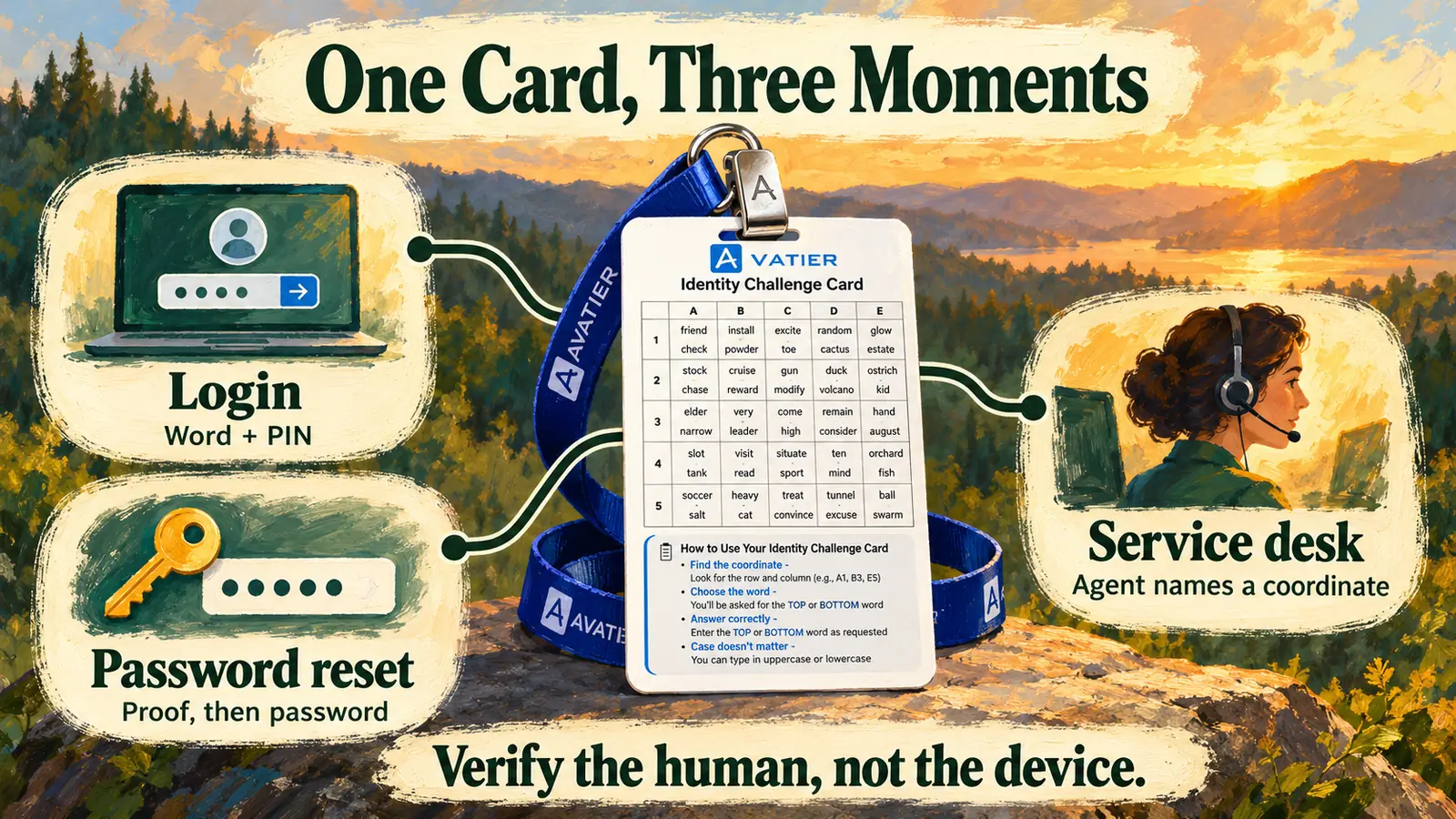 The same printed card proves identity at sign-in, before a password changes, and on a service desk call, with no phone involved.
Policy decides who uses it. In Avatier's description, the card sits alongside the MFA you already run, and policy routes each worker to the right method, even where device MFA can't reach. As a general pattern, workers with managed devices keep their current method, and shared-station roles use the card as their factor.
What Avatier ships toward this pattern
- Identity Challenge Card™. The printed, three-factor card for login, reset, and the service desk. The card can also be added to Apple Wallet, Google Wallet, or Samsung Wallet, alongside the printed card, not instead of it. For the product and a live demo, see the Identity Challenge Card.
- Credential Governance™ pillars. Avatier Strong MFA Login binds a second factor, including the Identity Challenge Card, to every password authentication event. Assisted Reset, Pillar 3 of Credential Governance, gives service desk agents a governed way to verify users before sensitive credential actions, and supports deviceless verification for air-gapped and restricted environments with the card. For the service-desk side, see Assisted Reset.
- The wider platform. For Avatier's AI-native identity platform, see the Avatier Identity Anywhere 2027™ preview. For company background, see avatier.com.
- Security posture. Avatier is SOC 2 Type II audited with no exceptions noted and ISO/IEC 27001:2022 certified. For details, see the Avatier Trust Center.
About the author

More from Frontline & Shared Devices
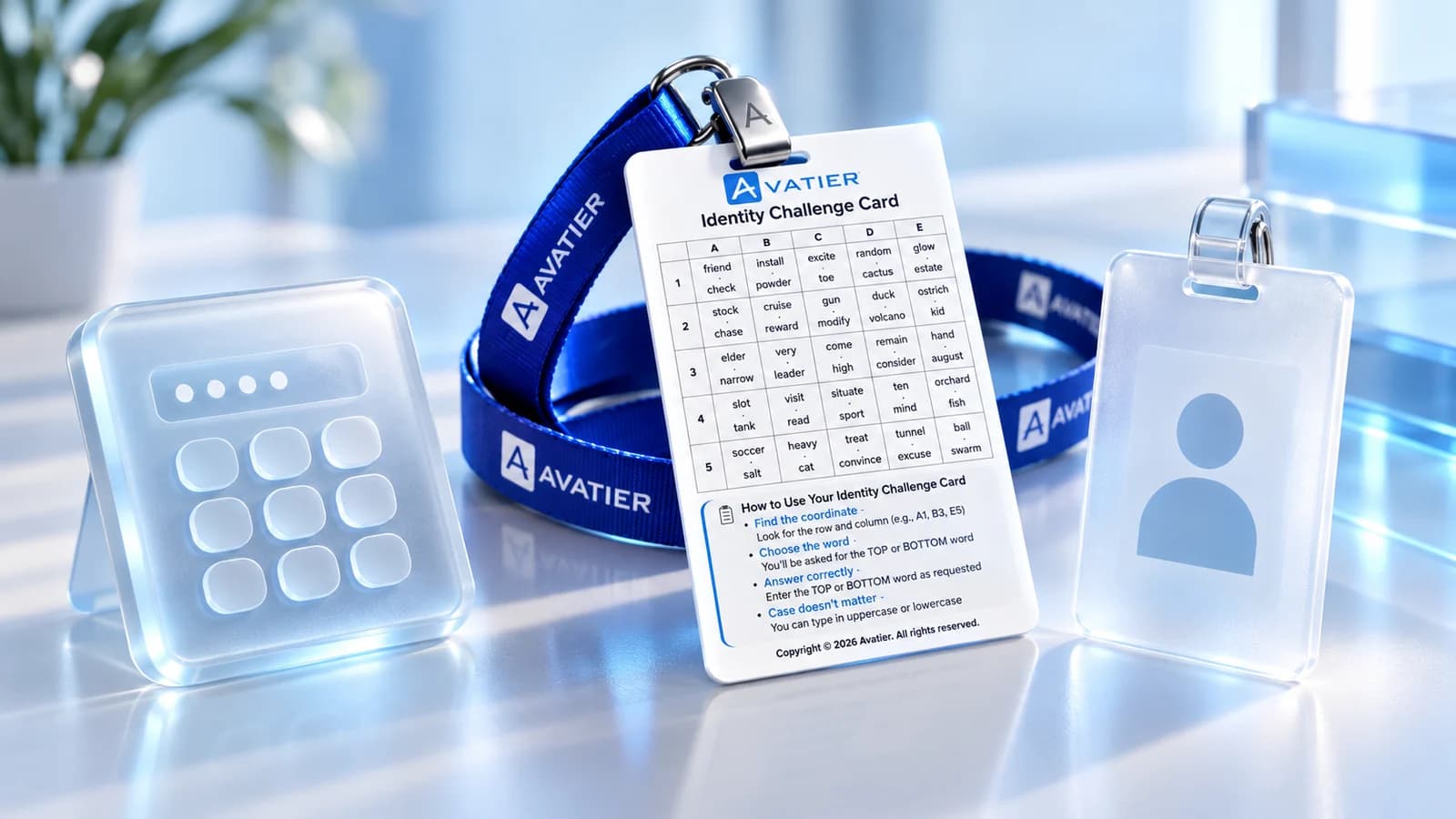
Three-Factor Authentication Explained: The Identity Challenge Card
What three-factor authentication is, how 3FA differs from 2FA, and how Avatier's Identity Challenge Card checks three factors: a printed grid card, a private PIN and a directory identity.
When Your IdP or MFA Goes Down: Avatier's Identity Challenge Card
When the identity provider, MFA service or devices go down, people still have to prove who they are. A runbook for verifying, restoring and recording access with Avatier's printed card.

Air-Gapped MFA for Phone-Free Sites: Avatier's Identity Challenge Card
Air-gapped MFA for sites where phones are banned or networks don't reach. How Avatier's printed Identity Challenge Card verifies a worker locally, with no phone, no app and no network.