SSO Architecture for Distributed Workforces in 2026
Single Sign-On for a distributed workforce — remote employees, hybrid schedules, contractor populations, partner organizations, and education-sector users — isn't the same problem it was when SSO meant SAML inside a corporate intranet. The 2026 reference on what SSO actually solves, where the architectural breakage modes live, and the federation patterns that survive contact with mixed workforces.
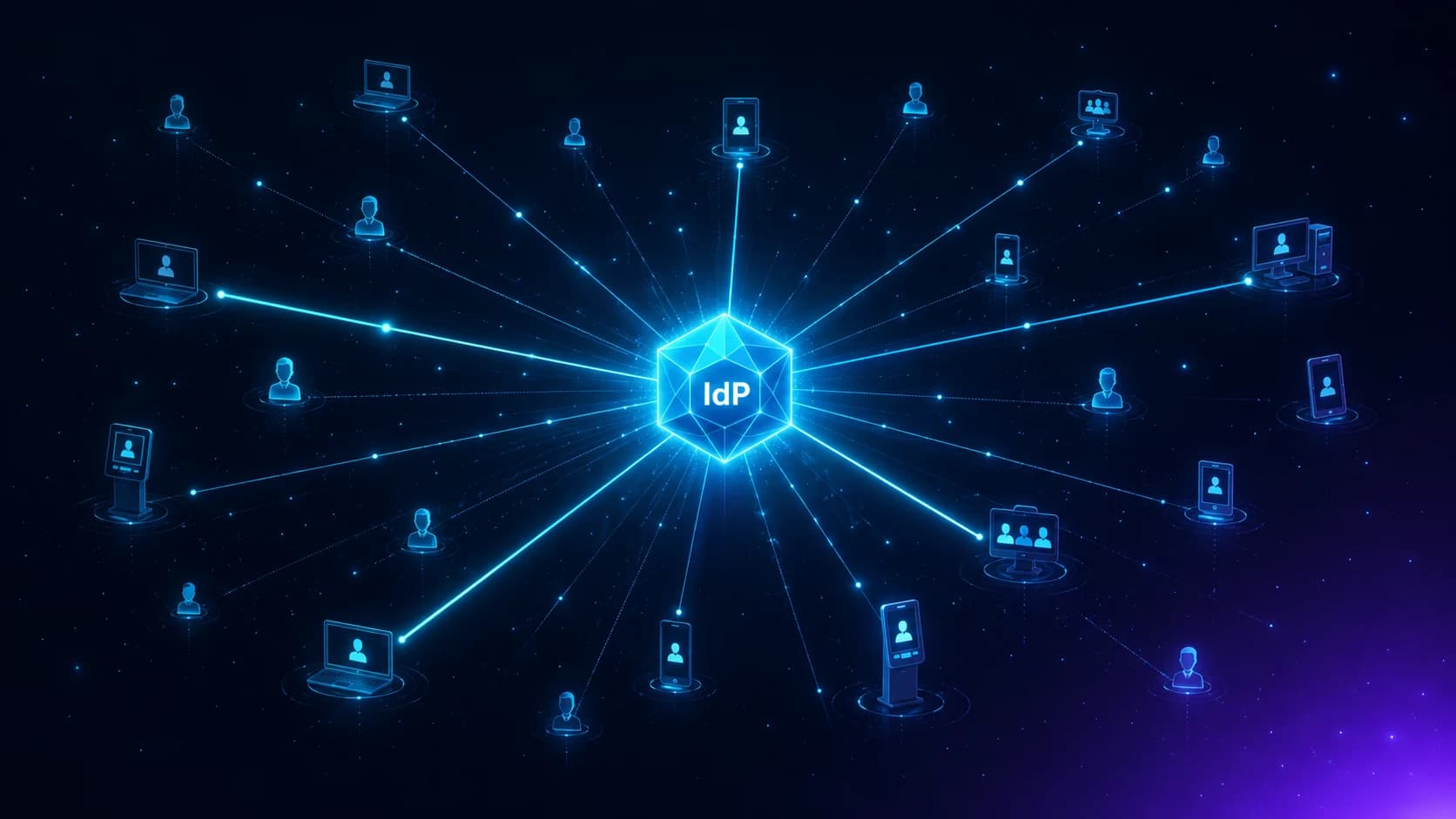
Single Sign-On for a distributed workforce — remote employees, hybrid schedules, contractor populations, partner organizations, and education-sector users — isn't the same problem it was when SSO meant SAML inside a corporate intranet. The 2026 reference on what SSO actually solves, where the architectural breakage modes live, and the federation patterns that survive contact with mixed workforces.
Single Sign-On as an architectural pattern is older than most of the people implementing it. The first major enterprise SSO products shipped in the mid-1990s. SAML 2.0 became the dominant federation protocol in 2005. The mental model most security architects still use — "users authenticate once at a central directory and then access applications without re-authenticating" — has been stable for two decades.
The implementation reality has changed substantially. SSO in 2005 meant a user inside the corporate firewall authenticating to Active Directory, then accessing internal applications that trusted the corporate domain. SSO in 2026 means a user on a home network authenticating to a cloud IdP, then accessing dozens of SaaS applications run by other companies, possibly while wearing different identity contexts (employee, contractor, partner, customer) within a single session. The protocols are similar; the architectural problem is fundamentally different.
This piece is the 2026 enterprise reference on SSO architecture for distributed workforces — remote employees, hybrid schedules, contractor populations, partner organizations, and education-sector users. The companion pieces handle adjacent territory: Authentication vs Authorization covers the federation protocols underneath SSO, Phishing-Resistant MFA covers the authentication ceremony SSO depends on, Passkey Deployment Playbook covers the credential layer, and the Best MFA Solutions buyer's guide covers the IdP vendor landscape. This piece is the SSO-specific layer that runs across all of them.
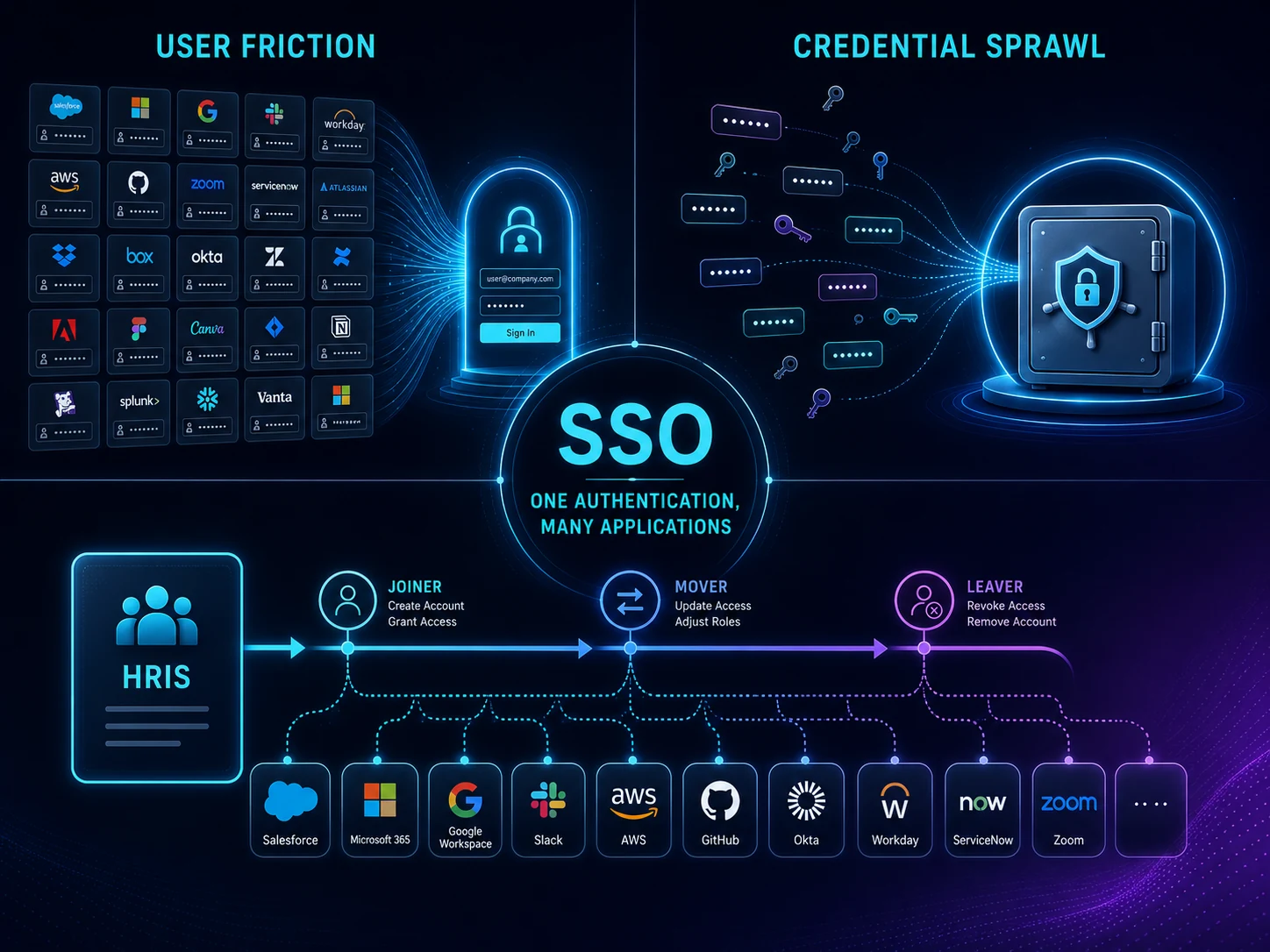 Three problems SSO actually solves — user friction, credential sprawl, lifecycle governance — and the lifecycle propagation pattern that makes the third one work at enterprise scale.
What SSO actually solves, and what it doesn't
Single Sign-On solves three real problems and creates one new one. Knowing which is which matters because SSO is sometimes deployed as if it solves problems it doesn't, and the architectural decisions that follow inherit the confusion.
Problem 1 — User friction. Without SSO, a user with access to twenty SaaS applications has twenty separate login flows, twenty separate password reset experiences, and twenty separate MFA enrollment ceremonies. The friction cost is enormous; the security cost is worse because users cope by reusing passwords or skipping MFA. SSO collapses the twenty flows into one. The user authenticates at the IdP, then access to the twenty applications is mediated by the federation protocol without user-visible re-authentication.
Problem 2 — Application credential sprawl. Without SSO, each application maintains its own user database with its own password hashes, its own session management, and its own audit log. The attack surface scales with the number of applications. SSO removes the per-application credential store — applications don't run user databases or check passwords; they trust the IdP's authentication assertion. Compromise of one application's session doesn't compromise the others because no application holds long-lived credentials.
Problem 3 — Lifecycle governance. Without SSO, when a user leaves the company, the IT team has to manually deprovision access from twenty applications. The drift between intended access state and actual access state grows over time. With SSO and the companion SCIM (System for Cross-domain Identity Management) provisioning protocol, the IdP can push lifecycle events (joiner, mover, leaver) into federated applications automatically — a leaver event at the IdP cascades into deprovisioning across every SCIM-connected application. Our Best ILM Solutions piece covers the lifecycle layer this depends on.
The new problem SSO creates — single point of failure for authentication. With SSO, if the IdP is compromised or unavailable, the user cannot access any federated application. The blast radius of an IdP compromise is enormous — the canonical example is the 2022-2023 Okta incidents, where IdP-level compromise gave attackers indirect access to thousands of downstream customer applications. The architectural response is to harden the IdP layer disproportionately compared to individual applications: phishing-resistant MFA at the IdP for all users (not just admins), strict conditional access policies, monitored federation broker behavior, and independent recovery paths for IdP outages.
The strategic point is that SSO is a layer of architecture, not a feature. Treating SSO as "we'll add OAuth to our login button" misses what's actually happening — the application is delegating authentication entirely to the IdP, with all the implications for trust, audit, lifecycle, and incident response that delegation creates.
The four SSO protocols that matter in 2026
Enterprise SSO architectures in 2026 use four protocols, sometimes simultaneously. Each handles a different position in the federation stack.
SAML 2.0 is the oldest of the four and the most-deployed across legacy enterprise SaaS. The protocol uses XML-based assertions signed by the IdP and consumed by the relying party. A SAML flow typically involves a browser-mediated redirect from the application to the IdP, an authentication ceremony at the IdP, and a signed SAML response posted back to the application via the browser. SAML predates OAuth and is more verbose and harder to debug, but it works reliably across the long tail of enterprise SaaS where SAML integration was established before OIDC became standard. Migration from SAML to OIDC is a multi-year project most enterprises haven't completed.
OpenID Connect (OIDC) is the modern standard built on top of OAuth 2.0. OIDC adds an ID token (a signed JSON Web Token containing identity claims) alongside the OAuth access token. The relying party verifies the ID token's signature and consumes the identity claims; the access token is separately used for authorization to specific API scopes. OIDC is the dominant pattern for new federation integrations in 2026, including most consumer-facing SaaS, mobile applications, and modern enterprise tools. Most major IdPs (Microsoft Entra ID, Okta, Ping, Google Workspace, ForgeRock, Avatier Identity Anywhere) support OIDC as the default federation pattern for new applications.
OAuth 2.0 is a related but distinct protocol. OAuth is fundamentally an authorization framework — it issues access tokens that authorize a client application to access specific resources on a user's behalf, with scoped permissions. OAuth alone does not authenticate the user; OIDC adds the authentication layer on top. In SSO architectures, OAuth handles the service-to-service authorization underneath OIDC's user authentication. Understanding the OAuth/OIDC relationship is what separates an SSO architecture that handles authorization cleanly from one where the "auth" layer is doing too many jobs at once.
Kerberos is the Windows-domain-bound authentication and SSO protocol. Kerberos issues tickets — the ticket-granting ticket (TGT) and service tickets — that prove the user authenticated at the Key Distribution Center (KDC, typically Active Directory). Kerberos works exceptionally well inside the corporate network where domain membership and KDC reachability are guaranteed. It works less well for distributed workforces because Kerberos depends on time synchronization and network reachability to the KDC. Modern enterprises run Kerberos for on-prem and hybrid workloads, OIDC/SAML for cloud-hosted SaaS, and federation broker functionality that translates between them as needed.
The 2026 enterprise architecture usually runs all four simultaneously. OIDC for modern SaaS. SAML for legacy SaaS where integration was established years ago and migration cost outweighs migration value. OAuth for service-to-service flows underneath OIDC. Kerberos inside the Windows-bound on-prem environment. The IdP's federation broker layer is what translates between the four when needed.
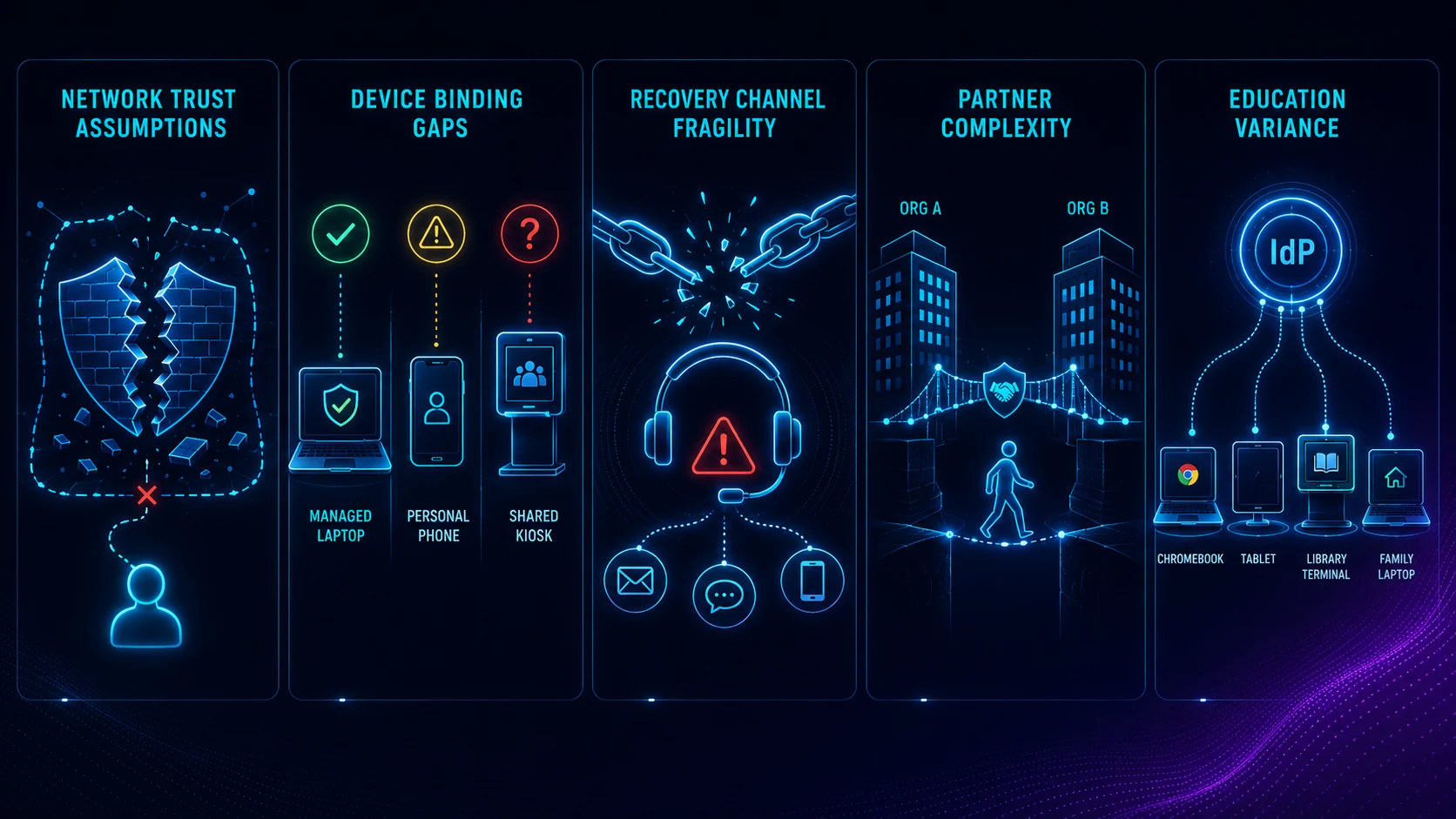 Five predictable breakage modes when traditional SSO meets the distributed-workforce reality. Each one represents an assumption inherited from the corporate-intranet era that no longer holds.
Where SSO breaks for distributed workforces
SSO deployments designed for the corporate intranet break in predictable ways when the workforce becomes distributed. Five breakage modes show up across most enterprises that haven't refactored their SSO architecture for 2026 reality.
Network-trust assumptions. Traditional SSO architectures assume the user is on the corporate network when authenticating. The IdP is reachable via internal DNS, applications trust the corporate domain by network proximity, and risk-evaluation policies are tuned for "is the user inside the firewall." When users authenticate from home networks, coffee shops, partner-organization offices, and personal devices, those assumptions break. The architectural response is to remove network position from the trust signal entirely — the modern pattern (zero-trust) treats every request as untrusted regardless of origin, with conditional access evaluating identity, device posture, behavior, and context at every session establishment.
Device-binding gaps. Traditional SSO assumed the device the user authenticated from was a managed corporate laptop with known security posture. Distributed workforces use personal devices, contractor-supplied devices, and shared-workstation devices the enterprise doesn't manage. The 2026 architectural response is to treat device posture as a first-class authentication signal — managed devices get full session access, unmanaged devices get restricted scope or step-up authentication for sensitive operations. Microsoft Entra ID's Conditional Access, Okta's Device Trust, and Ping's risk-based access patterns all implement this; the deployment quality varies by enterprise.
Recovery channel fragility. Distributed workforces have more authenticator-loss events than centralized ones — phones are lost more often, laptops break more often, contractor populations have higher turnover. The recovery flow that issues new credentials when the original is gone needs to be workflow-verified rather than knowledge-based — exactly the Storm-2949 lesson covered in our Storm-2949 governance failure analysis. SSO doesn't fix the recovery channel; it makes the recovery channel more important because a compromised SSO recovery is one path to compromising every federated application.
Partner and contractor identity complexity. Distributed workforces include people who are partially "yours" — partner-organization employees who need limited access to your applications, contractors with bounded scope, alumni with archival access. SSO architecture has to handle these populations differently from full employees. Cross-domain federation (where Partner A's IdP federates with Partner B's applications via SAML or OIDC) is the standard pattern; the operational complexity is bounded but real. Get the federation right and the partner population is just another lifecycle scope; get it wrong and you end up with shadow user records and access state that nobody can audit.
Education-sector device and identity variance. Education workforces (K-12, higher ed, training organizations) have all the distributed-workforce challenges plus students using family devices, public-library terminals, and school-issued Chromebooks with shared profiles. The SSO architecture has to handle the breadth of authentication contexts — the IdP and federation flow need to work in browser, on mobile, on Chromebooks, on shared workstations, and through learning-management-system embedded contexts (LMS-launched authentication, LTI deep linking). The InCommon Federation (US higher ed) and equivalents in other countries provide federation infrastructure for the education segment; the per-institution architecture still has to compose with whatever the LMS, library, and research-resource providers require.
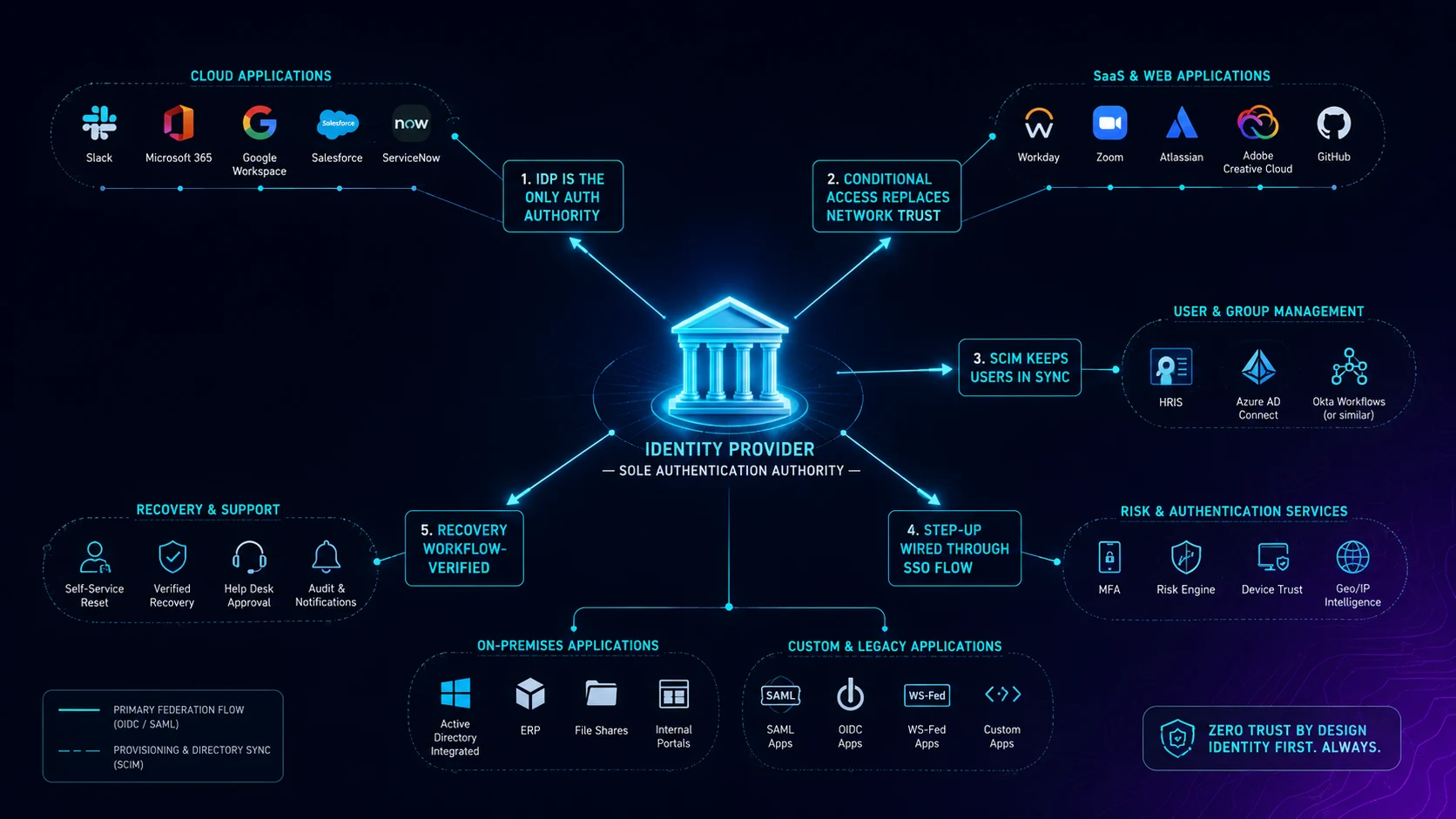 Five design properties radiating from a single IdP-as-sole-authentication-authority core. The architecture that ships clean for distributed workforces composes all five — the architectural test is whether the deployment actually has them all in place.
The architecture that ships clean for distributed workforces
Enterprise SSO architectures that ship clean for distributed workforces in 2026 share five design properties. None of them are novel — they're well-documented zero-trust patterns. The differentiator is whether the SSO layer composes with them or fights them.
Property 1: The IdP is the only authentication authority. Every federated application delegates authentication to the IdP via OIDC or SAML. No application runs its own user database, no application checks passwords, no application maintains its own MFA enrollment. The IdP is the single source of truth for authentication — and the single point that gets disproportionate security investment (phishing-resistant MFA enforced for all users, strict conditional access, monitored federation broker behavior, independent IdP outage recovery).
Property 2: Conditional access policies replace network-trust assumptions. Instead of "is the user on the corporate network," the policy engine evaluates identity, device posture, behavioral signals, time of day, geographic location, and risk score. The decision is per-session (and increasingly per-resource access in zero-trust deployments). The IdP enforces conditional access on every authentication attempt regardless of where the user is connecting from.
Property 3: SCIM provisioning keeps user records in sync across federated applications. When a user is hired, the HRIS-driven joiner workflow creates the user at the IdP. The IdP pushes user creation into every SCIM-connected application via the SCIM protocol. When the user changes roles, the mover workflow updates the IdP, which propagates to applications. When the user leaves, the leaver workflow deprovisions at the IdP, which cascades into application-level deprovisioning. The 2026 pattern requires SCIM at every meaningful application boundary — otherwise lifecycle drift accumulates and audit failures follow.
Property 4: Step-up authentication is wired through the SSO flow. Sensitive operations don't trust the existing session — they request fresh authentication at a higher assurance level. The application sends the user back through the IdP with acr_values (or SAML equivalent) specifying the required authentication context. The IdP runs a fresh ceremony (hardware key, biometric-unlocked passkey, workflow-verified verification), issues an updated session token reflecting the fresher authentication, and the application proceeds. The step-up wiring is per-operation, not global.
Property 5: Recovery and offboarding flows are workflow-verified. When a user loses their authenticator, the recovery flow runs through workflow-verified help-desk verification (the Storm-2949 mitigation pattern) rather than knowledge-based questions. When a user offboards, the leaver workflow cascades through every SCIM-connected application with explicit deprovisioning confirmation, not just session expiration. Both flows are auditable and tied to authoritative HRIS state, not to the discretionary judgment of individual help-desk agents.
The five properties compose into an architecture where distributed-workforce SSO works without recreating the security gaps that distributed workforces would otherwise introduce. The architectural test is whether all five properties are actually in place — most enterprises have three or four and are missing one or two, which is where incidents tend to surface.
What Avatier ships toward this pattern
Avatier Identity Anywhere is a federation broker that supports the four SSO protocols enterprise architectures depend on — SAML 2.0 for legacy SaaS, OIDC for modern SaaS, OAuth 2.0 for service-to-service authorization, Kerberos for on-prem and hybrid workloads. The platform handles phishing-resistant MFA at the authentication layer (FIDO2/WebAuthn for passkeys, hardware FIDO2 keys for privileged accounts), plus the Avatier Identity Challenge Card for workforce segments where personal devices don't fit, and then federates that authentication into downstream applications via the standard protocols.
For distributed workforces specifically, the platform supports conditional access policies that evaluate device posture, geographic context, behavioral signals, and risk score at every session — removing network position as a trust signal. The integration with Avatier Identity Anywhere Lifecycle Management handles SCIM provisioning into federated applications driven by HRIS source-of-truth, so the lifecycle workflows (joiner, mover, leaver) propagate automatically across the SSO-connected application surface. Recovery flows tie through Password Station for workflow-verified resets — the architecture that closes the Storm-2949 social-engineering vector that defeats SSO recovery as effectively as it defeats any other.
For workforce segments where personal devices and corporate networks structurally don't apply — frontline shared workstations, contractor populations without managed devices, education-sector users on shared Chromebooks, defense facilities where phones aren't viable — the Avatier Identity Challenge Card provides deviceless authentication that composes with SSO through the platform's standard OIDC ID-token flow. The federation path is the same; the form factor adapts to the segment's operational constraints.
The Avatier Trust Center publishes our compliance posture (SOC 2 Type II zero exceptions, ISO/IEC 27001:2022, PCI DSS v4.0.1, CSA STAR Level 1, NIST 800-53 Rev. 5 aligned, CISA Secure-by-Design Pledge signatory). The architectural pattern works regardless of vendor — the point of this piece is not that you have to buy Avatier — but the integrated pattern of federation broker + conditional access + SCIM lifecycle + workflow-verified recovery + deviceless fallback is what separates an SSO architecture that actually serves distributed workforces from one that recreates the corporate-intranet assumptions in a cloud-hosted IdP.
The honest closing
SSO is one of the oldest patterns in enterprise identity and one of the most-deployed. The architecture, however, has shifted substantially since the corporate-intranet era. Distributed workforces — remote employees, hybrid schedules, contractor populations, partner organizations, education-sector users — require federation patterns that don't depend on network position, device homogeneity, or proximity to a corporate domain. The 2026 architecture pairs SSO with phishing-resistant MFA at the IdP, conditional access at every session, SCIM provisioning across the federated application surface, workflow-verified recovery, and explicit step-up authentication for sensitive operations. The enterprises that compose these layers cleanly produce an SSO experience that's both substantially more secure than the legacy intranet pattern and meaningfully better for the distributed users who depend on it. The enterprises that deploy SSO without refactoring the assumptions inherited from the 2005 architecture end up with SSO that works fine until it doesn't — typically at a moment when the gap between the assumed network trust and the actual user context is exactly what an attacker is exploiting.
About the author

More from Identity & Access Trends

AI-Driven Biometrics in 2026: Modalities, Liveness, and What's Next
AI has redefined what a biometric even is — turning static face and fingerprint checks into continuous, behavior-aware signal, and this is a field guide to the modalities behind that shift.

Biometrics in Sci-Fi Movies: A 2026 Reality Check
For sixty years, sci-fi has been showing us biometric authentication — palm scans, retinal lasers, voice prompts, faces unlocking doors. Now most of us authenticate with biometrics every morning before we've finished our coffee. What did sci-fi get right, what did it get hilariously wrong, and what does workforce biometric authentication actually look like in 2026?

Identity for AI Agents and Agentic Authentication 2026
AI agents need identities, credentials, and authentication ceremonies of their own — separate from the humans they act on behalf of, separate from the service accounts they're often confused with. The 2026 enterprise reference on the architectures that issue agent identity, the protocols that authenticate them, the delegation chain that keeps user authority intact, and where agentic auth deployments break.