The Hidden Challenges of OTP Authentication in 2026
OTP fails less on cryptography than on deliverability, SIM-swap and phishing exposure, UX friction, and compliance. The real challenges of one-time passwords in 2026 — and how to implement OTP well.

OTP fails less on cryptography than on deliverability, SIM-swap and phishing exposure, UX friction, and compliance. The real challenges of one-time passwords in 2026 — and how to implement OTP well.
- The hardest OTP problems are not cryptographic — they are deliverability (codes that arrive late or never), SIM-swap and real-time phishing exposure, UX friction that drives abandonment, and compliance drift where a passing MFA checkbox still fails NIST 800-63B verifier rules.
- Implement OTP well by hardening the verifier, not the token: rate-limit and throttle failed attempts, burn each code on first use for replay resistance, keep codes short-lived, and default to authenticator-app TOTP over SMS.
- SMS OTP is a restricted channel and email OTP is not a valid out-of-band channel under NIST SP 800-63B — treat SMS as documented fallback on a migration clock, never as the primary factor for high-value accounts.
- The recovery flow is the soft target: social engineering attacks the human asking for a reset, not the code math, so verify identity in recovery as rigorously as in login.
- OTP has a hard phishing-resistance ceiling — a correct code relayed through an adversary-in-the-middle proxy still authenticates the attacker, which is why workforce, privileged, and regulated access belong on FIDO2/passkeys.
The hidden challenges of OTP authentication in 2026 are almost never cryptographic. One-time passwords fail — or quietly erode — because of four operational realities: codes that do not reliably arrive (deliverability), channels that attackers hijack through SIM-swap and real-time phishing, friction that pushes users to route around the control, and a compliance gap where a passing MFA checkbox still misses the specific NIST SP 800-63B verifier rules. You address them by hardening the verifier rather than the token, defaulting to authenticator-app codes over SMS, keeping codes short-lived and single-use, verifying the human in recovery flows, and fencing OTP to the accounts where a phishable factor is acceptable. Everything else in this piece is the detail behind that answer.
This is the 2026 update of an earlier Avatier post, The Hidden Challenges of Implementing OTP Authentication. The original leaned on a stack of vendor- and analyst-attributed effectiveness numbers that have not aged well and that we cannot stand behind, so we have stripped them and rebuilt the piece around what has held up: the operational failure modes practitioners actually hit, and the public NIST specification that tells you how to run OTP responsibly. The threat landscape moved — adversary-in-the-middle phishing became commodity tooling and SIM-swap fraud industrialized — so the honest framing is less "OTP is a silver bullet" and more "here is exactly where OTP breaks, and how far careful implementation carries you."
The four real-world challenges of OTP authentication
Start with the map, because the individual problems make more sense once you see how they relate. An OTP deployment has four pressure points, and a mature program treats each as a design decision rather than an afterthought. Deliverability determines whether the code even reaches the user. Channel security determines whether an attacker can intercept or hijack it. User experience determines whether people tolerate the control or work around it. And compliance determines whether your configuration actually satisfies the standard you are audited against — which is a different and stricter test than "we have MFA."
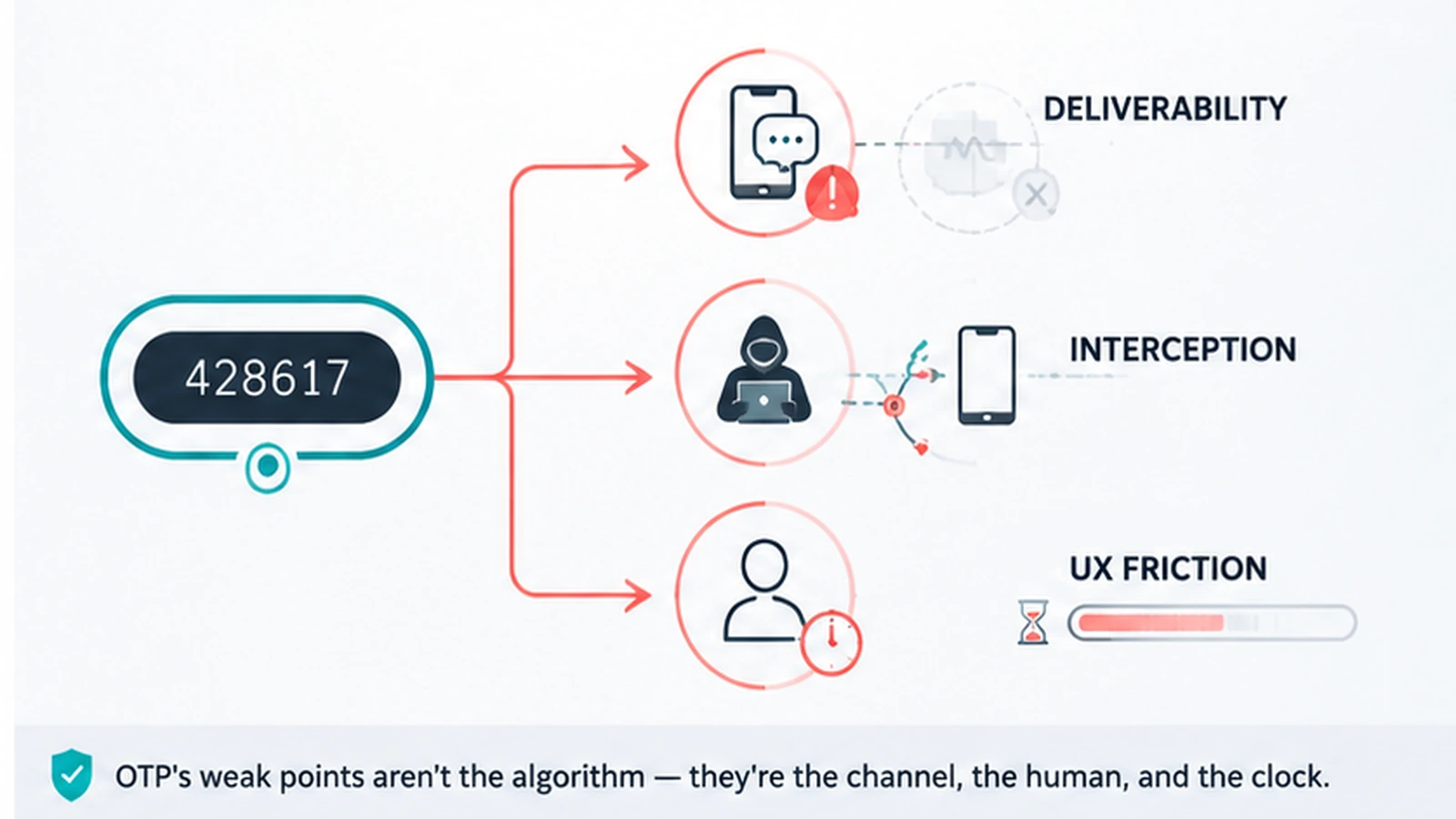 The four pressure points every OTP deployment lives or dies on — none about code math, all about delivery, interception, human tolerance, and compliance.
None of these are exotic. They are the reasons OTP projects generate help-desk tickets, security incidents, and audit findings even when the token library works perfectly. The rest of this piece takes them one at a time, then turns to implementation and compliance. If you want the broader framing of where OTP still earns its place versus where it has been replaced, our pros and cons of OTP breakdown sits alongside this one.
Deliverability: the challenge nobody budgets for
The first hidden challenge is the least glamorous and the most common: the code has to arrive, on time, every time, or the authentication simply fails. SMS delivery is subject to carrier filtering, aggregator throttling, international roaming delays, and number-portability edge cases. Email codes land in spam folders, get held by security gateways, or arrive minutes late behind greylisting. A code that is valid for 60 seconds but arrives in 90 is not a security control — it is a lockout.
Deliverability failures do not show up in a penetration test, so they rarely get budgeted. They show up in the help desk queue and in abandoned logins. When a code does not arrive, users request another, and another, which both trains them to expect delays and creates a window where multiple valid codes may be outstanding if the verifier is sloppy about invalidation. The operational cost compounds: every undelivered code is a potential support call, and password-and-OTP reset flows are already among the largest categories of help-desk volume.
The practical mitigations are unglamorous too. Default to a channel that does not depend on carrier delivery at all — an authenticator app generating TOTP offline removes the delivery path entirely, which is the single biggest deliverability win available. Where you must use SMS or email, monitor delivery-success rates as a first-class operational metric, set validity windows that account for realistic delivery latency without stretching so long that they widen the attack window, and give users a clear resend path that invalidates prior codes. Our guide to OTP authentication for organizations works through the enrollment and channel-selection decisions that keep deliverability from becoming a chronic tax.
SIM-swap, SS7, and the real-time phishing ceiling
The second challenge is the one security teams worry about most, and correctly so. The channels that are easiest to deploy are also the easiest to attack, and the attacks do not require defeating any cryptography.
SMS is the clearest example. SIM-swap fraud — convincing or bribing a carrier to move a victim's number to an attacker-controlled SIM — hands the attacker every code you send, and the user never sees a phishing page at all. SS7 signaling attacks let a suitably positioned adversary intercept messages in transit. Carrier-side social engineering achieves the same end through the support line. These are the reasons SMS sits in a restricted category under the current standard, and the reason a phone number should be treated as a weak binding to a person's identity rather than a strong one.
But the deeper ceiling applies to every OTP variant, not just SMS. Any flow where a human reads a code and types it somewhere is phishable through an adversary-in-the-middle (AiTM) proxy. Tooling like Evilginx presents a pixel-perfect login page, forwards the victim's password and OTP to the real service the instant they are entered, and captures the resulting session cookie. Every verifier rule is satisfied — the code was fresh, used once, correctly rate-limited — and the attacker still holds the session. This is structural. No amount of throttling, no shorter validity window, and no better delivery channel closes it, because the code is a shared secret in transit and the proxy simply relays it. We trace concrete versions of this pattern in our OTP failure case scenarios for enterprises, and the coercion variant — prompt-bombing a user into approving — in MFA fatigue attacks and defense patterns.
The honest read is that authenticator-app TOTP is a real improvement over SMS — it removes the SIM-swap and SS7 exposure and the delivery dependency — but it does not remove the AiTM exposure. TOTP is a better phishable factor, not a phishing-resistant one. That distinction drives the entire implementation and architecture discussion that follows.
UX friction and the abandonment problem
The third challenge is the one that silently defeats the other three: if the control is annoying enough, people route around it, and a control users evade provides no protection. OTP friction takes several forms. Every additional prompt is a chance for a user to abandon a transaction or a login. Clock-drift errors on TOTP produce confusing "invalid code" failures that feel like the system is broken. Lost or replaced phones strand users from their authenticator and generate recovery load. And repeated step-up challenges create fatigue that trains users to approve or type codes reflexively — which is exactly the reflex AiTM and prompt-bombing attacks exploit.
Friction is not only a conversion problem; it is a security problem, because the workarounds users adopt are usually worse than the control they are avoiding. Users who cannot receive a code call the help desk and ask a human to reset it — which moves the attack surface to the recovery flow. Users who find the authenticator app cumbersome push the organization back toward SMS. Users who are prompted constantly stop reading the prompts. Good OTP UX is therefore a security investment: fewer, better-targeted challenges (risk-based rather than blanket), clear and fast recovery paths that do not require a phone call, and enrollment support that gets people onto the strongest channel their situation allows.
There is also a workforce-segment reality that pure UX tuning cannot fix. Frontline staff on a factory floor, clinicians moving between shared workstations, and contractors without a managed phone often cannot use phone-bound OTP at all. For those segments the answer is a deviceless authenticator rather than a smoother code flow — a theme we return to in the Avatier section below.
How to implement OTP well: a best-practices checklist
If the first half of this piece is about where OTP breaks, this is where it holds. The security of an OTP deployment is decided far more by the verifier — the server that checks the code — than by the token that generates it. Get the verifier controls right and OTP is a legitimate second factor for the accounts it is suited to. Get them wrong and a six-digit code is a brute-force target.
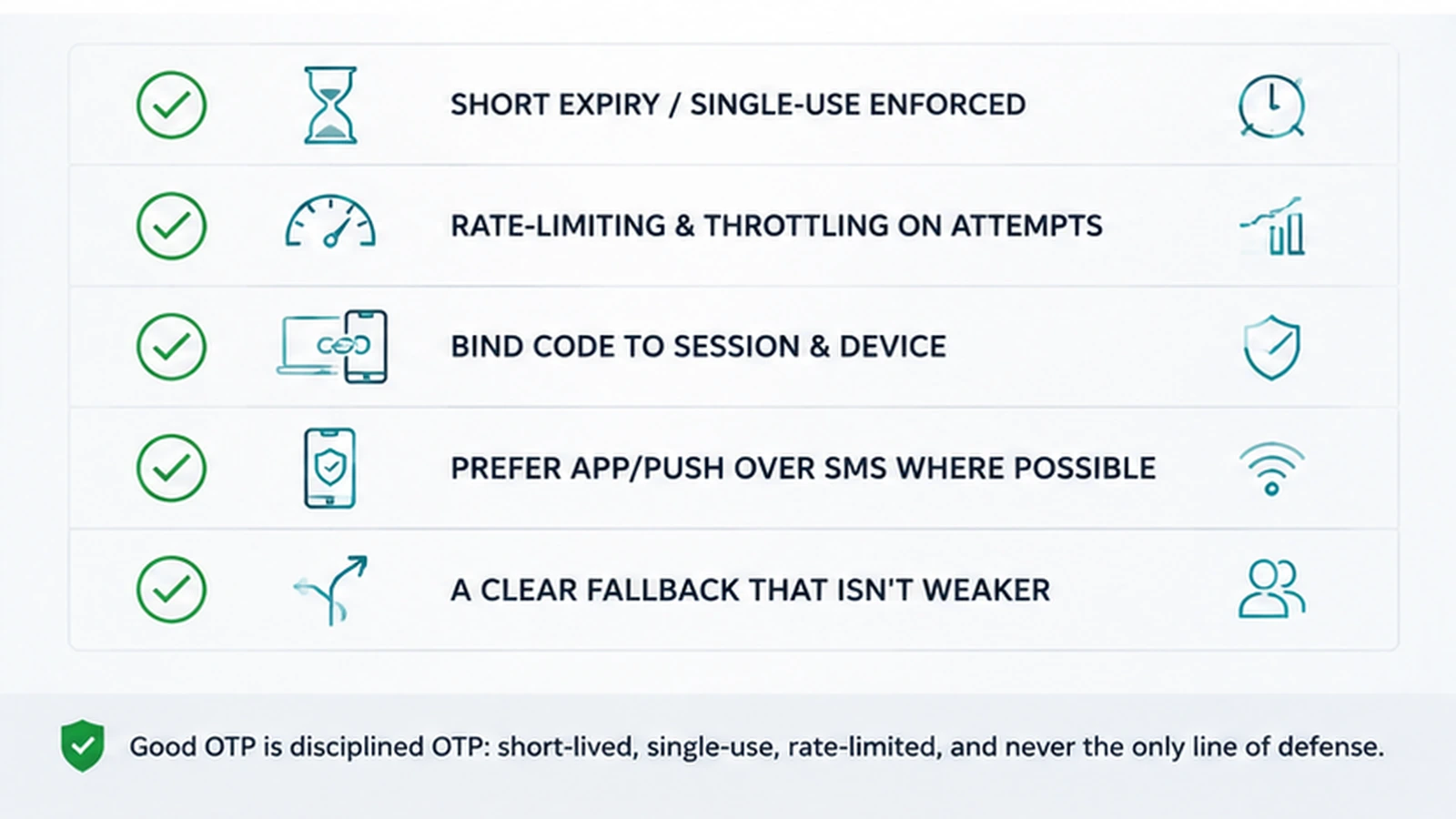 Implementing OTP well is verifier discipline — every item is a server-side control you configure once and enforce everywhere, independent of the token brand.
Work the checklist in order. Rate-limit and throttle failed attempts. A six-digit code has a million values and a lifetime measured in seconds; without a cap on failed guesses, an attacker who can submit attempts quickly will eventually land a valid one. Throttle consecutive failures — NIST references a ceiling of no more than 100 — with progressive backoff, temporary lockout, or CAPTCHA, counted per account and ideally per source so distributed guessing is not free. Burn each code on first use. Replay resistance is not automatic just because codes expire; the failure mode is a verifier that accepts a code anywhere inside a generous window without marking it consumed. The correct behavior is single-consumption — the moment a code authenticates, it is dead, even if the clock says it is still valid.
Prefer TOTP over SMS, and never use email as an out-of-band factor. Authenticator-app codes remove the delivery dependency and the SIM-swap exposure in one move. Keep validity windows tight — 30 to 60 seconds for primary login, with longer windows reserved for reset flows where deliverability outweighs blast radius. Harden the recovery flow, because self-service reset and help-desk-assisted recovery are where social engineering does its work; verify the identity of the human asking, not merely the possession of a code. And pair OTP with a phishing-resistant primary factor for anything high-value, so OTP carries the fallback and low-impact load while a stronger factor carries the accounts that matter. For the verifier requirements in full standards detail, our OTP under NIST 800-63B defense playbook is the companion reference.
OTP and compliance: what NIST 800-63B actually asks for
The fourth challenge is the one that surprises teams at audit time. "We deployed MFA" satisfies the letter of many mandates, but it does not automatically satisfy NIST SP 800-63B, which is the specification most modern frameworks either adopt or echo. The standard does not ban OTP — it tells you precisely how to run it, and its requirements land on the verifier, not the token.
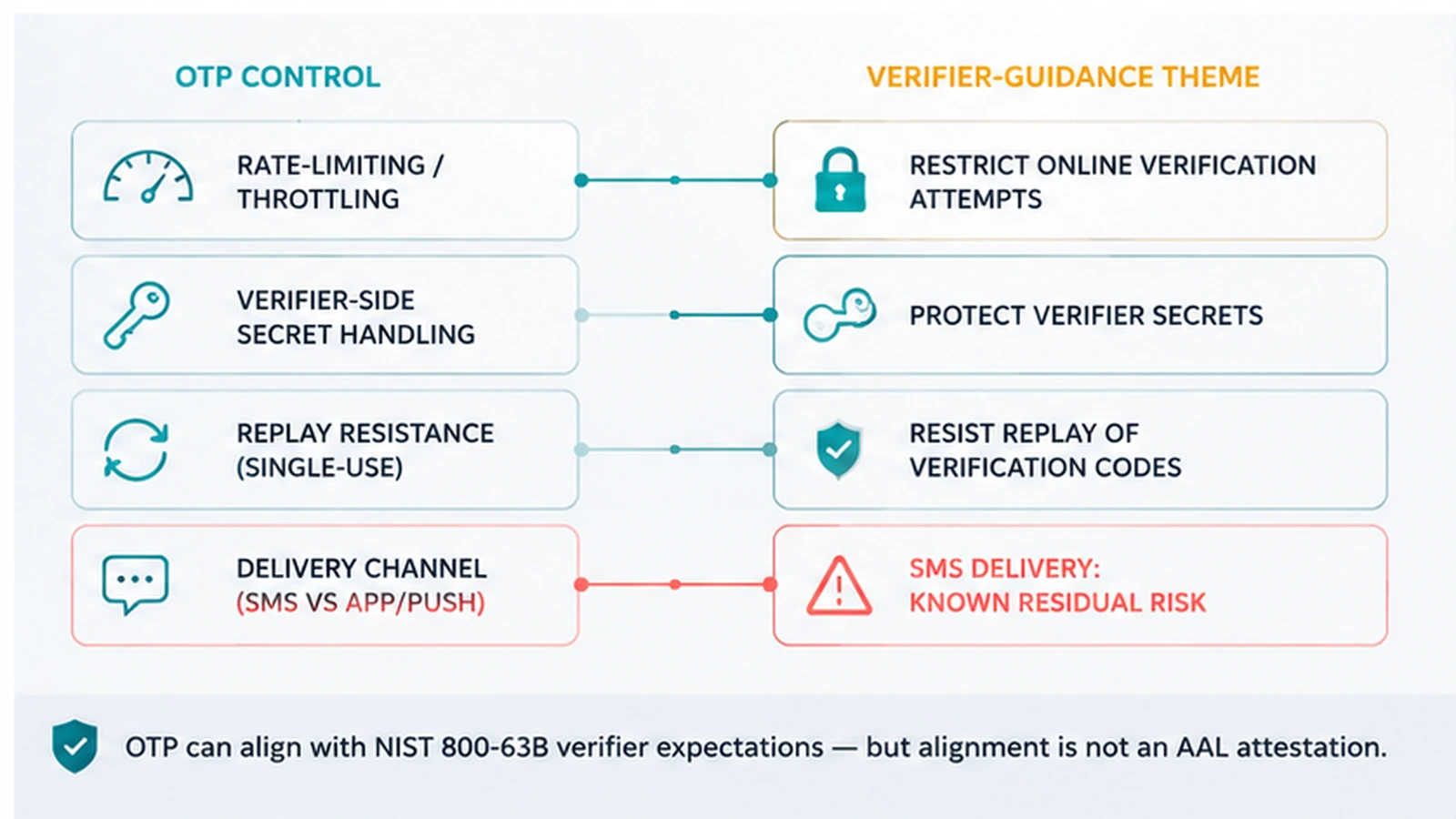 Compliance is configuration, not a label. Each row is a verifier obligation to hold a deployment against — and the last row is the one no OTP can satisfy.
Read the table as your audit checklist. Rate-limiting and replay resistance are the two controls that make a short code defensible, and both are things an auditor can ask you to demonstrate. The channel rules are categorical: email is not a valid out-of-band channel because an inbox is an account, not a device, and delivering a code there usually collapses your second factor back into "something you know." SMS is a restricted authenticator — permitted, but only with a documented risk assessment, a meaningful user notice, at least one non-restricted alternative, and a roadmap for migrating off it. That is a materially different posture from "SMS is fine."
The row that no configuration satisfies is the last one. OTP cannot reach the highest assurance level because it is not verifier-impersonation-resistant — the property NIST uses for phishing resistance. A well-configured multi-factor OTP device can support AAL2; none reach AAL3. This matters for how you describe your program: it is accurate to say a deployment is configured to the 800-63B verifier requirements, and inaccurate to claim a product "is AAL2" or "is AAL3," because assurance levels describe an authentication ceremony as deployed and assessed, not a vendor. The same discipline applies to adjacent controls like password and reset policy, which the sister analysis on enterprise password policy covers for the credential side of the house.
What are the best OTP tools for compliance and security?
Practitioners asking this question usually want a shortlist, so here is the crisp version. For the token itself, authenticator-app TOTP — Microsoft Authenticator, Google Authenticator, Duo Mobile, 1Password, and equivalents — beats SMS on every axis that matters: no delivery dependency, no SIM-swap exposure, and a clean AAL2-capable profile. Hardware OTP fobs are operationally durable where a phone is not available. SMS and email belong in the fallback-and-recovery tier only.
But the tool that decides your compliance and security posture is not the code generator — it is the platform that enforces the verifier controls consistently across every application. The best choice is whichever identity platform lets you configure and prove the 800-63B requirements: rate-limiting and lockout you can tune, single-consumption codes, out-of-band delivery to registered devices rather than accounts, and self-service recovery gated by real identity verification rather than a support agent's judgment. Token brand is a detail; verifier discipline is the product. And the strongest posture does not stop at OTP at all — it pairs well-configured OTP for low-impact and fallback use with phishing-resistant FIDO2 or passkeys for the high-value accounts, which our phishing-resistant MFA for enterprise reference lays out method by method.
What Avatier ships toward this pattern
Avatier's role here is to make the standard-compliant path the default one. On the OTP side, Identity Anywhere implements the verifier controls the standard asks for — throttling and lockout on failed attempts, single-consumption codes for replay resistance, and out-of-band delivery to registered devices rather than email. Password Station handles self-service password reset and account recovery with workflow-verified identity checks, which closes the social-engineering gap in recovery flows that no amount of code hygiene fixes on its own — the exact soft target described earlier in this piece.
On the other end of the spectrum, the platform is FIDO2-compatible across the full ceremony — origin binding, cryptographic challenge-response, and no shared-secret transmission — so the same system that runs your OTP fallback can carry passkeys and hardware security keys. For the workforce segments where personal devices do not fit — frontline staff, shared workstations, contractors — the deviceless Avatier Identity Challenge Card provides an option that does not depend on a phone receiving a code. The realistic 2026 architecture is not "OTP or FIDO2"; it is both, with OTP fenced to fallback and low-impact use while phishing-resistant factors carry the accounts whose compromise is expensive.
To keep the compliance framing honest: the Avatier Trust Center publishes the current posture — SOC 2 Type II with zero exceptions, ISO/IEC 27001:2022 certified, PCI DSS v4.0.1 compliant, CSA STAR Level 1, NIST 800-53 Rev. 5 aligned, FedRAMP-aligned, and a signatory to the CISA Secure-by-Design Pledge. Note what that list does and does not claim. It describes Avatier's organizational and product security posture. It does not assert an authenticator assurance level for any specific deployment, because AAL is a property of an authentication ceremony as configured and assessed in your environment — a distinction we hold to deliberately.
The honest closing: what OTP does not solve
Here is the residual weakness stated plainly. You can implement every best practice in this piece — throttle failed attempts to the letter, burn each code on first use, refuse email delivery, put SMS on a documented migration plan, and smooth the UX until abandonment is negligible — and OTP will still be phishable. A perfectly rate-limited, perfectly replay-resistant one-time password relayed through an adversary-in-the-middle proxy authenticates the attacker just as cleanly as it authenticates the user. The verifier requirements are real security value against guessing, reuse, interception, and SIM-swap. They were never a defense against real-time relay, and no configuration makes them one.
That is why the standard reserves its highest assurance level for verifier-impersonation-resistant methods and leaves OTP below the line. It is not a knock on OTP; it is an accurate statement of what a typed code can and cannot do. So the 2026 posture is a two-handed one: configure OTP correctly everywhere you keep it, and move past OTP everywhere the blast radius is high. Hold OTP to the verifier requirements so it is the best version of a phishable factor. Then deploy phishing-resistant credentials — passkeys, FIDO2 keys, or a deviceless card for the segments that cannot use either — for the accounts where "phishable, but well-configured" is not good enough. For most enterprises that is more accounts than they think, and the path from one to the other is the whole job.
Frequently asked questions
What are the main challenges of OTP authentication?
The main challenges of OTP authentication in 2026 are operational and architectural rather than cryptographic. Deliverability is first: SMS and email codes arrive late, out of order, or not at all because of carrier filtering, roaming, and spam rules, which turns a security control into a support-desk problem. Second is exposure — SMS is hijacked through SIM-swap and SS7, and every typed code is replayable through a real-time adversary-in-the-middle proxy. Third is UX friction, where extra steps, clock drift, and lost devices drive abandonment and step-up fatigue. Fourth is compliance drift, where meeting a generic MFA requirement still fails the specific NIST SP 800-63B verifier rules. Address each deliberately or the control quietly erodes.
How do you implement OTP authentication securely?
Implement OTP securely by hardening the verifier — the server that checks the code — because that is where the security actually lives. Rate-limit and throttle consecutive failed attempts so a six-digit code cannot be brute-forced online. Enforce replay resistance by burning each code the instant it is consumed, even if its time window has not closed. Keep codes short-lived: 30 to 60 seconds for primary OTP, longer only for reset flows where deliverability matters more than blast radius. Default to authenticator-app TOTP rather than SMS, and keep SMS only as a documented fallback. Finally, verify the human in recovery flows, not just the code, and pair OTP with a phishing-resistant primary factor for high-value accounts.
What are OTP best practices?
OTP best practices center on the verifier and the channel. Throttle failed attempts and apply progressive backoff or lockout so short codes resist online guessing. Accept each code exactly once for replay resistance. Prefer authenticator-app TOTP over SMS, and never deliver codes over email as an out-of-band factor. Keep validity windows tight — around 30 to 60 seconds for login. Monitor delivery success and failed-attempt patterns as security signals. Harden self-service recovery with real identity verification so social engineering cannot reset around your controls. And fence OTP to fallback, recovery, and low-impact use while carrying workforce, privileged, and regulated access on phishing-resistant FIDO2 or passkeys.
What are the best OTP tools for compliance and security?
The best OTP tooling for compliance and security is whatever lets you enforce the NIST SP 800-63B verifier requirements consistently: authenticator-app TOTP (Microsoft Authenticator, Google Authenticator, Duo, 1Password) rather than SMS, backed by a platform that rate-limits, throttles, and enforces single-use codes. For enterprise deployments, an identity platform that centralizes those controls — configurable throttling and lockout, single-consumption codes, out-of-band delivery to registered devices, and workflow-verified self-service recovery — matters more than the token brand. The strongest posture pairs well-configured OTP for fallback and low-impact use with phishing-resistant FIDO2 or passkeys for high-value access. Choose tools by whether they let you configure to the standard, not by marketing claims.
Is OTP compliant with NIST 800-63B?
OTP can be run in a way that satisfies NIST SP 800-63B, but OTP is not automatically compliant. The standard places its obligations on the verifier: rate-limit and throttle failed attempts (the guidance references a ceiling of no more than 100 consecutive failures), enforce replay resistance, refuse email as an out-of-band channel, and treat SMS as a restricted authenticator allowed only with a risk assessment, user notice, and a migration plan. A properly configured multi-factor OTP device can support AAL2. What OTP cannot reach is AAL3, because that level requires verifier-impersonation resistance — phishing resistance — which a typed code does not provide. Compliance is about configuration, not the label OTP.
What is OTP compliance?
OTP compliance means running one-time passwords in a way that satisfies the specific requirements a framework sets — not just checking an MFA box. Under NIST SP 800-63B the requirements are concrete verifier controls: throttle failed attempts, enforce single-use replay resistance, prohibit email as out-of-band delivery, and classify SMS as restricted. Frameworks such as PCI DSS v4.0.1, HIPAA, and SOX generally accept OTP-based MFA as a baseline, but a baseline is a floor, not a design target. True OTP compliance also means documenting your risk assessment for any restricted channel, offering a non-restricted alternative, and maintaining a migration roadmap. The gap between a passing audit and an actually hardened deployment is where most programs drift.
Is SMS OTP secure enough for enterprise use in 2026?
SMS OTP is not secure enough to be the primary factor for enterprise, privileged, or regulated access in 2026. NIST SP 800-63B classifies SMS as a restricted authenticator because of SIM-swap fraud, SS7 signaling attacks, and carrier social engineering — none of which require breaking any cryptography, only breaking the assumption that a phone number maps to one person's device. SMS also carries the worst deliverability profile of any channel. It remains a defensible fallback and recovery option behind a stronger primary factor, and it is acceptable for low-impact consumer accounts. But if administrators authenticate with a text message, the standard is telling you, in its own careful language, to have a plan to replace it.
Does OTP stop phishing attacks?
No. OTP does not stop modern phishing, and this is its most important limitation. Any OTP variant where a user reads a code and types it elsewhere — SMS, email, TOTP, hardware token — can be captured on a look-alike login page and relayed to the real service in real time by an adversary-in-the-middle proxy such as Evilginx. The code is fresh, used once, correctly rate-limited, and the attacker still walks away with the session cookie. Rate-limiting and replay resistance defeat guessing and reuse; they are silent against real-time relay. Only FIDO2/WebAuthn credentials, which bind the ceremony to the real origin, are phishing-resistant by design. For high-value access, move past OTP.
Bottom line
The hidden challenges of OTP authentication are not in the algorithm — they are in delivery, interception, human tolerance, and standards conformance. Codes have to arrive, channels have to resist SIM-swap and relay, users have to accept the friction, and the configuration has to satisfy the verifier rules an auditor actually tests. Implement OTP well by hardening the verifier: throttle failed attempts, burn each code on first use, keep windows tight, default to authenticator-app TOTP, and verify the human in recovery. Then be honest about the ceiling — a correctly implemented OTP is still phishable through real-time relay, so keep it for fallback and low-impact access and move workforce, privileged, and regulated accounts onto FIDO2 and passkeys. Configure OTP to the standard everywhere you keep it, and let the blast radius — not habit — decide which accounts sit on which factor.
About the author

More from MFA & Authentication

What Is an Identity Continuity Layer? Authentication When Devices Fail
An Identity Continuity Layer keeps authentication working when phones are lost, batteries die, or signal drops. What it is, where device MFA breaks, and how the Identity Challenge Card fills the gap.
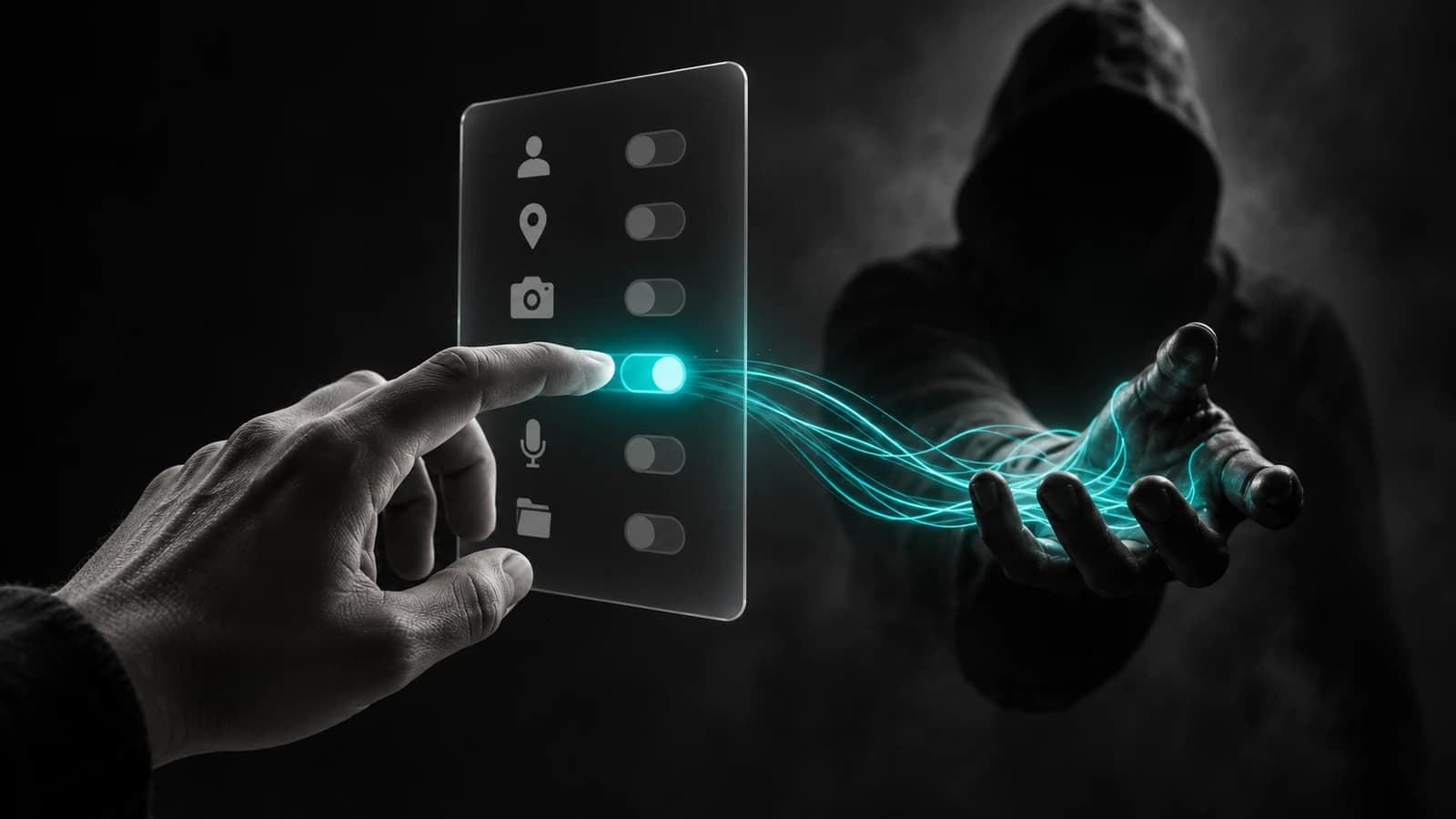
OAuth Consent Phishing: The Attack That Steals a Token, Not a Password
Consent phishing lures a user to a real OAuth consent screen for a malicious app, they click Allow, and the attacker walks away with a token that grants lasting access. Because no password is stolen, MFA never fires. The 2026 reference on how the illicit consent grant works and the app-governance defenses that actually stop it.
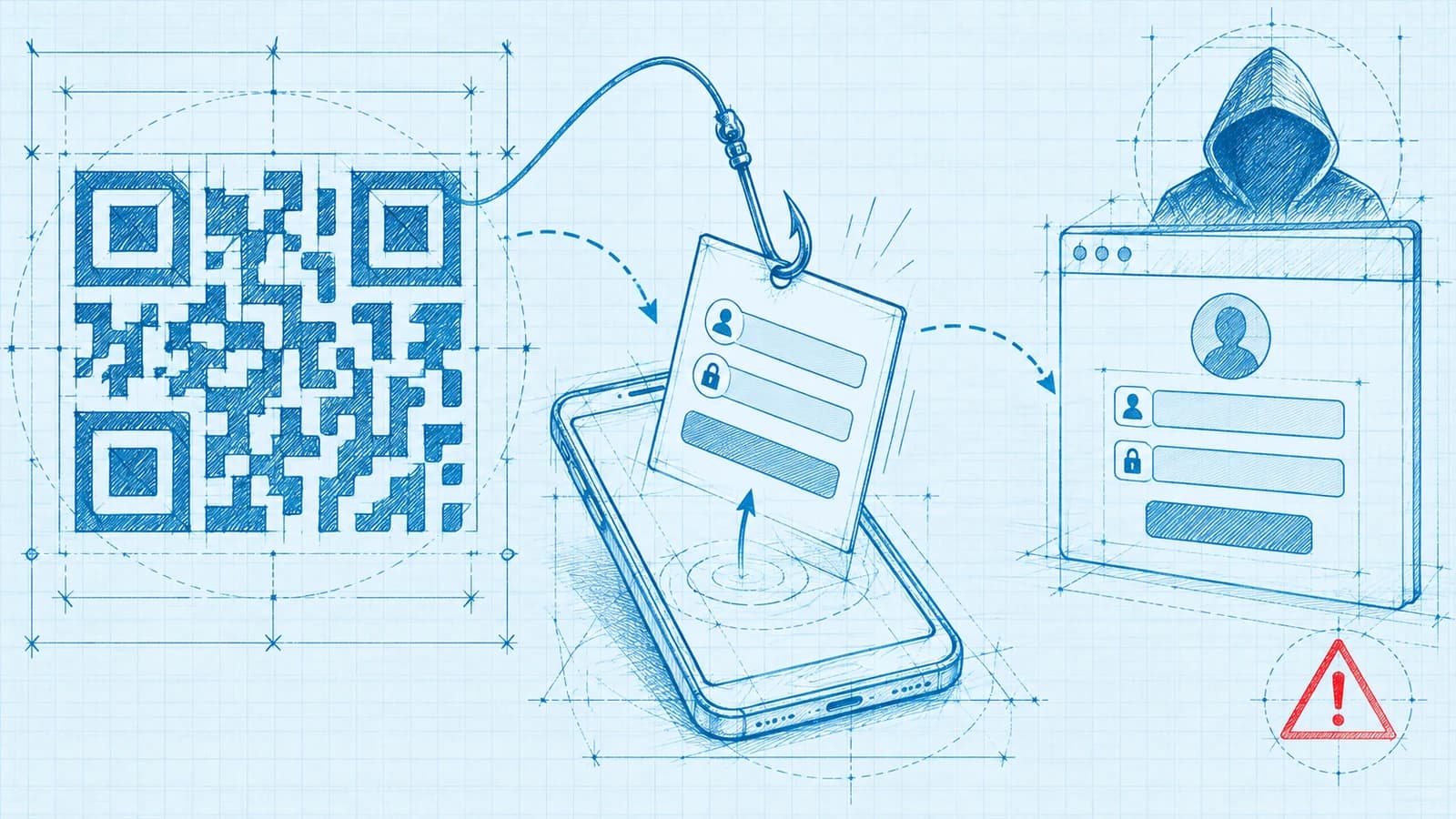
QR Code Phishing (Quishing): How It Works and How to Defend in 2026
Quishing hides a malicious URL inside a QR code, slips past email link scanners, and moves the victim onto a personal phone where the fake login is hard to inspect. The 2026 reference on how the attack runs and the phishing-resistant defenses that actually stop it.