OAuth Consent Phishing: The Attack That Steals a Token, Not a Password
Consent phishing lures a user to a real OAuth consent screen for a malicious app, they click Allow, and the attacker walks away with a token that grants lasting access. Because no password is stolen, MFA never fires. The 2026 reference on how the illicit consent grant works and the app-governance defenses that actually stop it.
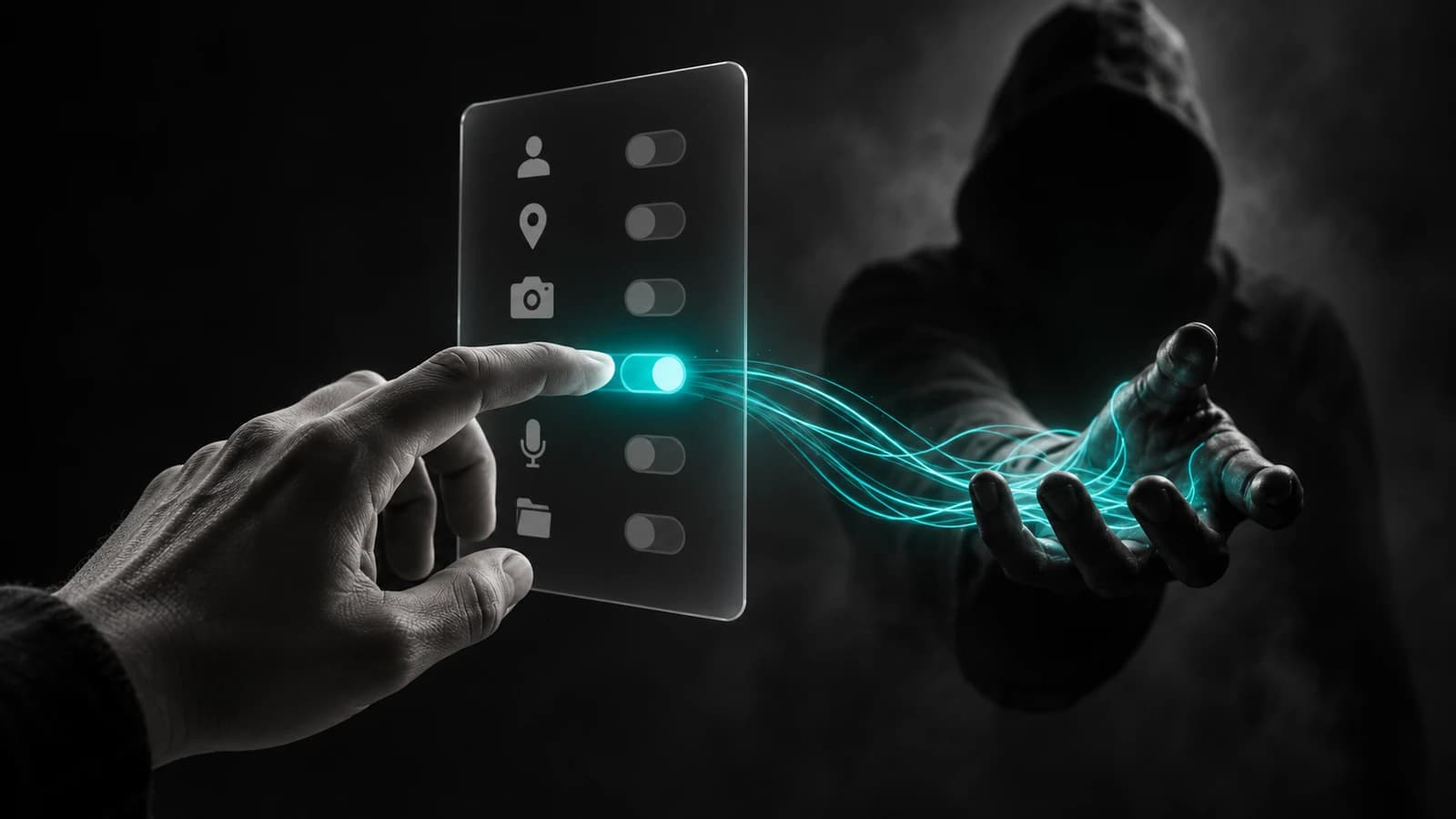
Consent phishing lures a user to a real OAuth consent screen for a malicious app, they click Allow, and the attacker walks away with a token that grants lasting access. Because no password is stolen, MFA never fires. The 2026 reference on how the illicit consent grant works and the app-governance defenses that actually stop it.
- OAuth consent phishing — the illicit consent grant — tricks a user into approving a malicious application on a genuine OAuth consent screen, so the attacker receives an access token instead of a password.
- Because no credential is ever entered, multi-factor authentication never fires; the user already authenticated legitimately, and the theft happens at the authorization step that MFA does not guard.
- The stolen token grants lasting, backgrounded access to mailbox, files, or calendar that survives a password reset, because a password was never involved in the grant.
- It is distinct from credential phishing: credential phishing steals the secret you type, consent phishing steals the permission you approve — and the consent screen is real, hosted on the provider's own infrastructure.
- The defenses that work are authorization-layer controls: restrict who can consent to apps, require admin approval for sensitive scopes, review and revoke existing grants, and monitor OAuth token activity — not stronger passwords or more MFA.
Most phishing defense is built around a single assumption: the attacker is trying to steal a secret the user knows. Harden the login, add multi-factor authentication, move to phishing-resistant credentials, and you make that secret impossible to hand over to a fake page. OAuth consent phishing quietly breaks the assumption. It does not want the password — it wants the user to click Allow on a real permission screen and grant a malicious application lasting access to their account. What the attacker walks away with is a token, not a credential, and because the user authenticated legitimately on the way to that screen, multi-factor authentication never had anything to challenge.
This is the illicit consent grant, and it deserves its own place in the enterprise threat model rather than being folded into "phishing" generally. It is not a look-alike login and not a stolen password. It is an abuse of the authorization step that sits just past authentication — where a user delegates access to an application — so every control an organization has invested in to protect the login is aimed at the wrong door. This piece is the 2026 reference on how consent phishing works, how it differs from the credential phishing it is so often confused with, why MFA does not stop it, and which defenses genuinely close the gap. It is closely related to the delivery-side techniques in QR code phishing (quishing), one common way victims are carried to a consent prompt in the first place.
What OAuth consent phishing is
To see the attack clearly, separate two steps that users experience as one. Authentication is proving who you are — you sign in, and the provider confirms your identity, increasingly with a second factor. Authorization is deciding what an application is allowed to do on your behalf — you grant an app permission to read your mail or files. OAuth is the protocol that governs that second step: when you sign in to a third-party tool "with" your work account and it asks to access your calendar, that is OAuth in action, and the screen listing the permissions it wants is the consent screen.
Consent phishing abuses that consent screen. The attacker registers or controls an application and crafts a request for a broad set of scopes — reading and sending mail, reading all files, or reading contacts and directory data. They then lure a victim to the application's authorization URL, which points at the genuine identity provider, so the page that loads is the real consent screen, on the real domain, with the real provider's branding. The user, already signed in or signing in normally, sees an application asking for access and clicks Allow. The provider dutifully issues the attacker's application an access token, and in most flows a refresh token as well.
At that moment the attacker has delegated access to the account — not a password, but a token the application presents directly to the provider's APIs to read mail, pull files, or enumerate contacts, programmatically and in the background. The user believed they were enabling a helpful tool. They were signing a permission slip for the attacker.
How the attack works, step by step
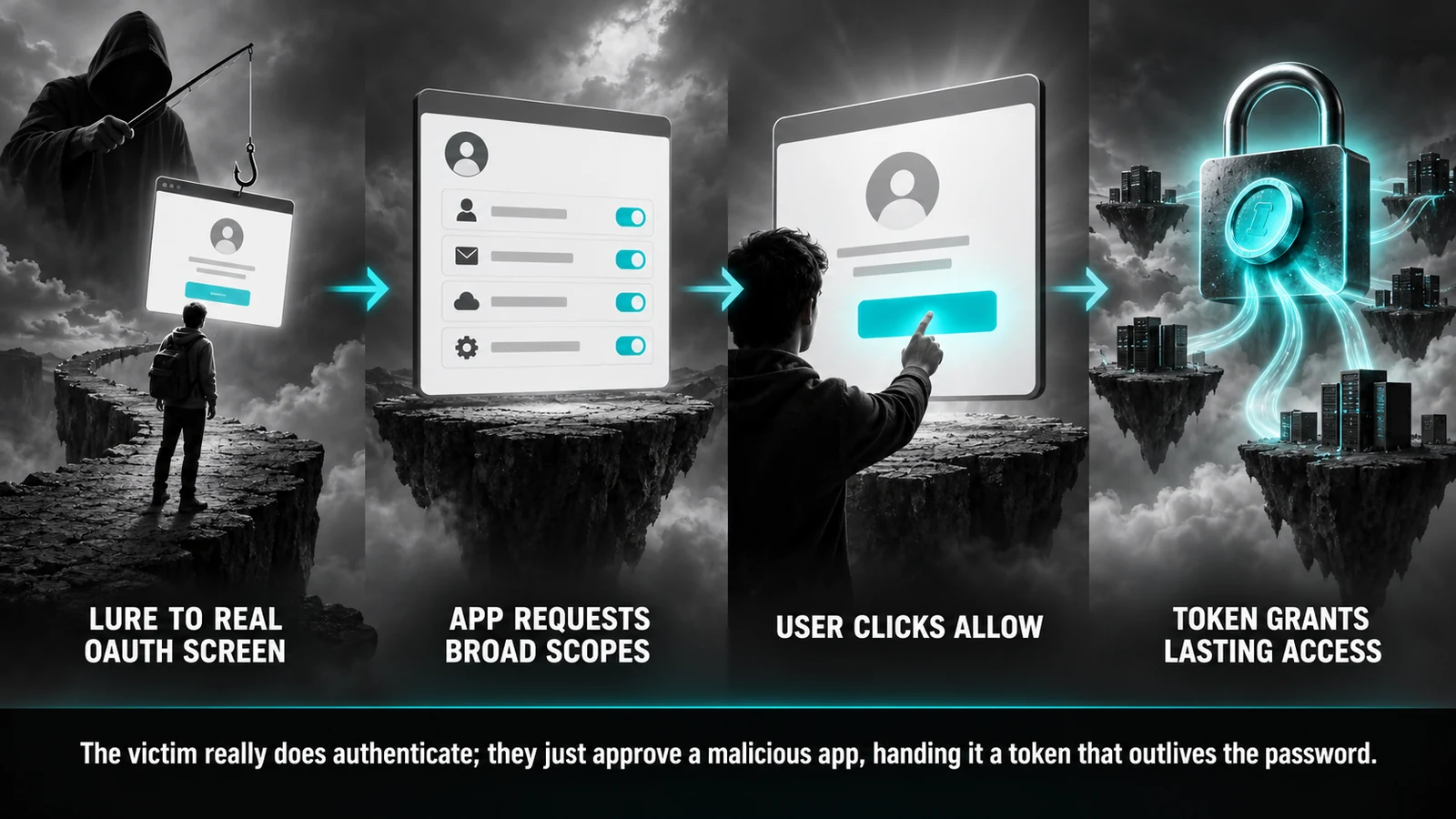
The attack runs through a predictable sequence, and each stage clarifies where it can and cannot be interrupted.
The malicious application is prepared. The attacker registers an application with an OAuth provider and configures it to request the scopes they want — often broad ones like full mailbox access and file read. They give it a name and, where possible, branding chosen to look plausible or official: a document viewer, a security add-in, a productivity tool. Its redirect target points back to infrastructure the attacker controls, where the issued token will land.
The victim is lured to the consent URL. The attacker sends a message with a pretext that makes granting access seem reasonable — a shared file that requires enabling an add-in, an invitation to a new collaboration tool, a "security" or "compliance" application to authorize. The link is a genuine OAuth authorization URL on the provider's real domain. This is the critical distinction from ordinary phishing: there is no fake look-alike site to detect, because the page really is the provider's. Advice about checking for a misspelled domain does not apply.
The user authenticates legitimately. If the user is not already signed in, they sign in to the real provider — with their real password and their real second factor. The attacker wants this login to succeed. Every authentication control the organization has works exactly as designed and confirms the user is who they say they are. Nothing is amiss at the authentication layer, because the attack is not there.
The consent screen is shown, and the user clicks Allow. The provider displays the consent screen naming the application and its requested permissions. A hurried user, seeing a familiar provider's genuine page and a plausibly named app, approves. This single click is the entire attack — no credential capture, no relay, no fake page, just an authorization the user granted.
The token is issued and access begins. The provider issues the application an access token scoped to what the user approved, and typically a refresh token that lets it obtain fresh access tokens over time. The attacker's infrastructure receives the grant and uses it against the provider's APIs — reading mail, exfiltrating files, harvesting contacts, and often establishing persistence through mailbox rules or forwarding. Because the refresh token can silently mint new access tokens, the access continues in the background without further action by the user.
A representative attack pattern
Consent phishing follows a recognizable shape in practice, even without naming any specific incident. An attacker compromises or spoofs a trusted sender, then distributes a message across a set of users — a shared document, a new tool the "team" is adopting, or an application to enable for a security or compliance reason. The message carries a link to a real OAuth authorization page for the attacker's application.
Some recipients ignore it; some click through, authenticate normally, glance at the consent screen, and approve. For each user who approves, the attacker gains a token-based foothold in that mailbox and its files, and uses it to read sensitive correspondence, pull documents, and — most damagingly — harvest contacts and inbox content to launch the next wave from a genuinely trusted internal sender. The initial grants also enable quiet persistence through forwarding or mailbox rules.
What makes this pattern effective is that nothing in it trips the alarms built for credential theft. The logins are legitimate. The MFA prompts are satisfied by the real user. There is no impossible-travel sign-in from a stolen password, because the attacker is not signing in as the user at all — the malicious application is acting with delegated authority the user handed it. An organization can have flawless authentication hygiene and still be reading about the incident weeks later, when someone finally notices an unfamiliar application in the granted-apps list or a forwarding rule nobody created.
Consent phishing versus credential phishing
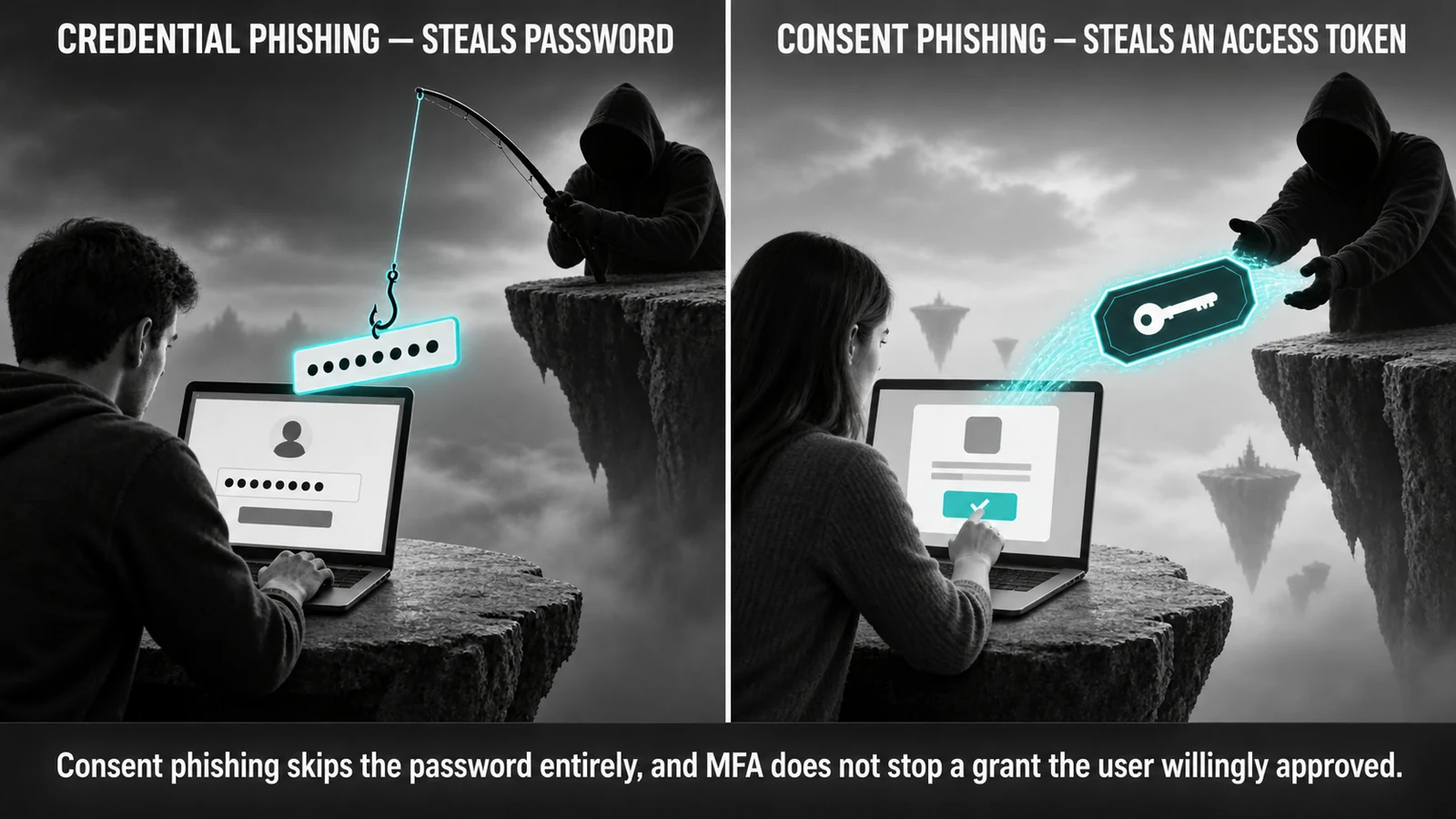
The two attacks are constantly conflated, and the conflation leads directly to spending on the wrong defenses. The cleanest way to hold them apart is by what is stolen and where.
Credential phishing steals a secret the user types. The classic form is a fake login page — a look-alike domain that captures the username, password, and often a one-time code as the user enters them. The theft happens at the authentication step, and the artifact stolen is a credential. The tell-tale signs are the ones awareness has taught for years: an unfamiliar or misspelled domain, an unexpected login page, a request to re-enter a password. The strongest defense is phishing-resistant authentication — passkeys and hardware FIDO2 keys — which binds the credential to the real origin so it cannot be entered into a fake page at all. The broader family of relay and bypass techniques that target the login is covered in MFA bypass techniques and defenses.
Consent phishing steals a permission the user approves. There is no fake page and no captured secret. The user authenticates legitimately, on the real provider, with whatever strong method they have — and then grants a malicious application access on the real consent screen. The theft happens at the authorization step, and the artifact stolen is a token. The tell-tale signs are entirely different: an unfamiliar application requesting access, broad or mismatched permissions, an app you did not seek out. And the defenses are different, because the thing that stops credential phishing — a credential that cannot be typed into a fake page — is irrelevant here. The user did not type anything. They clicked Allow on a real page.
Put plainly: credential phishing attacks who you are; consent phishing attacks what you have allowed. Phishing-resistant credentials, the right answer to the first, do nothing about the second. That is why consent phishing needs its own controls.
Why MFA does not stop it
The instinct, on hearing about a phishing attack, is to reach for multi-factor authentication. Against consent phishing that instinct misfires, and understanding why is the key to the problem.
MFA guards the authentication step — it ensures that whoever is signing in can present not just a password but a second factor. It is a check on identity at the moment of login. Consent phishing does not attack that moment. The user's login is genuine and welcome; the attacker is counting on it succeeding, complete with a satisfied MFA challenge, because a signed-in user is the prerequisite for reaching the consent screen. The malicious act comes one step later, at authorization, and there is no second authentication for MFA to interpose. The user is simply approving an application.
This is a categorical limitation, not a gap in a particular MFA method. Even phishing-resistant MFA — passkeys, hardware keys — protects the login and only the login. It makes the credential impossible to phish, which is exactly why credential phishing fails against it. But consent phishing never tries to phish the credential; it lets the user authenticate perfectly and then abuses the delegated-access mechanism downstream of authentication. An organization can deploy the strongest authentication available, as argued in phishing-resistant MFA for the enterprise, and remain fully exposed, because the attack is not aimed at the door that MFA locks.
This is also why a password reset does not help after the fact. Resetting the password, re-enrolling MFA, and forcing sign-outs all address authentication. The attacker's access does not depend on authentication — it depends on the OAuth grant issued to the application, which persists until someone explicitly revokes it. The token, not the password, has to be taken away.
Defenses that actually work
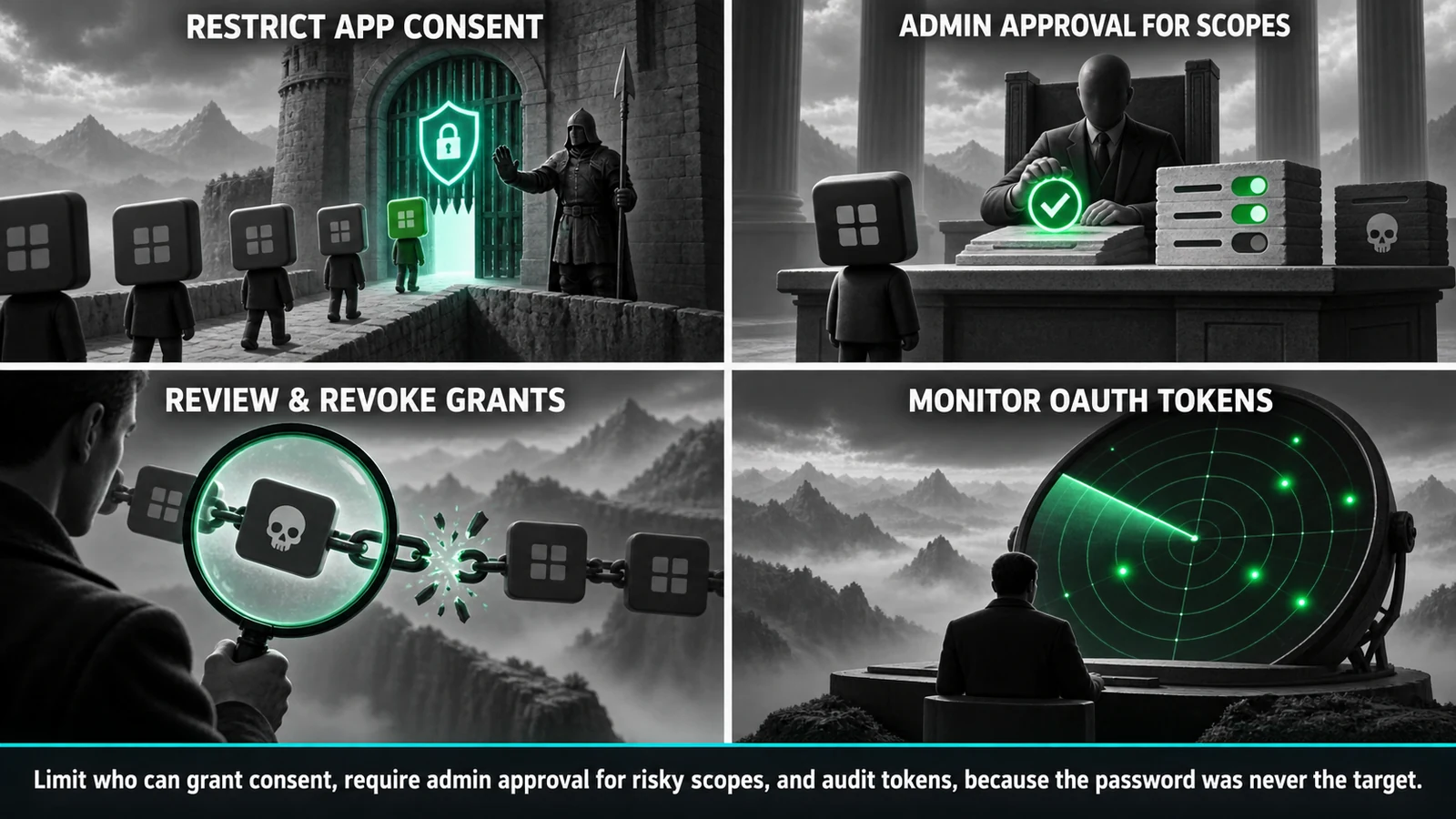
Because the attack lives at the authorization layer, the defenses do too: govern what can be granted, clean up what already has been, watch for abuse, and prepare users for a decision they rarely treat as a security one.
Restrict who can consent to applications. The most powerful single control is limiting the ability of ordinary users to grant applications access on their own. When an unknown application cannot receive a broad grant from a single user click — because only vetted, allowlisted applications can be consented to freely — the attack loses its one-click payoff. This does not mean blocking all delegated access; it means making unrestricted user consent the exception rather than the default.
Require admin approval for sensitive scopes. For applications requesting high-privilege or sensitive permissions, route the request through an administrator approval workflow. This converts a silent, hurried individual decision into a reviewed one, where someone with context evaluates whether the application is legitimate and its scopes justified — and gives users a safe path rather than leaving them to judge alone under a plausible pretext.
Review and revoke existing grants. Consent governance is not only forward-looking. Regularly enumerate the applications that already hold grants across the tenant and scrutinize them: unfamiliar, over-privileged, unused, or unverifiable publishers. Revoke anything that does not belong. Because a stolen token survives password changes, revoking the grant is the only action that severs an attacker's access — and a periodic review surfaces the grants that slipped through.
Monitor OAuth and token activity. Instrument the authorization layer the way you instrument logins. Watch for new grants to unfamiliar applications, spikes in consent activity, unusual scope combinations, and tokens used from unexpected locations or volumes. Because consent phishing produces no failed logins and no impossible-travel sign-ins, this telemetry is often the only signal that an attack has occurred. Tie it to alerting so an unrecognized grant does not sit unnoticed for weeks.
Prepare users to treat consent as a decision. Awareness for consent phishing has to teach something new, because users are trained to look for fake domains — and here the domain is real. The lesson is that the consent screen itself is a security checkpoint: pause on an unexpected request, read the permissions, and question why a document viewer needs to read all your mail. Awareness is a reinforcement, not the control — the governance that prevents an unvetted app from being granted access in the first place is what removes the payoff.
Reduce standing exposure elsewhere. Narrowing the overall attack surface — moving toward passwordless authentication and deploying passkeys across the fleet per the passkey deployment playbook — does not stop consent phishing on its own, but it removes the parallel paths an attacker would combine with a stolen token to deepen a foothold.
Where consent phishing defenses break down
Even a careful program has predictable weak points, and naming them is part of the threat model.
Ungoverned user consent. The default configuration in many environments lets ordinary users grant applications access freely. If that default is left in place, every control downstream is compensating for a wide-open front door. The most common failure is simply never having restricted who can consent.
Grants that outlive attention. A malicious grant issued during a brief campaign can persist indefinitely if no one reviews the application list. Treating consent as a set-and-forget event leaves stolen tokens live long after the lure is forgotten.
Password-centric incident response. When an account is suspected of compromise, the reflexive response — reset the password, re-enroll MFA, force sign-out — does nothing to a consent grant. Runbooks that do not include revoking application grants and reviewing forwarding rules leave the attacker's access intact while declaring the incident closed.
"Low-risk" scopes left ungoverned. Treating read-only scopes as harmless invites a slow leak. Read access to mail, files, and contacts is enough for large-scale exfiltration and for the reconnaissance behind business email compromise. Least privilege has to be enforced for modest scopes too.
The real-domain blind spot in awareness. Training that teaches users to spot fake domains gives them no defense here, because the consent page is genuine. Programs not updated to cover the consent decision itself leave users confident and unprepared.
What Avatier ships toward this problem
Avatier's position on consent phishing follows from where the attack lives: the durable controls are at the authorization layer, and authentication strength — however important elsewhere — is not the answer to this threat. Avatier Identity Anywhere treats application access as governed identity rather than an unmanaged user decision, so access to applications runs through policy, workflow, and review rather than a single unsupervised click. Access certification and periodic review extend to the applications and entitlements that hold delegated access, which is what surfaces the unrecognized, over-privileged, or stale grants a consent phishing attack depends on going unnoticed.
Because a stolen token survives a password reset, deprovisioning and access revocation are first-class workflow actions — the ability to cut off an application's access, not merely reset a credential, is the control that actually severs an attacker who holds a grant. Recovery and reset flows route through workflow-verified processes rather than help-desk improvisation. The Avatier Trust Center publishes the compliance posture this operates within.
The logic is vendor-neutral. Any enterprise that restricts who can consent to applications, requires administrative approval for sensitive scopes, reviews and revokes existing grants on a cadence, monitors OAuth token activity, and includes grant revocation in its incident response will substantially reduce its consent phishing exposure regardless of which platform enforces those controls. The point is the ordering: govern authorization, because that is where this attack succeeds — and do not mistake a strong login for protection against an attack that never touches the login.
The honest closing
OAuth consent phishing is unsettling precisely because it turns the user's legitimate behavior into the attack. There is no fake page to spot, no stolen password to reset, no failed login to alert on. The user signs in correctly, satisfies MFA correctly, and then approves an application on a consent screen that really is the provider's own. What the attacker takes is a token — a durable, backgrounded grant of access that keeps working after the password changes and that no amount of authentication strength was positioned to prevent.
That is the reframing this attack demands. The last decade of identity security has been a march toward stronger authentication, and rightly so — it has made credential phishing far harder and, with phishing-resistant methods, close to impossible. But consent phishing is not a login attack. It is an authorization attack, and it will keep working against organizations that pour everything into the login and leave the consent decision ungoverned. The defense is to treat delegated access the way we now treat authentication: governed by policy, reviewed on a cadence, monitored for abuse, and revocable in one deliberate action. Restrict who can consent, require approval for sensitive scopes, review and revoke what has been granted, and watch the tokens. Lead with authorization governance — because in this attack, the user already did the one thing every login control was built to protect, and the theft happened the moment after.
About the author
More from MFA & Authentication
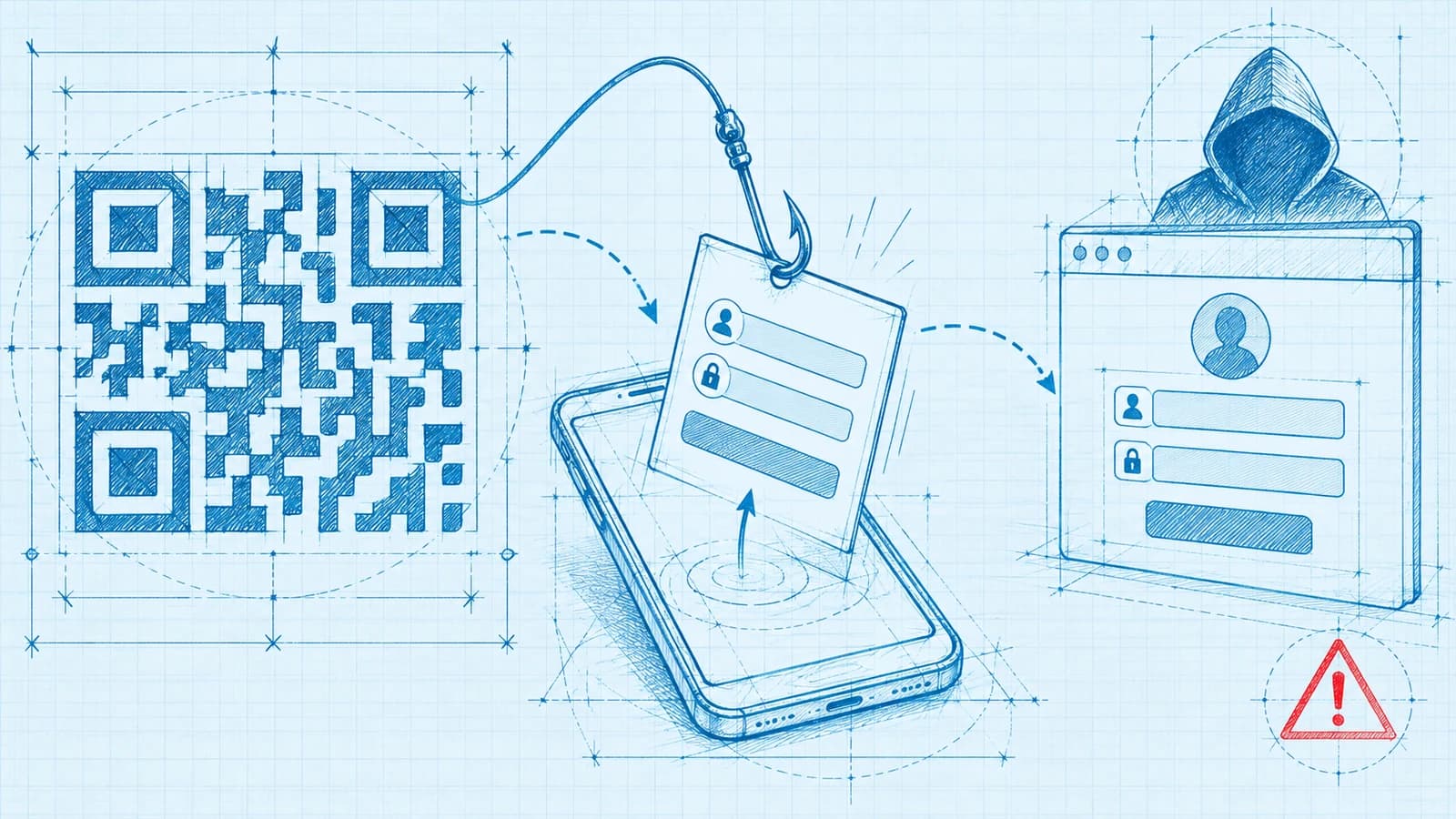
QR Code Phishing (Quishing): How It Works and How to Defend in 2026
Quishing hides a malicious URL inside a QR code, slips past email link scanners, and moves the victim onto a personal phone where the fake login is hard to inspect. The 2026 reference on how the attack runs and the phishing-resistant defenses that actually stop it.

Credential Stuffing Defense: Stopping Password-Reuse Attacks in 2026
Credential stuffing replays username and password pairs leaked from other breaches against your login, at automated scale, until reused passwords hit. The 2026 reference on how the attack chain works, why it differs from brute force and password spraying, and the layered defenses that actually stop it.

Step-Up Authentication: Re-Authentication for Sensitive Actions 2026
Step-up authentication keeps baseline login light for routine work and demands fresh, stronger verification the moment an action turns sensitive. The 2026 reference on what triggers a step-up, how users complete one, and how it differs from adaptive authentication.