AI-Driven Biometrics in 2026: Modalities, Liveness, and What's Next
AI has redefined what a biometric even is — turning static face and fingerprint checks into continuous, behavior-aware signal, and this is a field guide to the modalities behind that shift.
AI has redefined what a biometric even is — turning static face and fingerprint checks into continuous, behavior-aware signal, and this is a field guide to the modalities behind that shift.
- AI hasn't added a sixth biometric modality — it changed what the existing five (face, fingerprint, iris, voice, behavioral) do after enrollment, turning a one-time match into a continuously re-evaluated signal.
- Liveness detection is now the load-bearing part of biometric security, not the biometric match itself; AI models scoring micro-motion, depth, and texture are what actually stop a printed photo or silicone mold from working.
- Deepfakes and synthetic biometric data have turned spoofing into a generative arms race, and the practical countermeasure gaining ground isn't a better static check — it's continuous behavioral biometrics that make a single successful spoof insufficient.
- The frictionless-UX promise of AI-driven biometrics is real, but so is the risk side: broader attack surface for synthetic media, harder-to-audit AI decision logic, and biometric data that — unlike a password — can't be reset once it's compromised.
- The trend line is passwords to biometrics to continuous/behavioral authentication as the 2026+ frontier — this piece is the modalities-and-trend entry in a three-part series that also covers the migration playbook and the pop-culture reality check.
Biometric authentication used to mean a single decision made once: does this face, this fingerprint, this iris pattern match the enrolled template — yes or no, checked at login, trusted for the rest of the session. AI has quietly dismantled that model. The same generative techniques that produce convincing synthetic faces and cloned voices have forced liveness detection into the foreground of biometric security, and the same machine-learning approaches that made those liveness models possible have also made it practical to keep verifying identity continuously, in the background, using how someone types and moves rather than a single static snapshot. The result is that "biometric authentication" in 2026 increasingly means something closer to a continuous stream of identity signal than a one-time credential check — and understanding that shift matters more for security architects than memorizing which vendor supports which sensor.
This is the 2026 update to Avatier's original biometrics and AI piece, rebuilt around what's actually changed in the intervening period rather than the framing the original piece used. It's also worth being explicit about scope, because Avatier has published two adjacent pieces on biometric authentication and this one is deliberately not either of them. If you're planning an actual enterprise rollout — phased deployment, fallback design for workforce segments without smartphones, running biometric and password authentication in parallel during the transition — that's the passwords-to-biometrics migration piece, and it stays in the architecture lane. If you want the fun cultural read on what sci-fi got right and wrong about biometric authentication, that's the sci-fi reality check. This piece stays in a third lane: what the core biometric modalities actually are, how AI changed what happens after enrollment, the spoofing arms race AI created and is now being used to fight, and where the trend line points next.
The five modalities: what "biometric" actually covers in 2026
"Biometric authentication" collapses five fairly different technologies into one word, and the differences matter for anyone evaluating deployment options.
Face recognition maps geometric relationships between facial landmarks — eye spacing, nose bridge width, jaw contour — into a mathematical template, then compares a live capture against that template. It's the most widely deployed modality by volume because it's built into the device most employees already carry; Face ID and Windows Hello face unlock put it in front of a large share of the workforce without any separate hardware purchase — though Windows Hello's documented limitations are worth knowing before treating it as a complete authentication strategy on its own. Match accuracy is strong under good lighting and controlled angle; accuracy degrades with poor lighting, extreme angles, and — historically — showed measurable disparities across demographic groups, which is part of why liveness and quality-gating layers matter as much as the raw match algorithm. The broader workforce deployment patterns for face and fingerprint biometrics are covered in more depth in our biometric authentication workforce MFA piece.
Fingerprint recognition reads ridge pattern, minutiae points, and — on better sensors — subsurface capillary structure. It's the oldest deployed biometric modality and remains extremely common on laptops and phones via capacitive sensors. It's fast, doesn't require good lighting, and has a mature spoofing-defense literature, but it's also the modality most people associate with movie-plot spoofing (the gummy-bear mold trope), which is precisely why liveness detection for fingerprint sensors focuses heavily on detecting live tissue characteristics like sub-dermal blood flow rather than surface pattern alone.
Iris scanning captures the unique pattern in the colored part of the eye, which is more stable over a person's lifetime than face geometry and offers higher theoretical match precision than either face or fingerprint. The tradeoff is hardware cost and user friction — it typically requires dedicated near-infrared capture hardware rather than a standard camera — which is why iris scanning concentrates in high-security facility access, border control, and specific government and defense contexts rather than general workforce authentication.
Voice biometrics authenticate against a combination of vocal tract physiology (how sound resonates through an individual's specific anatomy) and behavioral speech pattern (cadence, pronunciation, pitch contour). It's useful in call-center identity verification and hands-free contexts, but it's also the modality where generative AI has moved fastest — a voice clone trained on a short public audio sample can now approximate a target's voice well enough to challenge a naive matcher, which is why voice biometrics in any serious 2026 deployment gets paired with active anti-spoofing rather than trusted alone.
Behavioral biometrics are the newest category and the one AI made viable in the first place: typing rhythm and pressure, mouse movement and acceleration curves, touchscreen gesture pattern, gait, even the specific sequence in which someone navigates an application. Unlike the first four modalities, behavioral biometrics aren't a one-time enrollment snapshot compared against a live capture — they're a continuously updated statistical baseline, scored in the background, that flags drift rather than producing a single pass/fail decision.
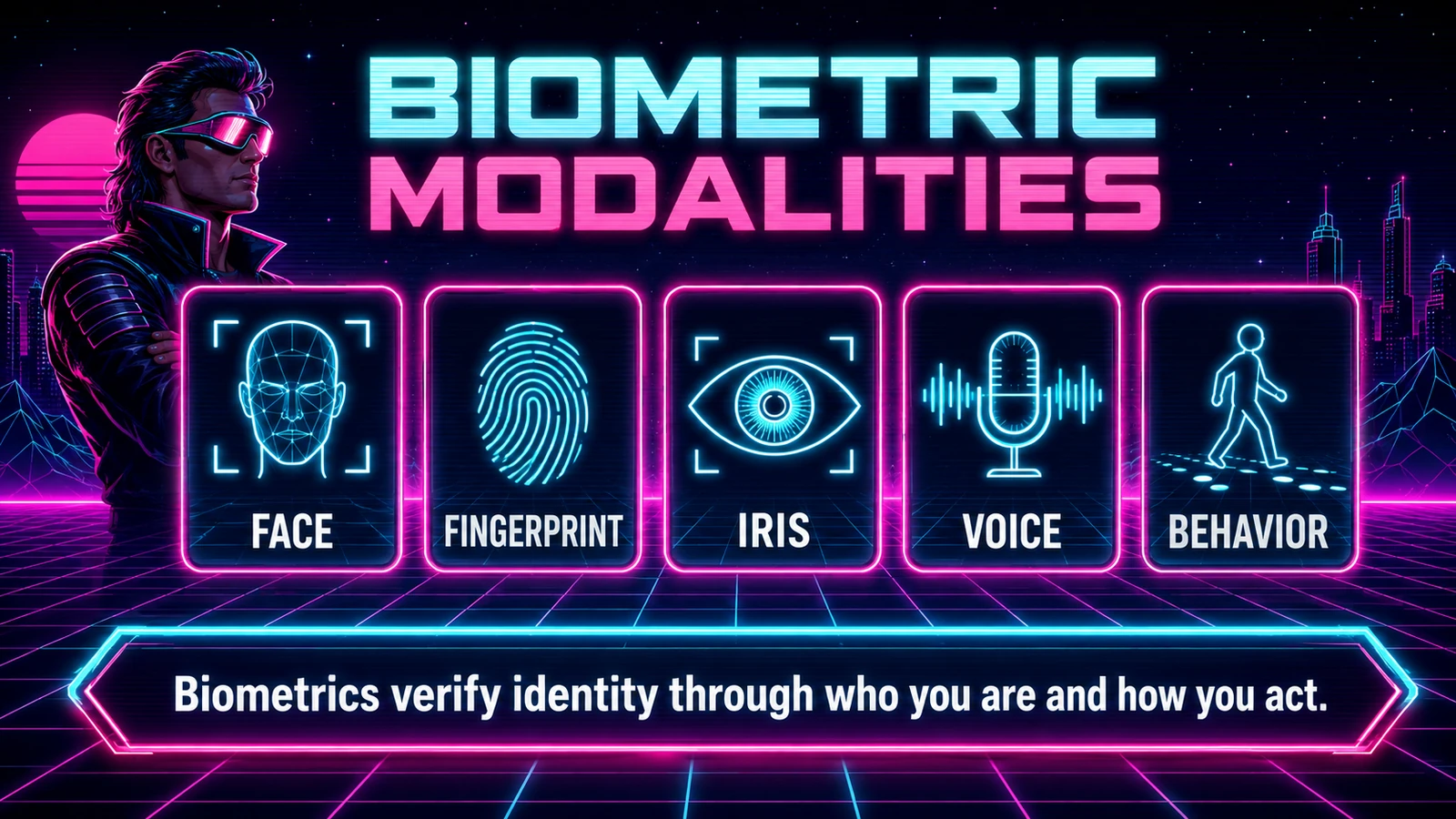 Five modalities, one shared shift: AI turned each from a one-time snapshot into a signal that can be continuously re-evaluated rather than trusted once and forgotten.
How AI changes liveness detection and spoof resistance
The biometric match itself — does this capture resemble the enrolled template closely enough — hasn't fundamentally changed in the last few years. What has changed is everything sitting in front of that match. Liveness detection used to mean a single heuristic: ask the user to blink, check capacitive response on a fingerprint sensor. AI turned it into a genuine classification problem, scoring multiple signals simultaneously: depth information from structured-light or time-of-flight sensors that a flat photo or screen replay can't reproduce, micro-texture analysis that distinguishes live skin from paper, silicone, or latex, involuntary micro-movements that are difficult to consciously fake, and — for voice — spectral artifact detection that flags the subtle signatures generative audio models leave behind.
The practical consequence for security architects is that liveness detection, not the underlying biometric matcher, is now the component doing most of the actual security work. A printed photo can sometimes fool a face matcher that isn't paired with liveness scoring; it essentially never fools one that is. This is also where the real arms race concentrates, and it's worth being honest about the shape of it: every generation of AI-driven liveness detection trains against a slightly more sophisticated generation of spoofing technique, and there is no evidence either side holds a permanent structural advantage. Enterprises evaluating biometric vendors in 2026 are better served asking about liveness-detection methodology and update cadence than asking about raw match accuracy, which has been commoditized for years.
The deepfake and synthetic-biometric arms race
Generative AI didn't just improve legitimate biometric systems — it also produced the most capable spoofing tools the field has ever had to defend against. Synthetic face video generated from a handful of source images can, without a liveness layer in front of it, challenge a naive face matcher. Voice cloning built from a short public audio clip can approximate a target's voice well enough to pass a basic voice-match check. Synthetic fingerprint-pattern generation is less mature but active in the research literature. None of this is speculative — it's the direct reason liveness detection went from a nice-to-have feature to a deployment requirement across the industry, and the reason single-modality, single-moment biometric checks are increasingly treated by security architects as insufficient for anything beyond low-risk actions.
The deeper issue is architectural, not just algorithmic: a deepfake or synthetic biometric is built to defeat one moment of verification. It doesn't need to sustain that deception indefinitely — it needs to win once, at login. That observation is what's driving the shift toward continuous and behavioral biometrics as the countermeasure of choice, rather than simply investing in ever-better one-time liveness models. If authentication doesn't stop at login — if typing rhythm, navigation pattern, and interaction cadence keep getting scored throughout the session — then a successful one-time spoof stops being sufficient on its own. The attacker who beats the login check still has to sustain a convincing behavioral profile for the length of a working session, which is a materially harder problem than beating a single snapshot.
This is also the point where biometric authentication and cryptographic authentication have to be understood as complementary rather than substitutes. A biometric match, however well-defended by liveness detection, is a local decision made on a device. What actually needs to be defeated for an attacker to gain access is the cryptographic ceremony the biometric unlocks — the FIDO2 private key bound to that device, whether that's a platform authenticator or a dedicated hardware FIDO2 key. A spoofed biometric that somehow passes a liveness check still doesn't produce a valid authentication unless it's unlocking a legitimate, device-bound credential. That layering — biometric-gated cryptography rather than biometric-as-the-whole-system — is what keeps the deepfake arms race from being an existential threat to biometric authentication generally, even as it keeps escalating.
Promise vs. risk: frictionless UX against a wider attack surface
The promise side of AI-driven biometrics is genuinely strong and shouldn't get lost in the security discussion. Continuous, AI-scored biometrics reduce authentication friction dramatically — no PIN re-entry, no repeated MFA prompts, identity confirmed passively in the background while someone works. For workforces where authentication friction translates directly into productivity loss or help-desk burden, that's a real, measurable benefit, not a marketing claim.
The risk side is equally real and deserves the same directness. Generative AI expanded the attack surface for synthetic media faster than most organizations' threat models updated to account for it. AI-driven decision logic in liveness and behavioral scoring is harder to audit than a simple rule-based check — when a behavioral biometric system flags or clears a session, the reasoning is a statistical model output, not a human-readable rule, which complicates incident review and compliance documentation. And continuous behavioral monitoring, by its nature, collects far more granular data about how a person moves, types, and interacts than a one-time fingerprint scan ever did — which raises the privacy stakes even as it raises the security ceiling.
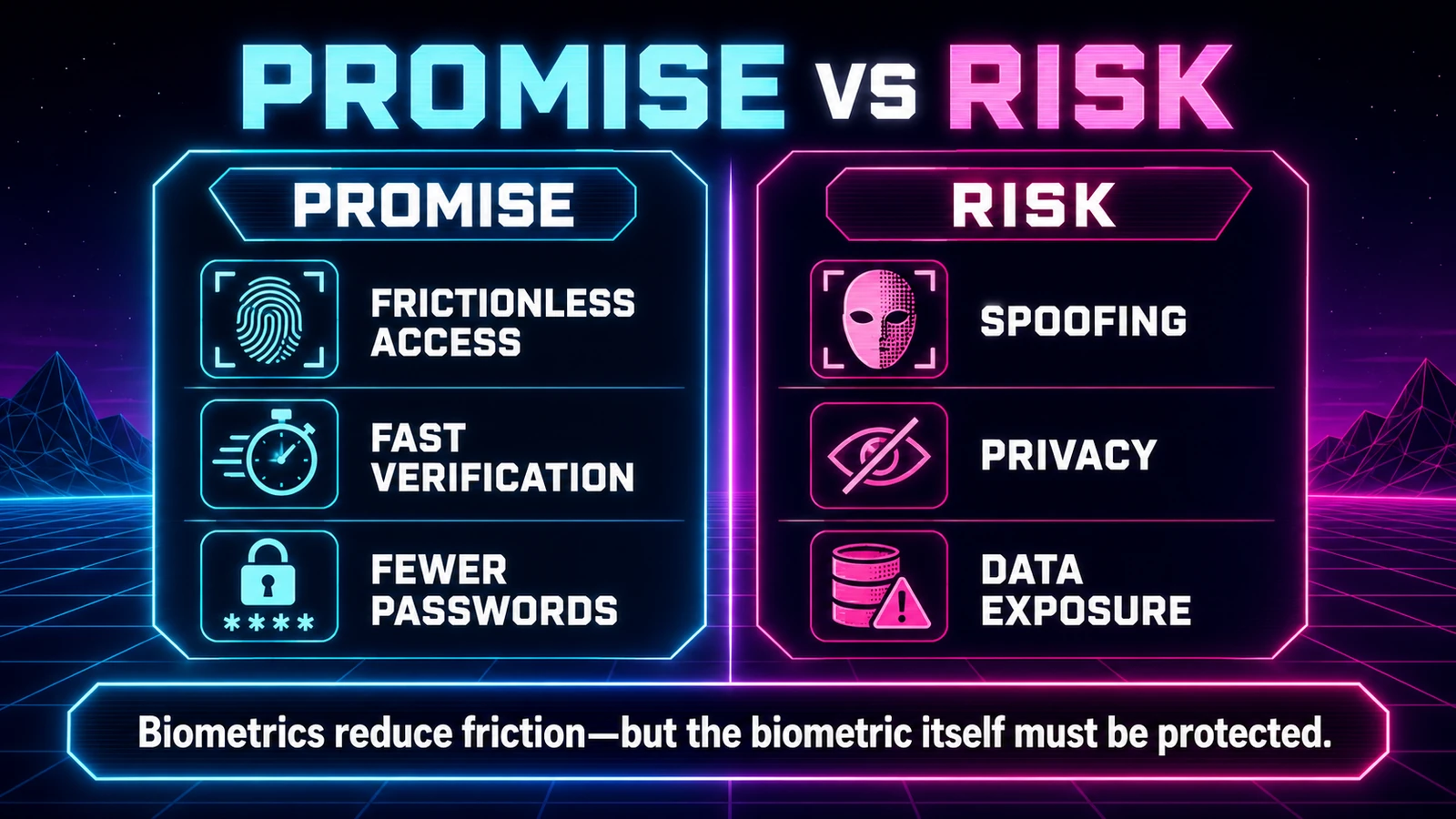 Continuous AI-scored biometrics cut friction meaningfully, but the same generative techniques that improved liveness detection also armed the spoofing side of the arms race — the promise and the risk scaled together.
Regulatory and privacy considerations for biometric data at rest
Biometric data occupies a different risk category than most authentication data, and the regulatory landscape reflects that. Illinois's Biometric Information Privacy Act, Texas's Capture or Use of Biometric Identifier statute, similar state-level frameworks, and GDPR's Article 9 treatment of biometric data as a special category all impose stricter consent, disclosure, and retention requirements than apply to ordinary authentication logs. The operational implications for enterprise deployments are consistent across jurisdictions: biometric templates should be stored and matched locally on the device wherever the architecture allows it rather than centralized in a server-side database, retention windows need explicit policy rather than indefinite storage, and consent needs to be genuine and revocable rather than buried in an onboarding checkbox.
The revocability problem is the piece that makes biometric data governance categorically different from password governance. A compromised password gets reset. A compromised fingerprint template or facial geometry vector can't be — the underlying biological trait doesn't change because a database got breached. What actually gets revoked in a well-architected system is the credential binding: the cryptographic key that the biometric unlocks, not the biometric itself. That's a deliberate architectural choice, not an automatic property of biometric authentication, and it's worth confirming any vendor's biometric implementation actually works that way before treating "biometric" as synonymous with "secure."
Where the trend line points: passwords to biometrics to continuous authentication
The trajectory is reasonably clear at this point, even if the pace varies by industry and workforce type. Passwords, as the primary authentication factor, are on a multi-year decline — not gone, but increasingly relegated to fallback status behind stronger factors. Biometrics, layered with FIDO2-compatible cryptography, have become the default primary factor for a growing share of enterprise authentication, mainly because the hardware is already in employees' hands. And the frontier past that — where AI's contribution is most distinct — is continuous, behavioral authentication: identity treated as an ongoing, re-evaluated signal throughout a session rather than a single gate checked once at login.
That third stage is still maturing operationally in 2026. Behavioral biometric baselines take time to establish reliably, false-positive rates need tuning to avoid interrupting legitimate work, and the audit and explainability questions around AI-scored continuous authentication are still being worked out across the industry. But the direction is consistent across vendors, analyst commentary, and deployment patterns: the endpoint isn't a better one-time biometric check, it's authentication that never fully stops checking. Enterprises building authentication architecture for a five-year horizon are increasingly designing for that endpoint now — pairing today's biometric-plus-cryptography deployment with the risk-scoring and behavioral-signal infrastructure that a continuous model requires, rather than treating it as a separate future project.
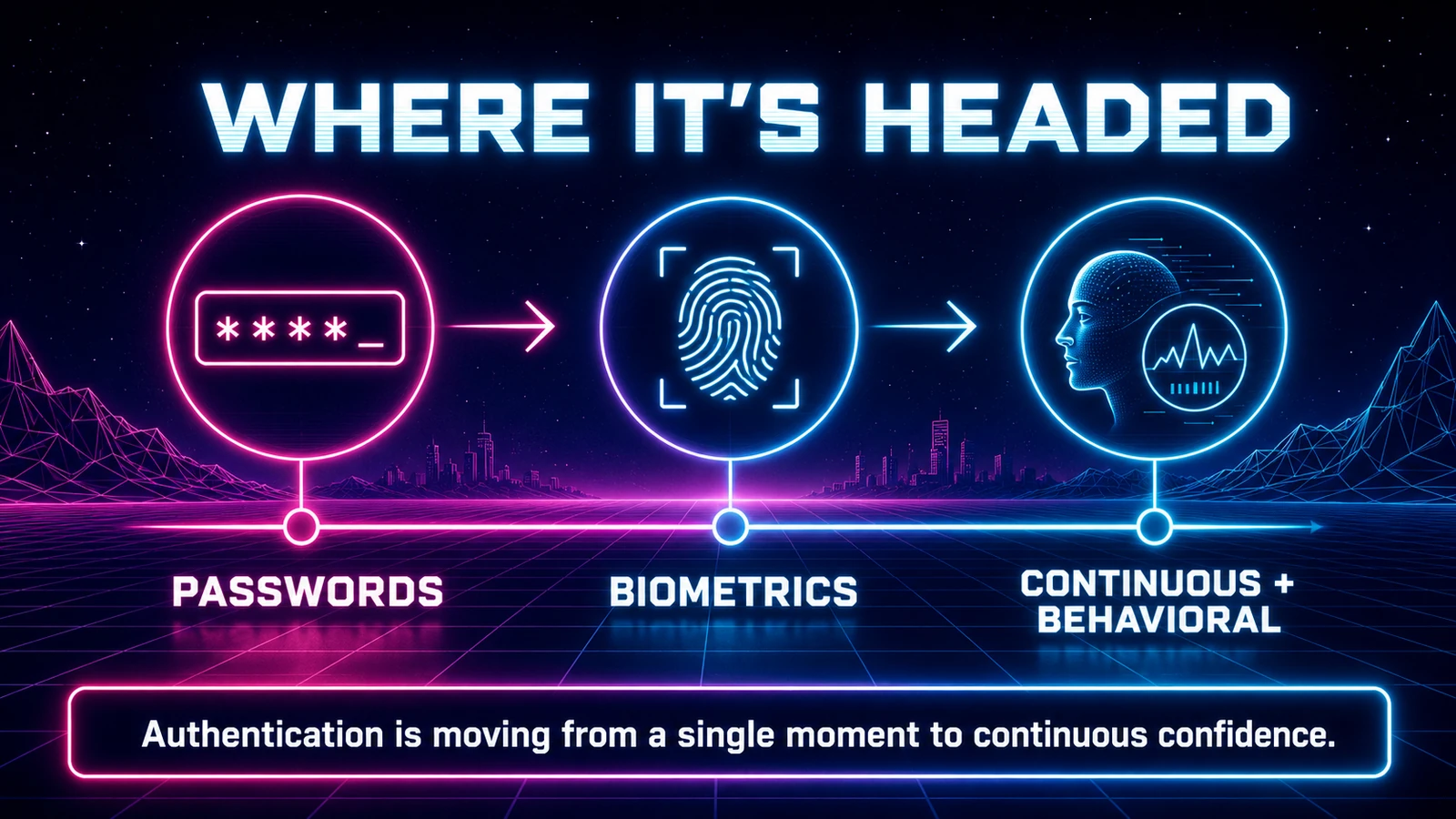 The multi-year trajectory in one line: static passwords give way to biometric-plus-cryptography, and the 2026+ frontier is continuous, behavioral authentication that never fully stops checking.
What Avatier ships toward this pattern
Avatier Identity Anywhere supports FIDO2-compatible biometric authentication across the standard modalities workforces already use — platform face and fingerprint biometrics on managed devices, hardware security keys with biometric unlock, and passkeys bound to biometric-gated device credential stores — composed with adaptive, risk-based policy so a biometric match is never the sole standing decision for a session. That composition matters more than any single modality choice: the architecture treats the biometric as a local unlock for device-bound cryptography, and layers continuous risk scoring on top rather than trusting a login-time match indefinitely. For workforce segments outside standard device assumptions — frontline retail, manufacturing floor, healthcare clinicians who can't carry a smartphone bedside — the Avatier Identity Challenge Card extends enterprise authentication to deviceless environments, which matters because the continuous-behavioral frontier described above still needs a device-based signal source, and deviceless segments need an equivalent authentication floor that doesn't depend on one existing.
For teams evaluating the broader threat landscape this sits inside, Avatier's sister site covers the detection and response side of identity risk in more depth in its identity threat detection and response piece, which is a useful companion read for security teams thinking about how AI-driven biometric signal feeds into broader identity threat monitoring rather than standing alone. The Avatier Trust Center publishes the compliance posture underpinning all of this: SOC 2 Type II audited with zero exceptions noted, ISO/IEC 27001:2022 certified, PCI DSS v4.0.1 compliant, CSA STAR Level 1 attestation, NIST 800-53 Rev. 5 aligned, FedRAMP-aligned, and a CISA Secure-by-Design Pledge signatory.
What AI-driven biometrics doesn't solve
It's worth closing honestly rather than triumphantly. AI has made biometric authentication meaningfully more capable — better liveness detection, continuous rather than one-time verification, a real countermeasure to the deepfake threat it partly helped create. It hasn't solved two structural problems, and no amount of additional AI sophistication is likely to on its own.
The first is revocability. A password is, at bottom, a piece of information you can change. A fingerprint, a facial geometry, an iris pattern is a biological trait you can't. When biometric data is compromised, the compromise is permanent in a way password compromise never is — which is exactly why well-architected systems bind biometrics to revocable cryptographic credentials rather than treating the biometric itself as the durable secret. Any vendor conversation that doesn't address this distinction is skipping the most important architectural question in the category.
The second is consent and privacy complexity, and it's getting harder, not easier, as behavioral biometrics mature. Continuous monitoring of how someone types, moves, and navigates generates a volume and granularity of personal data that a one-time fingerprint scan never approached, and the regulatory frameworks governing that data — state biometric privacy statutes, GDPR's special-category treatment, sector-specific rules — are still catching up to what continuous behavioral monitoring actually collects. AI-driven biometrics is a genuine security upgrade. It is not, on its own, a privacy or governance shortcut, and any organization deploying it should plan the consent and data-minimization architecture with the same seriousness as the authentication architecture itself.
About the author

More from Identity & Access Trends
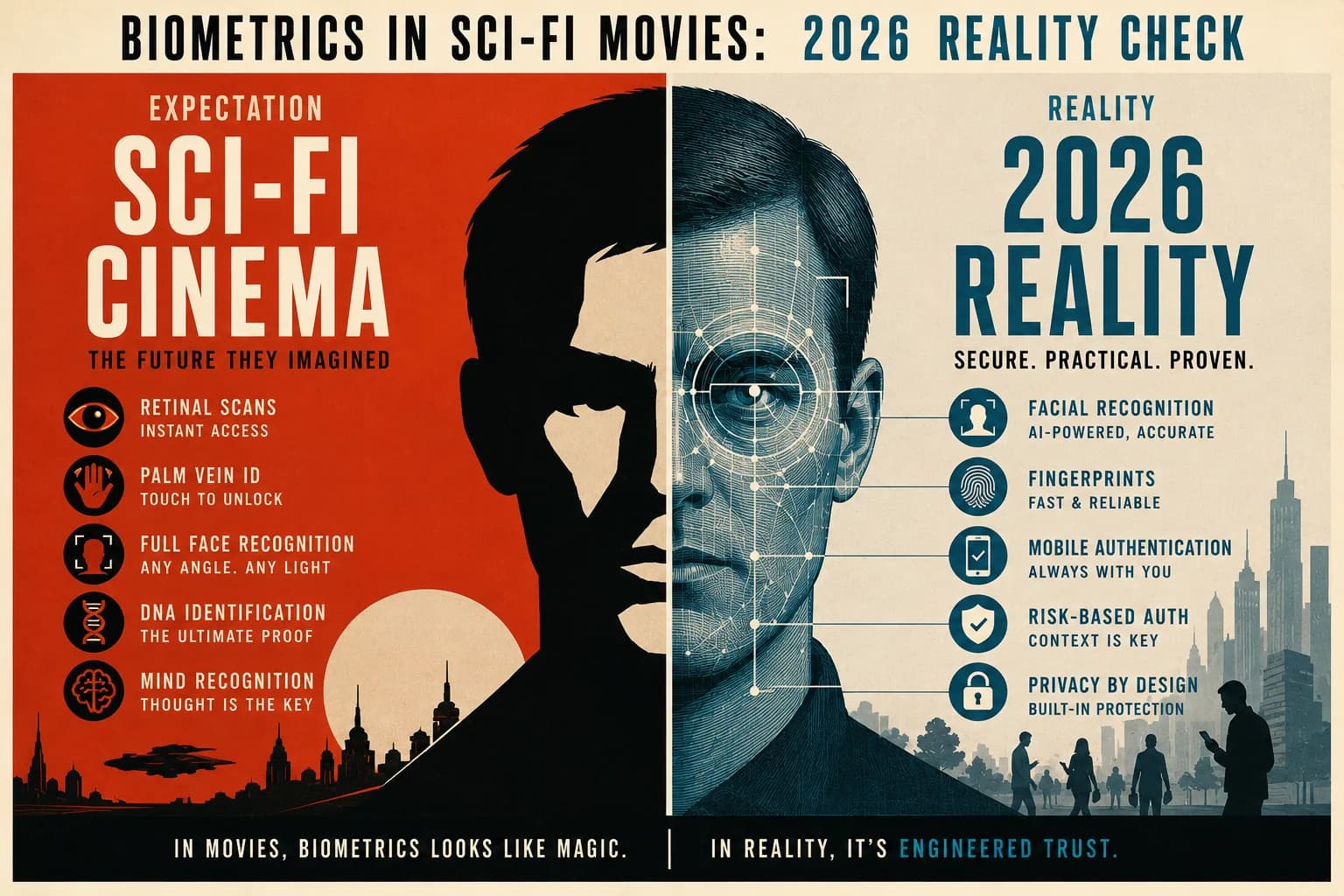
Biometrics in Sci-Fi Movies: A 2026 Reality Check
For sixty years, sci-fi has been showing us biometric authentication — palm scans, retinal lasers, voice prompts, faces unlocking doors. Now most of us authenticate with biometrics every morning before we've finished our coffee. What did sci-fi get right, what did it get hilariously wrong, and what does workforce biometric authentication actually look like in 2026?

Identity for AI Agents and Agentic Authentication 2026
AI agents need identities, credentials, and authentication ceremonies of their own — separate from the humans they act on behalf of, separate from the service accounts they're often confused with. The 2026 enterprise reference on the architectures that issue agent identity, the protocols that authenticate them, the delegation chain that keeps user authority intact, and where agentic auth deployments break.
SSO Architecture for Distributed Workforces in 2026
Single Sign-On for a distributed workforce — remote employees, hybrid schedules, contractor populations, partner organizations, and education-sector users — isn't the same problem it was when SSO meant SAML inside a corporate intranet. The 2026 reference on what SSO actually solves, where the architectural breakage modes live, and the federation patterns that survive contact with mixed workforces.