AI Call Center Authentication: A Caller Verification Guide by Avatier
AI call center authentication means proving a caller is who they claim before any reset or unlock runs, whether a human agent or AI voice answers. What strong caller verification looks like.

AI call center authentication means proving a caller is who they claim before any reset or unlock runs, whether a human agent or AI voice answers. What strong caller verification looks like.
- AI call center authentication is the practice of proving a caller is the person they claim to be before any identity action runs, whether a human agent, an IVR, or an AI voice system answers the call.
- The phone line is the vishing surface because a call carries only a voice and a story; CISA and the FBI have documented Scattered Spider actors posing as employees to get help desks to reset passwords and move MFA to a device the attacker controls.
- Good caller verification sends an MFA challenge to the factor the user already enrolled, shows the agent only pass or fail, steps up for privileged accounts, and falls back to the deviceless Identity Challenge Card when the caller has no phone.
- AI voice is a channel, not an authority: Avatier Credential Governance handles MFA-verified resets across web, mobile, Teams, Outlook, and AI voice, and supports 34 languages including the call-center workflow.
- Every verified call should leave evidence of who asked, how they were verified, and what changed, and Avatier Ledger's security-team briefing covers the vishing surface at the help desk.
AI call center authentication is the practice of proving that a caller is the person they claim to be before any identity action runs, whether a human agent, an IVR menu, or an AI voice system answers the phone. The call is a request, not proof. Nothing changes on the account until the caller passes a challenge they can't fake.
That rule sounds obvious, and many service desks still break it. A locked-out employee calls, the agent asks a few questions, the answers match, and the password gets reset. The process is built to help, which is what makes it a soft path in. This piece covers the vishing surface, weak and strong caller verification, the caller with no phone, AI voice, languages, and evidence. It's part of the Conversational AI pillar of our Avatier Identity Anywhere 2027™ series. The Conversational Identity hub covers the wider move of identity work into chat, voice, and AI assistants.
Why the phone and help-desk channel is the vishing surface
Enterprises have hardened the front door with single sign-on and MFA. The way back in, when something goes wrong, usually runs through a person on a phone.
A phone call arrives with almost no proof attached. There's a voice, a caller ID, and a story. The agent's job is to get legitimate people working again, fast, and the metrics they're measured on reward speed. An attacker doesn't need to defeat MFA cryptography. They need to sound like a stressed employee at the right desk at the right hour.
This isn't theoretical. In their joint advisory on Scattered Spider (AA23-320A), CISA and the FBI cite public reporting that the group's actors "posed as employees to convince IT and/or helpdesk staff to provide sensitive information, reset the employee's password, and transfer the employee's MFA to a device they control." The same advisory describes the reverse move too, with actors posing as IT and help desk staff to obtain credentials from employees. Our MGM help-desk breach lessons piece walks through how one impersonation call becomes an enterprise incident.
AI-generated voices raise the stakes. In a May 2025 public service announcement on the impersonation of senior U.S. officials, the FBI warned that a legitimate call from a known contact and AI-generated voice cloning "can sound nearly identical." If the check at the help desk depends on a human recognizing a voice, or trusting a story delivered in a convincing one, it's a check an attacker can pass.
Avatier frames the problem the same way. The Assisted Reset explainer puts it bluntly: attackers call the help desk "with urgency, impersonation, and pressure, and ask for a reset." When Avatier announced Avatier Actions and Avatier Ledger in September 2026, the security-team Persona Briefing in Ledger was described as built around exposure, dormant and orphaned access, privileged activity, and "the vishing surface at the help desk." That surface is where this article lives.
The requests attackers make on the phone are predictable:
- Password resets, the classic ask, usually with a deadline attached.
- Account unlocks, often paired with a claim that the reset link isn't arriving.
- MFA re-enrollment or a new device, which hands the attacker a factor for every later login.
- Enrollment help and contact changes, such as a new phone number or recovery email.
- Account checks, which leak information that makes the next call more convincing.
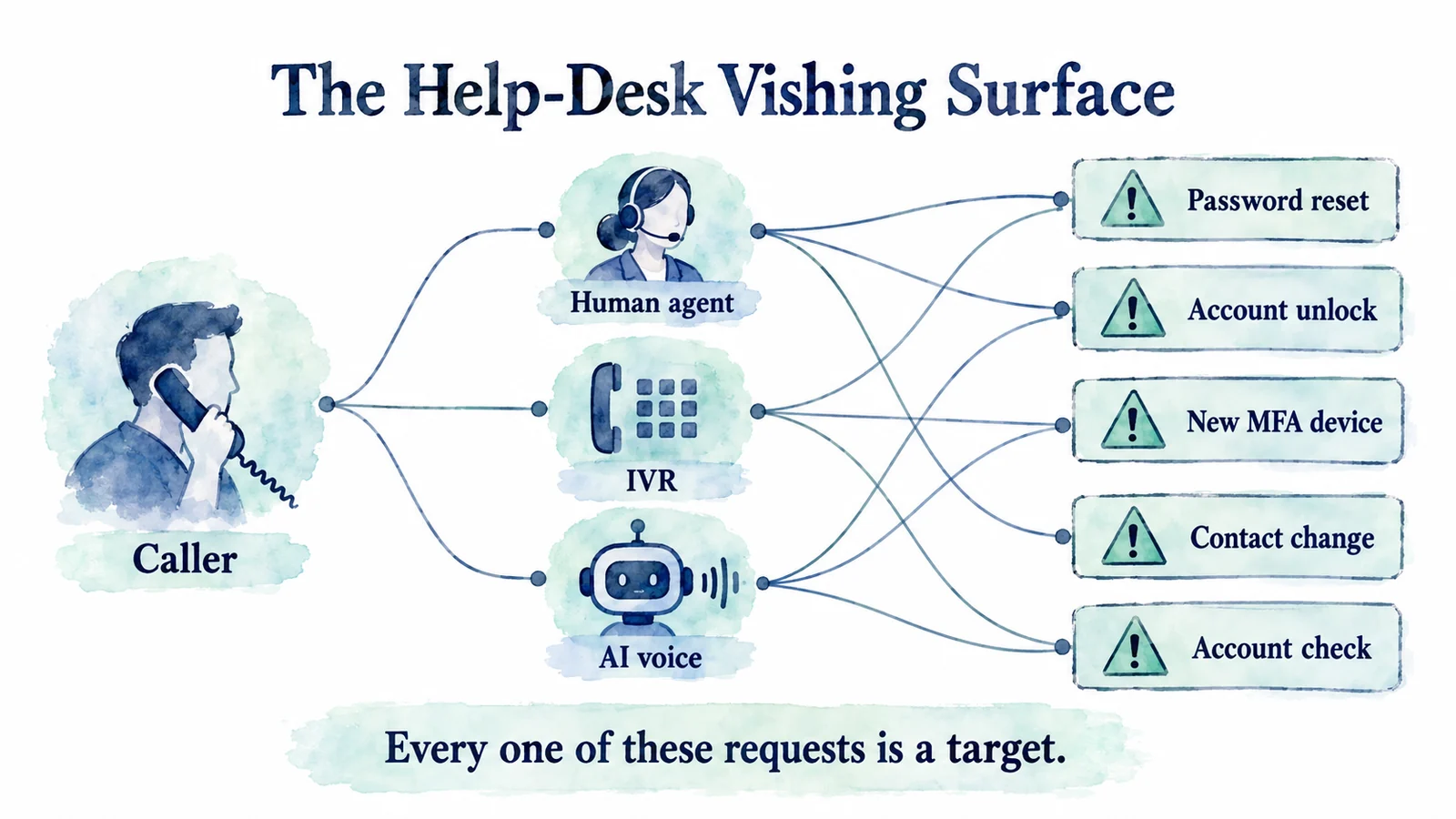 Whoever answers the call, the same five requests carry the risk. Each one that changes a credential or factor needs proof first.
Weak vs strong caller verification
Where the usual checks break
Weak verification isn't a failure of effort. It's a set of habits that made sense before attackers researched their targets. As general industry guidance, here's where the usual checks break.
Knowledge-based questions. Employee ID, manager name, hire date, last four of something. These are facts, and facts leak. Breach data, social profiles, org charts, and earlier calls all supply them. NIST's current identity-proofing guidance is direct on the point: SP 800-63A-4 states that "knowledge-based verification (KBV) or knowledge-based authentication SHALL NOT be used for identity verification." That rule is written for identity proofing, but the reasoning carries straight to the help desk. The password reset questions guide covers why static questions fail in the reset flow specifically.
A code sent to the caller's phone. It feels like MFA. The Identity Challenge Card explainer names the flaw: texting a code to the caller's phone "assumes the phone is theirs." If the reason for the call is a lost or hijacked phone, that assumption runs backwards.
Caller ID and callback. A familiar number on the screen isn't proof of who's holding the handset. The FCC defines caller ID spoofing as a caller deliberately falsifying the information sent to your caller ID display to disguise their identity. Calling back the number on file fails when that number belongs to the phone that's gone.
Manager vouching. It moves the decision to someone who is also just recognizing a voice.
Agent judgment. The deepest weakness is that any of these checks can be waived. An agent who can decide the caller "seems legitimate" can be persuaded. Ticketing systems then record that the work was done, but not that the user was verified before access changed. Avatier's Assisted Reset page calls this the help desk verification gap: "the process works until an attacker convinces a human to make the wrong access decision."
What good caller verification looks like
Good caller verification takes identity out of the agent's hands. The agent still helps, but the proof comes from somewhere the conversation can't reach. The comparison below summarizes the shift.
| Question | Weak caller verification | Strong caller verification |
|---|---|---|
| What proves identity? | Answers to knowledge questions | A challenge to the factor the user already enrolled |
| Where does the challenge go? | A number or email the caller supplies | The user's own enrolled factor, or a printed card |
| What does the agent see? | The answers, and a judgment call | Pass or fail, nothing else |
| When does the action run? | When the agent is satisfied | Only after verification passes and policy allows it |
| What if the caller has no phone? | An exception, or a manager override | A deviceless fallback such as the Identity Challenge Card |
| Privileged or high-risk accounts? | Same script as everyone | Stricter policy and stronger verification |
| What's recorded? | A ticket note that the work was done | Who asked, how they were verified, what changed |
Five principles sit behind the right-hand column. They're general practice, and they hold whichever product you run.
- Verify before acting. No reset, unlock, or factor change runs until verification passes. There is no "we'll verify after" path.
- Challenge the enrolled factor. The challenge goes to a factor the user registered earlier, through the MFA the organization already operates. Nothing the caller says on the call changes where it goes.
- Show the agent pass or fail only. If the agent never sees the factor and can't override the result, there's nothing to talk them into.
- Step up for the dangerous requests. Resets on privileged accounts and any change to MFA registration deserve stricter checks than a standard unlock. The step-up authentication guide covers how to size the challenge to the action.
- Record the verification, not just the outcome. An auditor should be able to see how the caller was verified, not only that the ticket closed.
Avatier's Assisted Reset pillar is built on this model. Its description of the mechanic is short: "the verification challenge goes straight to the end user. The agent only sees pass or fail." It uses existing MFA methods, naming Microsoft Authenticator, Okta Verify, Duo, and Google Authenticator, to verify users before agents complete resets, unlocks, or enrollment support. Help desk access can be delegated by group, region, OU, or support function, and Avatier says Assisted Reset "can support stricter policies for higher-risk users, privileged accounts, or sensitive groups."
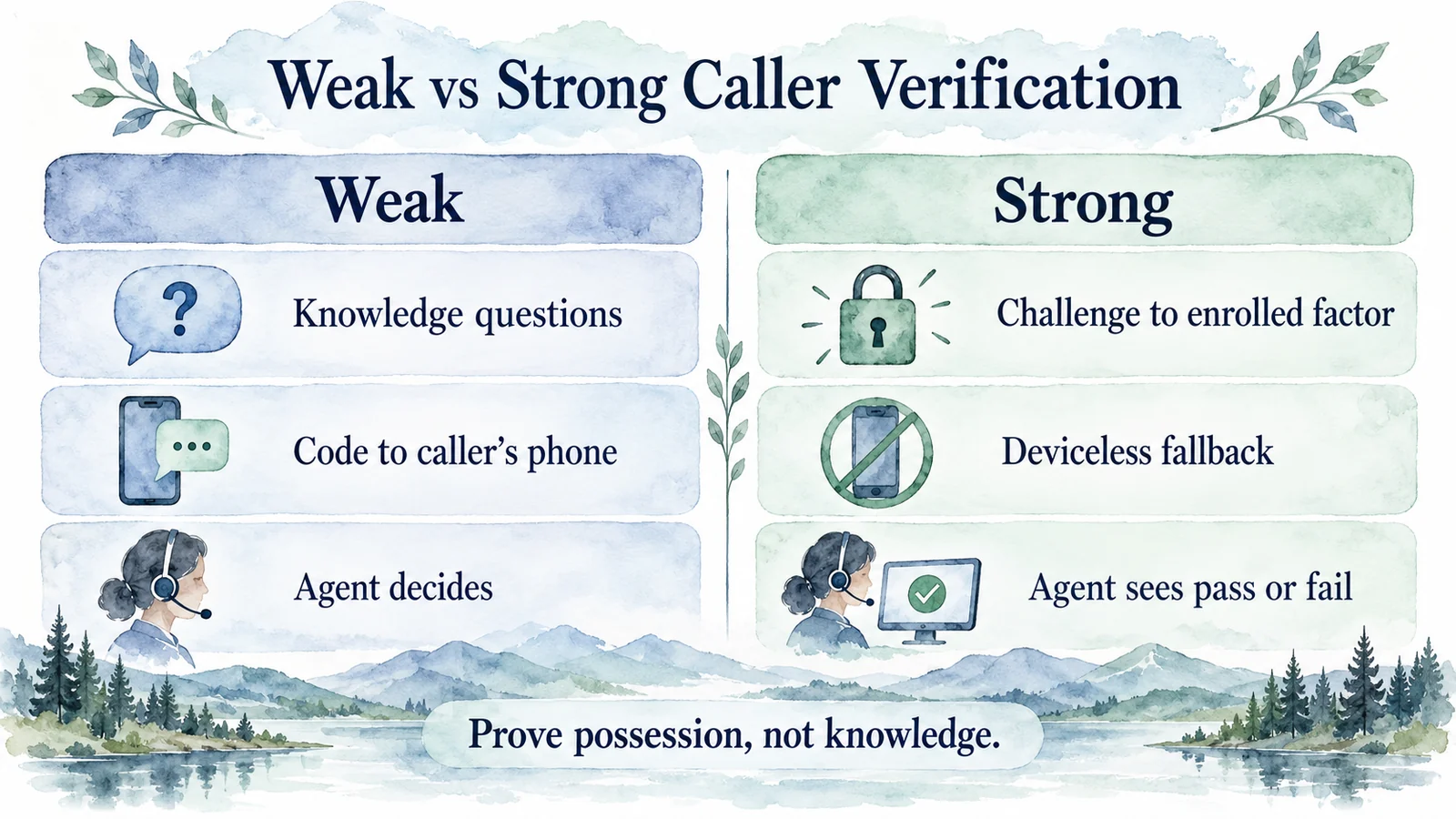 Weak checks ask what the caller knows. Strong checks prove what the real user holds, and keep the agent out of the decision.
The deviceless fallback: verifying a caller who has no phone
The hardest call is the one where the phone is the problem. The caller's device is lost, broken, dead, or in a locker. Every factor on it went with it: the authenticator app, the passkey, the SMS number. Sending an MFA challenge to the enrolled factor doesn't work when the enrolled factor is the thing that's missing.
"I lost my phone" is also a perfect cover story for a vishing caller, because it explains in advance why the normal check can't run.
A deviceless factor closes that gap. The Identity Challenge Card is a printed grid of word pairs, with no phone, no app, and no network involved. Avatier describes the service desk flow this way: someone calls asking for their access back, "the agent names a coordinate, the caller reads the answer off their printed card, and that value is spent." The desk resolves the answer against the grid locally, with no identity-provider call and no network dependency.
The card resolves three factors: the Challenge Card Factor (the printed grid), a Private Knowledge Factor (a short PIN only the user knows, bound to the card by policy), and an Identity Anchor Factor (the user's directory identity, such as an Employee ID, a badge, or a SCIM-provisioned principal).
Each coordinate value is one-time. In Avatier's words, "used values are permanently burned and never reused," so a value overheard on the call can't be used again. The card carries no phone number, biometric, or personal data, and its contents are opaque without the PIN. As the Identity Challenge Card explainer puts it, the old script "was a list of questions an attacker can research. What's on that card isn't online or on a device."
Assisted Reset lists the Identity Challenge Card for deviceless verification in air-gapped and restricted environments, alongside Have I Been Pwned and Password Firewall checks that help prevent known-compromised passwords from becoming active during an assisted reset. The card's lifecycle is governed too. Issuance, expiration, re-enrollment, and revocation are logged and policy-enforced, and re-issuance is identity-verified, which matters because "send me a new card" is the next thing an attacker would ask for.
The card defines what Avatier calls the Identity Continuity Layer, an infrastructure layer that ensures authentication persists when device-dependent systems fail. The Identity Continuity Layer explainer covers the category in depth, and our recovery channel gap piece explains why the recovery path, not the login page, is where many attacks now land.
AI voice: a channel under the same verification, policy, and logging
When an IVR or AI voice agent answers first, the security question doesn't change. It gets harder to see. An automated voice channel that accepts a persuasive story is a help desk agent that never gets tired of being tried. The rule that protects the human agent has to protect the automated one: the channel is not the credential.
In Avatier's model, voice is one of the channels on one identity platform, not a separate system with its own rules. The Identity Anywhere 2027 site lists Voice and Phone among the channels, alongside Web, Mobile, Microsoft Teams, Outlook, Chat, APIs, and MCP-compatible AI. Avatier Credential Governance handles "MFA-verified resets across web, mobile, Teams, Outlook, and AI voice," and the Password Portal pillar brief describes self-service recovery across web, mobile, Teams, Outlook, IVR, and AI voice workflows that is MFA-verified, breach-protected, and logged for compliance.
Avatier states the governing principle for AI assistants plainly: they don't receive unrestricted access, and every request "must invoke an approved Avatier capability and remain subject to authentication, authorization, delegated authority, policy enforcement, and audit controls." The September 2026 announcement put it in one phrase: the assistant is "the interface, never the authority." A voice front end deserves the same treatment. Avatier Actions includes a Help Desk module whose actions include verify user, assisted unlock, and quick and full assisted reset, and each outcome runs through the customer's existing policies, approvals, and roles.
In general terms, a verify-then-act voice flow looks like this, whether the voice on the line belongs to an agent or an AI:
- Take the request. The caller says what they need. The voice system maps it to one approved action, such as an unlock or a reset. Anything that doesn't map is refused or handed to a person.
- Identify the account. The caller names the account. Naming it proves nothing; it only tells the system whom to challenge.
- Challenge the enrolled factor. An MFA prompt goes to the factor the user registered earlier. The voice system never reads out, accepts, or relays a code the caller supplies from somewhere else.
- Fall back without a device. If the caller has no working phone, route to a deviceless check. In Avatier's published service desk flow, that's the Identity Challenge Card, read back to an agent.
- Apply policy. The requester's authority, the account's risk level, and any approval chain apply exactly as they would in the portal.
- Act and record. Only now does the reset or unlock run, and the outcome is written with how the caller was verified.
As general guidance for voice front ends: limit the agent to approved actions, cap repeated attempts against one account, escalate sensitive requests to a human, and treat what the caller says as input, not instruction. The Conversational Identity hub applies the same steps to chat and Teams.
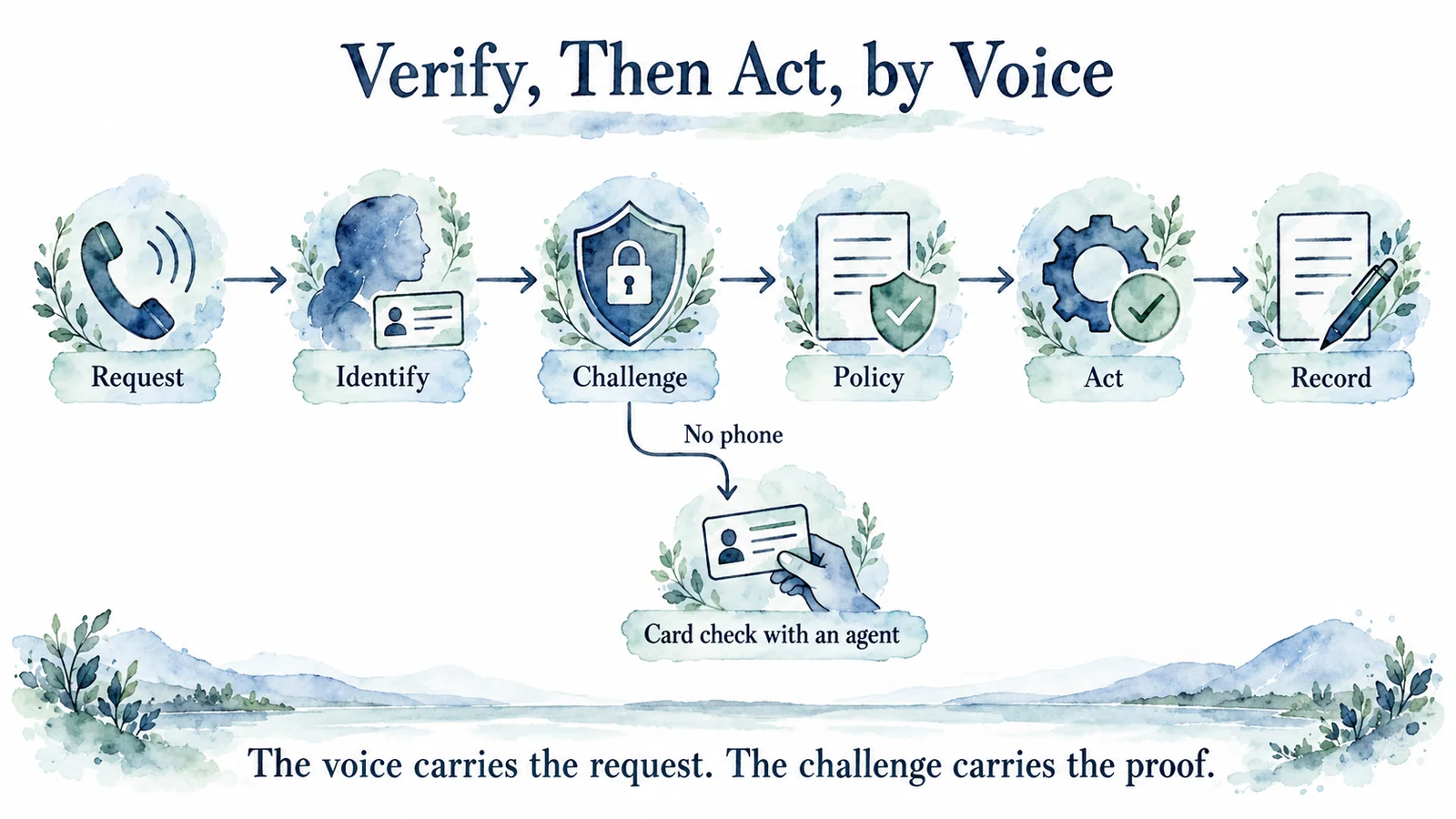 A voice channel can take the request, but only a challenge the caller can't fake unlocks the action. The card keeps the flow intact when the phone is gone.
34 languages, including the call-center workflow
A caller who struggles through a challenge in a second language can tempt a sympathetic agent to wave them through. For a global workforce, language support is a control, not a courtesy.
Avatier Credential Governance ships native support for 34 languages "across web, mobile, Microsoft Teams, Outlook, and AI voice, including the call-center workflow," with right-to-left layouts and CJK fonts supported. Assisted Reset is available in the same 34 languages, with localized enrollment templates, so global service desks follow one governed workflow without bolt-on translation tooling. The September 2026 announcement confirmed support for 34 languages across every conversational channel.
The printed card matters most here. A worker reading a coordinate aloud to an agent, often under time pressure, needs the card in a language and script they read fluently. The Identity Challenge Card ships in 34 languages, including right-to-left Arabic and the Chinese, Japanese, and Korean scripts, with the same three-factor flow in each.
Evidence: what a verified call should leave in Avatier Ledger
Many help desks can prove a ticket closed but not that the caller was verified before the password changed. That gap shows up in audits and in incident response, when the first question is who authorized the reset.
Avatier's Assisted Reset page sets the standard: a clearer record of assisted credential actions, "including who requested help, how verification was handled, what changed, and what was logged."
At the platform level, Avatier Identity Anywhere 2027 treats password resets, account unlocks, and identity verification as Secure Outcomes. Each Secure Outcome records the identity involved, the initiating agent or experience, the authorization context, the policy applied, the action taken, and the final result. For a help desk, that initiating-experience field matters: it is where a reset that began on a phone call should be told apart from one that began in a portal.
Avatier Ledger, an MCP connector, turns every outcome into evidence and every report into a question. It records who asked, what ran, under whose authority, and what policy allowed it, for human-initiated and agent-assisted actions alike. Persona Briefings then shape the same evidence for the person asking. For the security team, that briefing is built around exposure, dormant and orphaned access, privileged activity, and the vishing surface at the help desk. The AI agent audit trail piece covers Ledger's evidence model in detail.
What Avatier ships toward this pattern
This section sticks to what Avatier has published.
- Assisted Reset, Pillar 3 of Credential Governance, is a delegated help desk console that verifies users before sensitive credential actions. The challenge goes to the user, the agent sees pass or fail, delegation follows group, region, OU, or support function, and it integrates with ServiceNow, Zendesk, Jira Service Management, and Freshservice.
- The Identity Challenge Card™ gives the service desk a deviceless, three-factor check with one-time coordinate values for callers who have no working phone.
- Password Portal lets users reset, unlock, and enroll themselves across web, mobile, Teams, Outlook, and AI voice, with every request MFA-verified and breach-checked, so routine resets don't need a help-desk ticket.
- Avatier Actions exposes more than 50 identity outcomes as MCP tools across eight modules, including Help Desk, inside Claude, Claude Code, Microsoft Copilot, Avabot, and any MCP-compatible assistant. Setup is one administrator connection, with permissions inherited from Microsoft Entra ID, Active Directory, Okta, or Ping.
- 34 languages across web, mobile, Teams, Outlook, and AI voice, including the call-center workflow, and on the printed card.
Pay Per Identity Action™ is Avatier's trademarked pricing model in which customers pay only for completed, verified, policy-compliant identity outcomes. A verified reset is one of those outcomes. Getting started is free, deployment services are included, and a 45-day money-back guarantee applies. The model is explained in what Pay Per Identity Action™ is.
Avatier's credential governance customers report help-desk password ticket reductions of up to 70 percent. Avatier was founded in 1997, is based in Pleasanton, California, and has sold over 15 million licenses. It is SOC 2 Type II audited with no exceptions noted and ISO/IEC 27001:2022 certified, with details at the Avatier Trust Center.
The platform is previewed at Avatier Identity Anywhere 2027™. The six pillars are on Credential Governance™, and the wider company is at avatier.com.
What caller verification does not solve
Strong caller verification closes the path where an attacker talks an agent into a reset. It leaves other paths open.
It doesn't stop attackers from calling your employees. The CISA and FBI advisory describes actors posing as IT and help desk staff to get credentials from employees, and posing as IT staff to get employees to share one-time passcodes. That's the reverse of the vishing call, and a verification workflow at the desk doesn't reach it. If an attacker calls a worker, claims to be the help desk, and asks them to read a card coordinate or approve an MFA prompt, the worker is the control. Set one simple rule and repeat it: the help desk never calls you and asks for a code, a card value, or an approval. You call us.
It doesn't replace training. Agents still need to recognize pressure tactics, escalate calls that don't fit the script, and report attempts. Training works best when the workflow has already removed the judgment call.
It doesn't govern what happens after the reset. Verification establishes who called. It doesn't limit what that account can reach, detect a stolen session, or catch over-broad privileges. Those belong to access governance and identity threat detection. The MFA bypass techniques guide covers session theft and the other attacks that route around the help desk altogether.
It doesn't make AI voice agents immune to manipulation. Limiting a voice agent to approved actions narrows what a manipulated conversation can do. It doesn't remove the need to test the agent against adversarial callers, monitor attempt patterns, and hand sensitive cases to people.
It doesn't replace phishing-resistant MFA at the front door. For workers with managed devices, FIDO2 keys and passkeys are widely treated as the strongest everyday option. The phishing-resistant MFA reference covers that side. Caller verification protects the path people take when the front door fails them.
Evidence isn't prevention. A good record speeds investigations and audits. Someone still has to review what it shows and act on it.
About the author
More from MFA & Authentication

What Is an Identity Continuity Layer? Authentication When Devices Fail
An Identity Continuity Layer keeps authentication working when phones are lost, batteries die, or signal drops. What it is, where device MFA breaks, and how the Identity Challenge Card fills the gap.
OAuth Consent Phishing: The Attack That Steals a Token, Not a Password
Consent phishing lures a user to a real OAuth consent screen for a malicious app, they click Allow, and the attacker walks away with a token that grants lasting access. Because no password is stolen, MFA never fires. The 2026 reference on how the illicit consent grant works and the app-governance defenses that actually stop it.
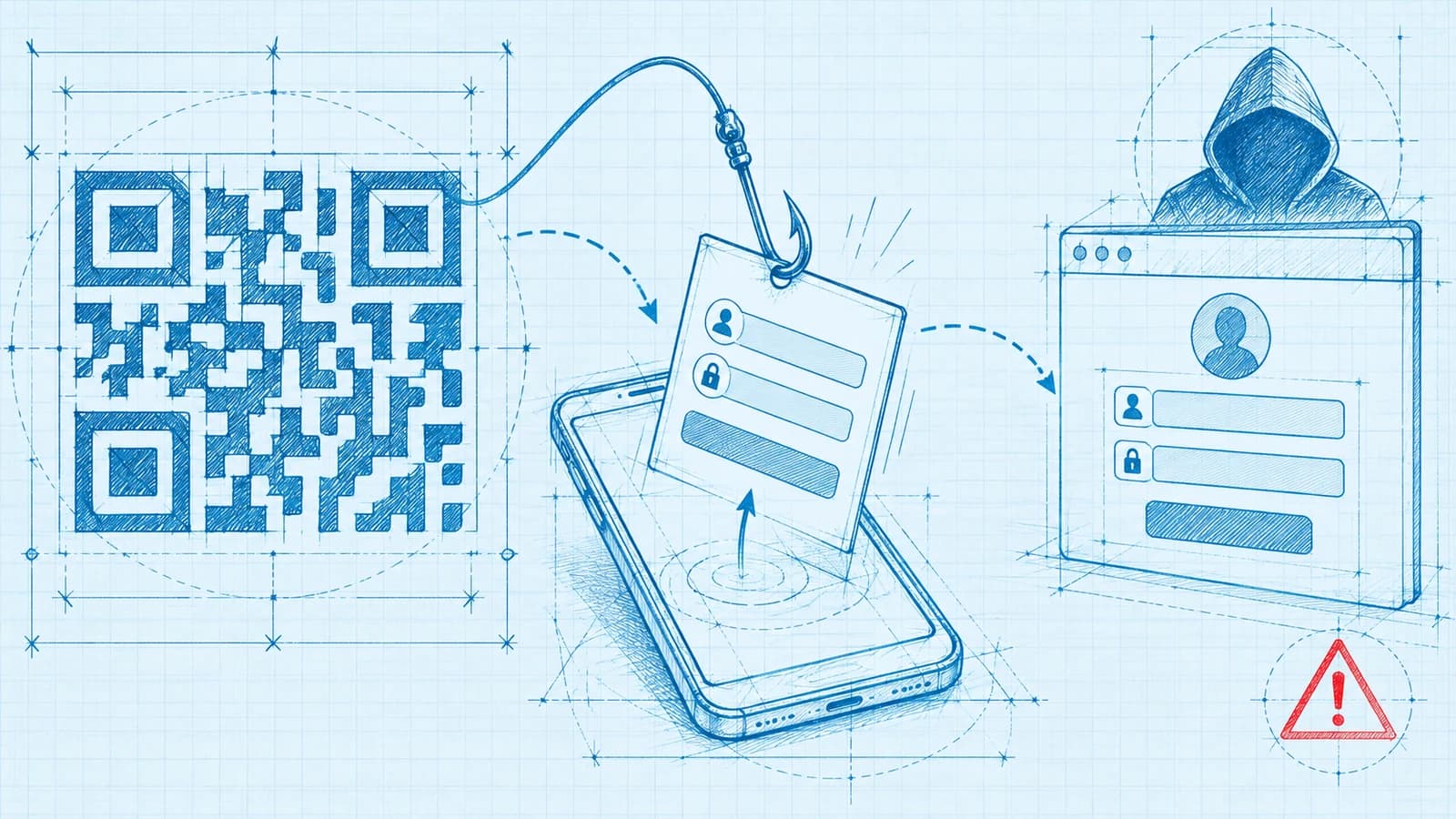
QR Code Phishing (Quishing): How It Works and How to Defend in 2026
Quishing hides a malicious URL inside a QR code, slips past email link scanners, and moves the victim onto a personal phone where the fake login is hard to inspect. The 2026 reference on how the attack runs and the phishing-resistant defenses that actually stop it.